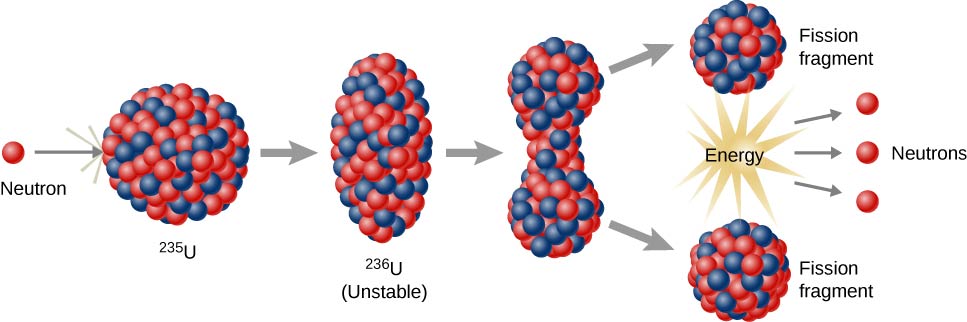
A man named Wilhelm Rontgen was experimenting with electrodes in a vacuum when he discovered x-rays in 1895 and took the first x-ray of his wife’s hand. Henry Becquerel, a french scientist, was studying phosphorescence, which is caused by a material glowing in the dark after absorbing light from a light source. This being in 1996 there was still excitement around Wilhelm’s discovery of x-rays, so Henry decided to try to x-ray uranium salt, which he thought was a phosphorescent material. It turned out that uranium salt did produce invisible x-rays, but that it wasn’t a phosphorescent material, it instead produced radiation light all on it’s own, whether in the dark or light. Marie Curie was interested in uranium salt and with her husband discovered both polonium and radium in 1898, which are both much more radioactive than uranium. It was the Curies who coined the term “radioactive”. Another man named Ernest Rutherford who had also been studying radiation discovered the 3 types of radiation: Alpha, Beta, and Gama radiation. Rutherford also split atoms and recognized the amount of power that came from splitting it, but decided it took so much energy to split it, you wouldn’t make enough energy to make it worth it. Leo Szilard disagreed. Leo saw that Rutherford used alpha radiation to split the atom, but Szilard found that if he fired a neutron at an atom it would split, and fire its own neutrons at other atoms, and it would cause a chain reaction that could end up releasing a ton of energy in an explosion, and when controlled it powers 20% of the US’s power grid. The splitting of an atom is called fission.

 School Essays