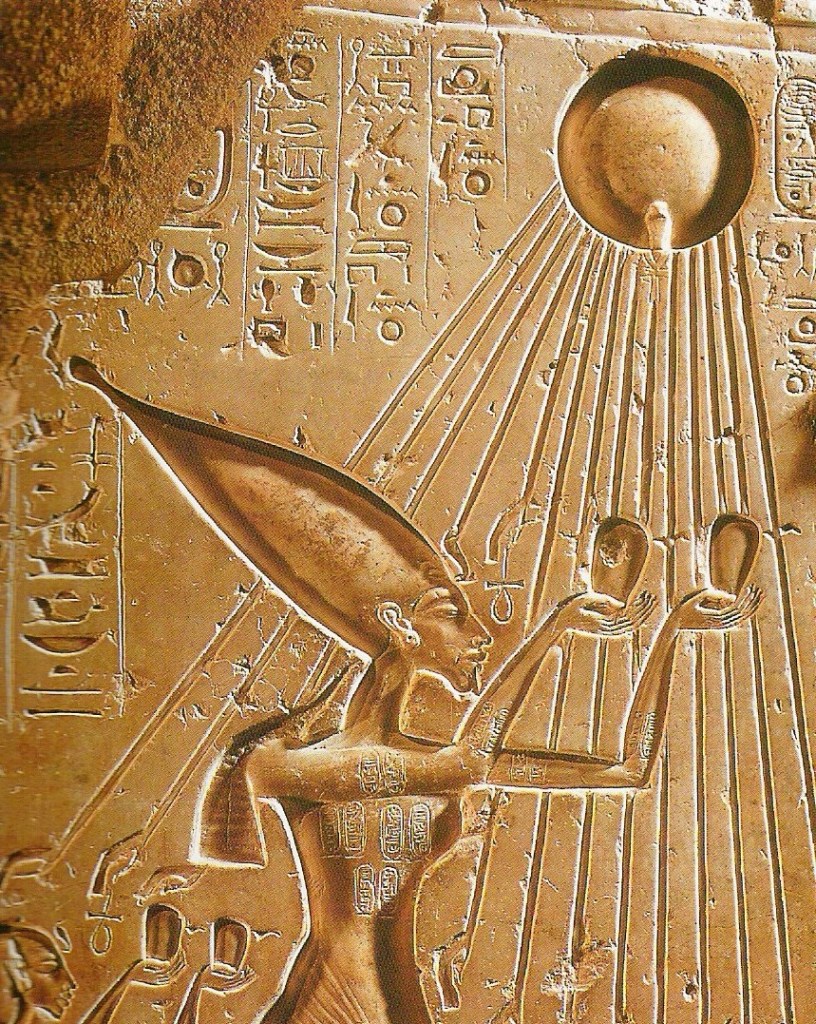
In Egypt there was a ruler in the eighteenth Dynasty named Amenhotep IV, and IV means four in roman numerals, in case you don’t know. Amenhotep IV was born with that name, and it means “Amun is pleased” Amun is the Egyptian god of the sky and wind, and made the earth, making him one of the most prominent gods in the Egyptian pantheon of gods. But when Amenhotep IV became pharaoh he changed his name to Akhenaten, which means “he who works for Aten”. Aten was the only god in Akhenatens religion, so he said Aten was the only true god and that all other gods that the people had worshiped were simply aspects of the one true god, Aten. The sun-like object in the picture is a representation of Aten, and the man is Akhenaten. Akhenaten quickly realized that none of his subjects were following his god Aten, and were instead following the former pantheon of gods, so he hired stone carvers to carve the former gods names out of the temple walls, and to carve the faces off the statues dedicated to the former gods. He also sent his military to make sure none of the priests tried to follow their former rituals, and instead worship his god Aten. But this led to friction between him and his military because the military had grown up with the old religion and did not believe in Aten like Akhenaten did. This caused his army to disitagrate, and the priests tentatively went back to the old ways. When Akhenaten died he was succeeded by one of his sons, Tutankhamen, better known as King Tut. When Tutankhamen became pharaoh he quickly reinstated the old religion and recarved the gods names on the walls and the gods faces on the statues.

 School Essays