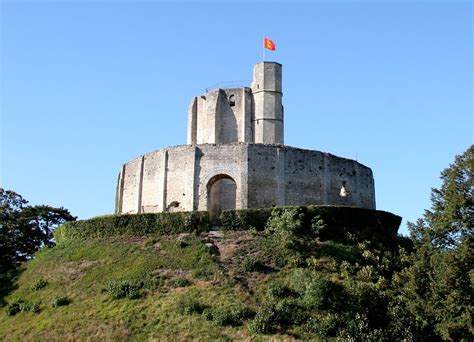
Medieval castles as we know them today are called “Motte and Bailey Style” castles, with both “Motte” and “Bailey” referring to the landscape. The motte was a hill with a flat top, most of the time artificial, upon which a miniature castle, oftentimes called a keep, would be built. This keep would be used as a last refuge for the besieged, a contingency plan for any attackers getting past the curtain wall and defenders. The curtain wall was the outer wall of the castle, and normally the moat would circle the perimeter of the curtain wall, thusly thwarting any ladders. While many children draw pictures of crocodiles and such in the moat, this was never done because anyone who fell in water with armor on would instantly drown, because of the weight of the armor. And, something most people don’t think of is that the servants and such would empty the privy buckets into the moat, along with any animal manure. This was part of the reason nobles liked to live the center of the castle. The bailey quite simply is the area between the curtain wall and the motte. While the motte and curtain wall were the most important things during war, the bailey was probably the most useful thing all around because it housed the main halls, the throne room, the kitchens, and anything else that needed storing in a castle. If there is a castle town around the castle it would probably be included in the bailey, though if it’s a real city and not a town surrounding the castle there would be an outer wall which surrounded the city, then the curtain wall within the city, the bailey, then the motte and keep. This style of castle started roughly soon after Charlemagne’s time, when all the countries of Europe were squabbling and fracturing. With so much war, no wonder such a simple, yet effective, design gained prominence. While the English knew of castle they didn’t really support them, and saw them as a sign of a weak ruler who couldn’t control his people. This changed when the Normans invaded England. The English didn’t like foreign kings as a rule, and William the Conqueror had killed one of their favorite kings to become ruler, so it was no wonder that rebellions sprang up. Being from the mainland the Normans felt no reason not to make castles, and these foreign castles proved useful in defeating the populace. For a long time the English felt castles where a symbol of oppression, but nowadays they’re a symbol of wealth and status. Fun fact: The Tower of London was the first castle built by William the Conqueror.

 School Essays