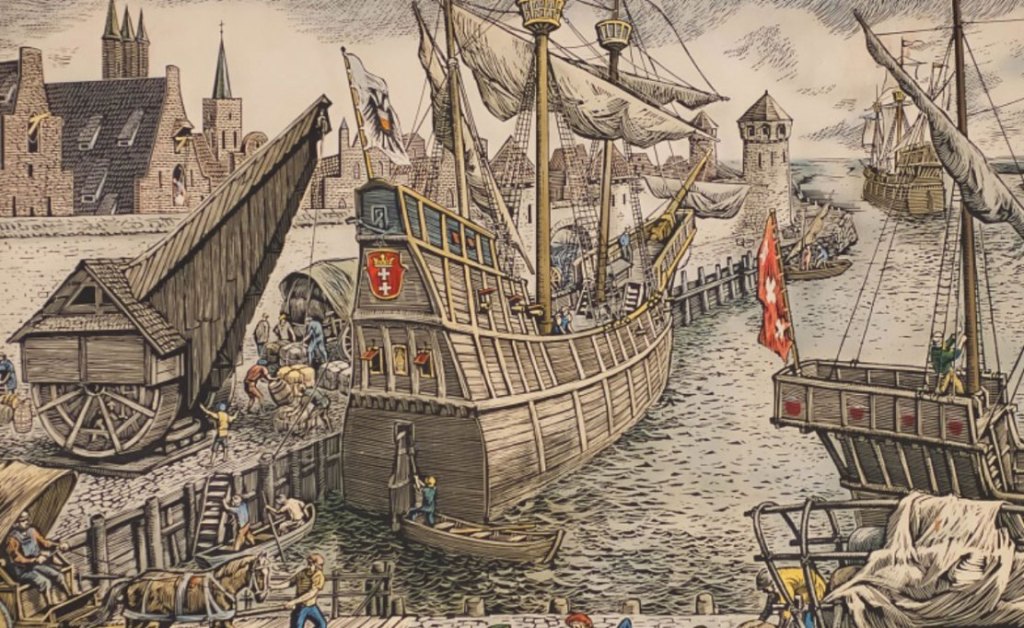
In the Middle Ages, also known as Medieval times, Merchants had to transport their goods by use of cargo ships (like the picture) when traveling over water, and caravans when going over land. Caravans often traveled in groups, called caravan trains, so that they could share in each others protection. The caravans would hire mercenaries or guards to escort them to where they were going, so as to guard them from bandits of brigands, who would capture and rob merchants without protection. This was obviously a big source of loss for the merchants, since the guards required considerable payment, so the traders were quite happy when the Hanseatic League popped up. It first started when Henry the Lion rebuilt a new Lubek over the fallen, original, 10th century town, and because of it’s location it became natural for traders to pass through it. Anyone going south to north, or north to south, would have been hard pressed not to go to Lubek, and while not as perfectly situated for east to west or west to east, many people would go there because there was so much trade already happening there. Eventually, the natives of Lubek, not the travelers, realized they could put taxes on anyone going through. They then decided to make deals with the merchants, where they would hire guards and protection in exchange for deals or percentages. This idea spread to other towns, and they realized they could pool their resources to get even better deals, forming a kind of merchant guild called the Hanseatic League in 1358. After this they realized that since they were in the north of Germany and so controlled trade that went through them to or from Scandinavia. They decided to take a monopoly over the salt fish trade, which was previously controlled by Scandinavia. Denmark, exactly north of them, was part of Scandinavia and didn’t like them taking their profits, so they went to war with the guild. The league was able to summon a powerful army, however, and defeated Denmark. After this the rest of Scandinavia made peaceful trade deals so as to avoid war. This time was the peak of the Hanseatic League, but it started to fall apart in the 1550s due to the cities focusing on themselves and not sending soldiers to protect the merchants, and due to this the merchants started leaving the league and cutting ties. It was then destroyed when the Swedish empire started progressing south at the same time Denmark broke free. But the Hanseatic League showed that an economic power could grow to be more powerful than a countries state, and was the most successful guild in Europe’s history at least.

 School Essays