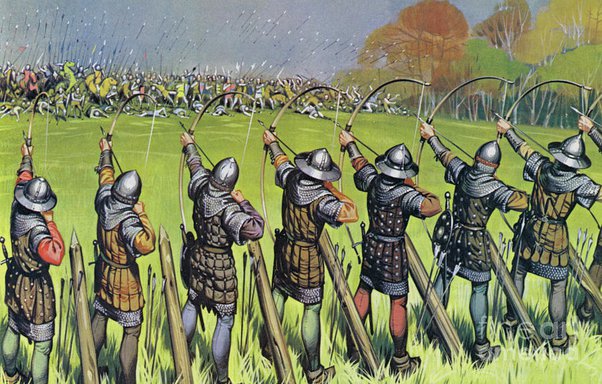
The Hundred Years War (not the century long war) was a war that lasted between England and France for, you guessed it, 116 years, but it’s often rounded down to 100 years. It was started in 1337 by the king of England, Edward the III, when he claimed the French throne for himself. Indeed, he was the closest heir to the dead King of France, but this was on his mothers side, and the claim was thus rendered obsolete. Philip VI was the closest heir through the male line and was thus considered the king of France.
The French were against having an English King, so they supported the war. They sent a huge French navy in 1340 that quickly defeated the major English ships. The French held the channel, with twice as many ships as the English and each ship was twice as big as the English ships, and all of Edward III’s advisors told him to back off on his claim and let the French tempers cool. Edward III did not do this. He sent his small fleet up against the huge navy and destroyed them so badly that the English kept the channel for the rest of the war, which was, as I’ve said, 100 years. This is commonly refered to as the battle of Sluys.
Edward then led his army across the channel to the city of Caen. Their speed surprised the French and the city was captured within a day, and the next day the late French troops arrived and fought the English troops leaving Caen. This was a major loss for the French, and Edward easily captured the city of Crecy during it, and upon a followup attack on the surviving French he captured city Calais. These were land mark events in the war, and allowed England to keep troops stationed in France throughout the year, which was uncommon for such a war.
By this time it was 1348, and that year is marked by the arrival of the Black Plague. The war was suspended for roughly eight years while the plague ravaged both countries. Edward III survived, but was in poor health, and his son Edward IV, known as The Black Prince took over the English side of the war. In France Phillip VI died, and John II, also John the Good, took over the kingship and the French side of the war.
In 1356 the Black Prince led his army into France and fought at the Battle of Poitiers. If you’ve discovered the theme of the war yet, you’ll realize this was a resounding English victory. John the Good had also been at this battle, and had been captured by the English. They continued on and the English met their first defeat at the city of Reims, It wasn’t a defeat as such, it was simply the fact that Reims defended against the siege of the English. However, during a freak hailstorm the English lost over 1000 lives. After that, they agreed to a truce. The French were unable to pay the ransom for John, and John the Good died in England in 1364.
This Treaty caused peace from 1360-1369 but Aquitaine revolted because they would not pay taxes to England. This reignited the war, with Charles V going for the English in earnest. The English, however, were not ready for the war to begin again. Edward III and the Black Prince were not in good health, and had many debts and were trying to deal with, so the French retook some of their land without resistance. The Black Prince died in 1376, and Edward III in 1377. Richard II, son of the Black Prince, then took the throne and seeing how much debt the war had thrown him in, he stopped financing it and tried to solve all of England’s own problems. He still kept troops in France however, and it wasn’t until 1389 that he asked for a truce.
This lasted until 1415, when King Richard was deposed by his cousin Henry IV, and Charles VI died, leaving Charles VII to fight the new English King. Richard went over to France, and after a delay in getting back their previous lands, fought the french outright in the famous battle of Agincourt. It’s said that the French lost 6,000 men to an English 400, and those 6,000 were mostly nobles, while the 400 were plain soldiers. This almost won the war for England. The Treaty that resulted from the battle said that Henry’s son would be given all the French lands upon his coming of age, meaning the English could’ve won the war if Henry IV hadn’t died on the way back to England, and his son was too young to become king.
This is when Joan of Arc comes to France, and offers her services to the French heir. She reformed the army and used the story of her being a saint to encourage the soldiers. She single-handedly took back all of France and put the French king on the throne. In 1430 however, she was captured by the English and burned at the stake. The war formally continued until 1453, but no battles were fought and nothing changed, England just took 20 years to realize they didn’t have a choice.

 School Essays