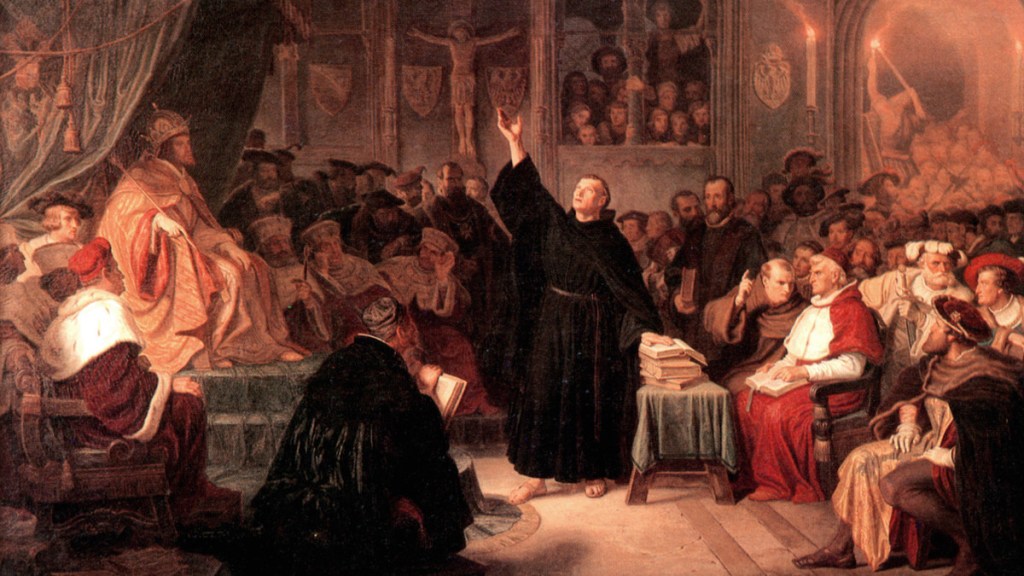
The Protestant Reformation was a movement that started as early as the late 1300s, but only got into full swing in the 16th century. It questioned the Pope’s authority and put all belief and faith in the Bible alone, which the Pope obviously did not like.
The very first seeds of it first appeared in 1320, when John Wycliffe was born in England. He questioned whether or not the Pope had the authority to sell indulgences, which was a piece of paper that said the person who owned it was absolved of their sins, which was a major argument between the reformers and the Catholics. He also thought that people should be able to read the Bible in their own language. He didn’t achieve much, and his translation of the Bible didn’t go far, but he planted the seeds for the reformation.
Then, from 1398-1415 Jan Hus preached in the Czech city of Prague, promoting Wycliffe’s ideas and spreading his books, and for a time he was ignored by the Pope, but when he started to convince the common people that the church system was corrupt, the church started pursuing him, and he lived in the countryside until he was caught and burned at the stake.
The next reformer lived at the same time as Hus, but didn’t take a direct stand. In the late 1300s the Dutchman Gerhard Groote survived a bout of the black plague, and after coming close to death he decided to start schools that would take in orphans and wealthy children alike, teaching them languages, math, and, as was common in the day, religion. He didn’t directly teach Protestantism, but his teaching implied the reformed teachings, and laid the groundwork for all the major reformers after him, and his schools managed to last 150 years after his death in 1384.
Martin Luther is by far the most famous reformer, living in Germany in the early 16th century, having become a monk after surviving a thunderstorm, and he was disgusted when the Pope claimed to be able to absolve people of their sins for a price, and so he wrote down his arguments, titled “95 Thesis” and nailed them to the church door, which many mark as the start of the reformation. He was excommunicated by the Pope in 1521, but managed to live a quiet life after his initial bravado.
Ulrich Zwingli was a Swiss reformer, posting his “67 Articles” 6 years after Martin Luther posted his “95 Thesis.” Zwingli was much more radical than any of the others, and wanted to execute huge changes in the church, and the majority of them were in fact adopted, albeit later than the calmer changes. He also wrote a Swiss translation of the Bible, and actually went to war with the Catholic church, and died on the battle field.
France had several internal wars of this subject, since the movement gained so much momentum since Luther. The French Protestants eventually had to leave France after several massacres and failed treatises, going to other countries like England and Germany which were much more friendly to the reformative cause. This may have laid the groundwork for the 30 Years War, which was fought in central Europe over people’s right to be a Protestant.
Over the course of the 16th and 17th centuries England, Germany, Czech, the Netherlands, Switzerland, and all of Scandinavia converted to Protestantism, coming out from under the power of the Pope, and they all believed in the ideas that only belief in Christ can save you, good life can only come from god, and only the bible should be listened to, among others. Because these countries also had large stakes in the new world the Protestant ideas spread quickly in an area that had never known a Pope.

 School Essays