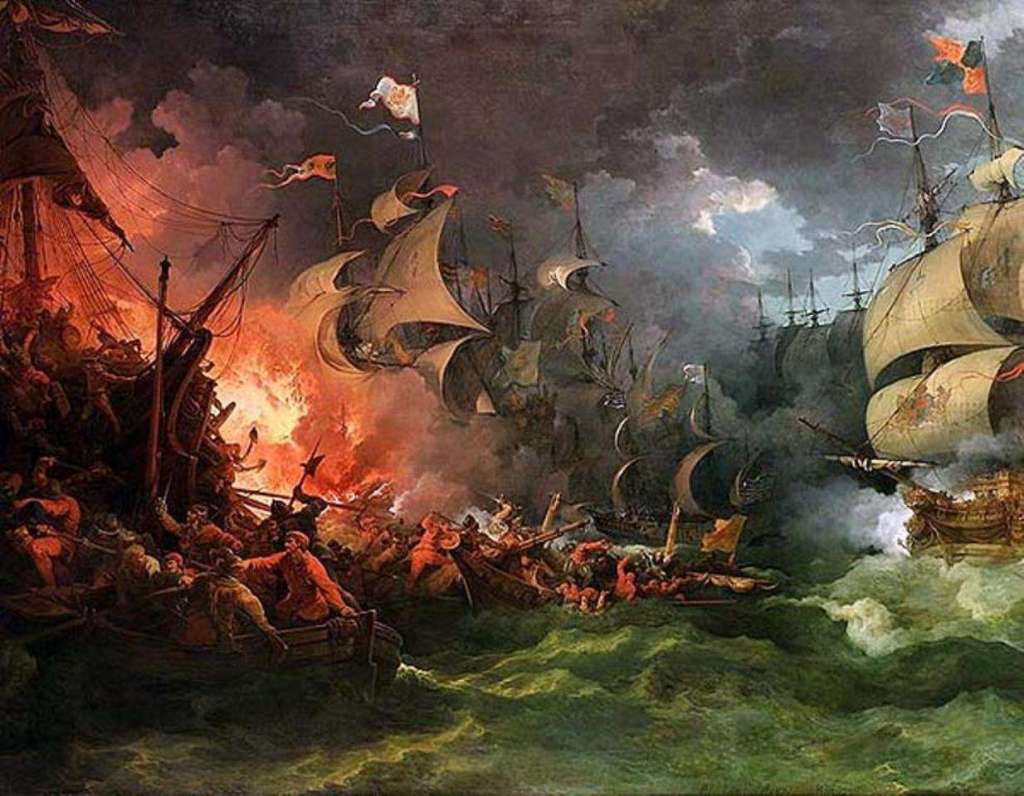
The English and the Spanish were mostly peaceful throughout their kingdom’s histories, but in the late 1500s this peace ended.
The Spanish had been the first to colonize the New World, also known as the Americas. The Spanish mainly colonized the Caribbean, but also managed to nab the majority of the western coast of North and South America, a few islands in Oceania, and a few countries in Africa, meaning Spain had an “Around the World” Empire. This was important for kick starting the war.
England had very, very few overseas possessions, in stark contrast to Spain. They had a few towns in the Caribbean and another few on the east coast of North America, but they didn’t have anything else at this point, though they would in only a hundred or two years.
Sir Francis Drake was born in 1544 to a simple peasants fishing family in Plymouth, southwest England, and became what is known as a privateer, after quickly growing to love sailing and the sea. Privateers were proto-pirates, or pirates with papers. This means that they would preform acts of piracy (i.e. stealing and breaking their stuff) on countries that their country didn’t like, and then give the King or Queen of their country some of the stuff they stole in return for, you know, not being hung, and for having some backup on big raids. Francis got so good at being a pirate- er, privateer, that Queen Elizabeth I of England asked him to go on a privateering expedition in 1577, and Drake couldn’t refuse.

In 1577 Drake set out on a circumnavigation of the world, making him the second man to sail like this around the world, the first being Ferdinand Magellan. As you can see from the above picture, Drake’s path is in blue while Magellan is in red, and Drake took a slightly more scenic route, the reason for this being that he was not just sailing around the world like Ferdinand, he was robbing every possible Spanish town, city, harbor, and ship that he could. Again unlike Ferdinand, who’s ships and men were lost, including himself, until only eighteen men made it back to Spain, Drake’s expedition grew as he went, because many people decided they liked the look of the loot Drake was getting, and part of the loot he got was other ships, so he never ran out of space for new editions. This is how he got his own ship, The Golden Hind. He got back to England in 1580, and gave the Queen half of the entire treasure he had collected, which was more than the rest of England’s treasury and taxes combined that year. His reward was the other half of the treasure, and was made a knight, and the Governor of his hometown Plymouth.
This obviously irked Spain, just a bit, and the fact that Spain was Catholic and England was Protestant didn’t help, and the fact that Phillip II (King of Spain) had tried to claim England when his wife Bloody Mary (Elizabeth’s half-sister and previous queen) died could be the reason Elizabeth hired Drake to privateer in the first place. Well, in culmination of these events Spain declared war in 1585, and riled up the Catholic Irish, neighbors of England. England then riled up the Protestant Netherlands, who the Spanish had recently conquered. Francis Drake then went back to privateering for the English, fighting the Spanish.
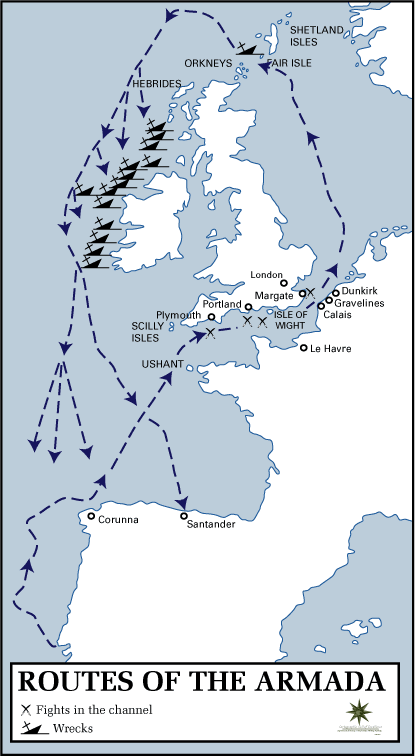
At this point Phillip II had had enough. He built the Spanish Armada, a fleet of ships that was unbelievable, with 130 gargantuan ships that housed a total of 26,000 soldiers, and they would have absolutely, undeniably, destroyed England if they had gotten there. To make a long story short, they didn’t. To make a short story slightly longer, they planned to arrive on the eastern coast, meaning they had to go past Plymouth, home of Francis Drake, and Drake didn’t like Spaniards. He shouldn’t have had a chance in this battle, the Battle of Gravelines, but he used fire ships (ships packed with tar, wood, and anything explosive, then sent to blow up anything on the water) and small, fast ships to ram and sink the huge, slow, large sided Armada ships, and he still wasn’t capable of sinking all of them, but they had decided to cut their losses and go up and over Scotland, returning to Spain. As the above map marks, the Armada was smashed on the Scottish and Irish coasts during a series of storms, and only 65 of the original 130 survived.
This pretty much made Spain lose interest in investing more into the war, obviously, but they remained at odds with England and fought a number of primarily inconsequential battles until 1604, when Queen Elizabeth I died and gave way to King James I and after King Phillip II died and had given way to King Phillip III in 1598, and these two were able to make a treaty. So even though there was only one real meaningful battle, the war dragged on for 19 years, 28 if you count Drake’s raids. Drake himself died in 1596, after being injured by a cannonball just off Puerto Rico. He was thrown out into the sea in a lead coffin, and divers are still looking for it today.

 School Essays