The Divine Right of Kings was the belief that the king of a country was divinely chosen by god for his position, and thus could do whatever he wanted, and not be in the wrong. This meant that the King was above the law, so Kings loved this idea, and just about everybody else hated it. It was practiced in ancient times like with the Egyptians, who believed their Pharaoh to literally be an incarnation of the god Horus, and in a score of other places, like the Roman Emperors who portrayed themselves as living gods. This changed when Christianity came along because there could only be one god, but it quickly shifted into the idea that God supported the King and everything he did, meaning he could do no wrong. Well, unfortunately for the kings that attempted to implement this form of ruling, the culture had changed. Feudalism had taken over since the fall of the Roman Empire and this put the social order into something like a step pyramid, with the common people being plentiful and at the bottom of the pyramid, then nobles and barons rising in power as there were fewer of them, and the King was the single man at the top of the pyramid. However, this made it easier for nobles to unite the people under them to rebel against the King, or for the people to fight the nobles, meaning the kings had to be of some good quality, or they were thrown out of the kingdom, or more likely, life. In England, people were not fond of the D.R.K, with basically the whole of plot of Robin Hood starting because John I took his rule too far, and while there were bad kings, and some probably did believe in the D.R.K, but none of them took it beyond the point of endurance for their people, until James I began spreading the idea.
Now, James didn’t actually take it too far, since when he tried to strut around his kingdoms doing what he wanted the Scottish and English taught him that was frowned on by nearly igniting a rebellion. For the rest of his reign James struggled with Parliament to do as much as he wanted without making the people hate him, and it worked pretty well, with him being remembered as an alright king, not as cool as his predecessor Elizabeth, but not a bad king. His successor was not nearly as successful at bargaining with Parliament.
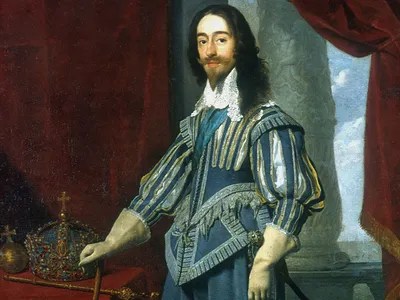
Charles I believed heavily in the D.R.K, and did push it too far. He was the second son of James, the first having died, and was made king in 1625. He began instituting the Episcopal, or Anglican, church across England and Scotland, which was still not Catholic, since that would give the Pope power, but much more Catholic than what the extremely protestant English and Scottish were used to. When Parliament tried to tell Charles to knock it off, he dismissed them. He then ruled for eleven years with no one checking his growth in power, commonly referred to as the Eleven Years of Tyranny. Those years ended only when the people revolted. The people fighting against Charles were called Roundheads, since they wore round helmets. The leader was called Oliver Cromwell, and it’s important to note that they were not fighting to get rid of the king, they just wanted to get the king to share power with Parliament, which was viewed as the voice of the people. The Scottish started a separate revolution, that was much more of a quiet resistance, but it was the English that killed Charles in 1649, and eventually instituted his son Charles II as a King in 1661.
So far, the Divine Right of Kings is not believed in, and is not in effect, as far as I know, at least in England.

 School Essays