
The Odyssey is not a chronological story, and instead of starting at the beginning it starts in the middle, with chapters 1-4 covering Odysseus’ wife, Penelope, and his son Telemachus on Ithaca, Odysseus’ home, as they search for Odysseus, since he never returned home after winning the Trojan war. Eventually Telemachus finds some of his dad’s war buddies who tell him that he had in fact survived the war.
Chapters 5-8 described Odysseus’ journey from Ogygia, an Island paradise where he rested for some time, to the Phaeacian Kingdom, a neighbor to Ithaca. Very little happens on this journey, save for a bad storm, but once he reaches the Phaeacians he recounts his story to the King to get help in returning home.
This storytelling on the Odysseus’ part is chapters 9-12, and we finally get the story’s beginning. From Troy the ship made good time, having skirmishes with different cannibalistic tribes and such, until they reach Polyphemus’ island. Polyphemus was a Cyclops, a one-eyed giant, and he herded goats on his island. when Odysseus landed there for food they went into Polyphemus’ cave, but then the giant himself entered and ate a couple of the crew, having blocked the door with a boulder. This went on day after day for a while, until they had the bright idea to blind the Cyclops, but not kill him, since he was the only one able to open the door. Since he couldn’t see them, he couldn’t squash them, and they sneaked out easily when Polyphemus let out his sheep. However, he heard them as their boat was leaving, and he cursed them as they left, which is what turned the month-long journey into a decade-long adventure.
He sailed past the home of the wind god, Aeolus, but his crew’s stupidity cost him the god’s favor, turning the wind against them and further lengthening the adventure. He spent time at Circe’s island, where Circe was a witch that transformed men into animals, but thanks to Hermes, god of travelers, Odysseus bested her and rested on the isle for a while. He also sailed into the Underworld, the realm of the dead. While there he talked to his mother, several of his friends that died during the Trojan war, and dead prophets, who told him the best path to get home to Ithaca. From there they sailed past the Sirens, birdlike people who hypnotized sailors into drowning themselves, into the passage of Scylla and Charybdis.
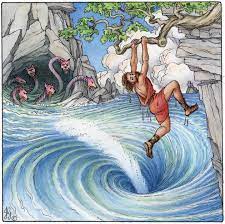
Scylla and Charybdis were two huge monsters that each took a side of a passage that Odysseus had to sail through. Scylla was a six-headed Hydra-like creature that would eat as many of the crew as possible. Charybdis was a living garbage disposal from a sink, as it sucked in and chewed up whatever possible, including ships. Odysseus, much to the displeasure of his crew, decided to sacrifice six of them to Scylla. Once they got through, however, one of the crew cursed Zeus, king of the gods, for forcing them to go through this. Zeus, who had done nothing of the sort, took that personally and blew them back through the passage into Charybdis, who happily munched on them and their ship. The only survivor was Odysseus, since he had immediately started praying upon hearing his retarded crew. He then washed up on Ogygia, Calypso’s island, where he rested until setting out to the Phaeacian kingdom, bringing us full circle to chapters 5-8.
Chapters 13-24, the second half of the book, don’t contain nearly as much material as those three chapters, but they did cover Penelope’s refusal to remarry, believing Odysseus to be alive, and Telemachus’ search for his father. Eventually Odysseus reaches home, but puts on a disguise after hearing about the many suitors that want to marry Penelope and take his kingdom. He goes in, and the only person to recognize him is his now over-20-year-old dog, which is adorable. He then challenges all of the suitors to an overly complex contest, reveals himself to everyone after winning, and kills all of the suitors in a father-son moment with Telemachus.
The Odyssey is a very good story, though it is very long, and quite hard to understand, being written in very old fashion, being translated from even older Greek, and being entirely written as a poem.

 School Essays