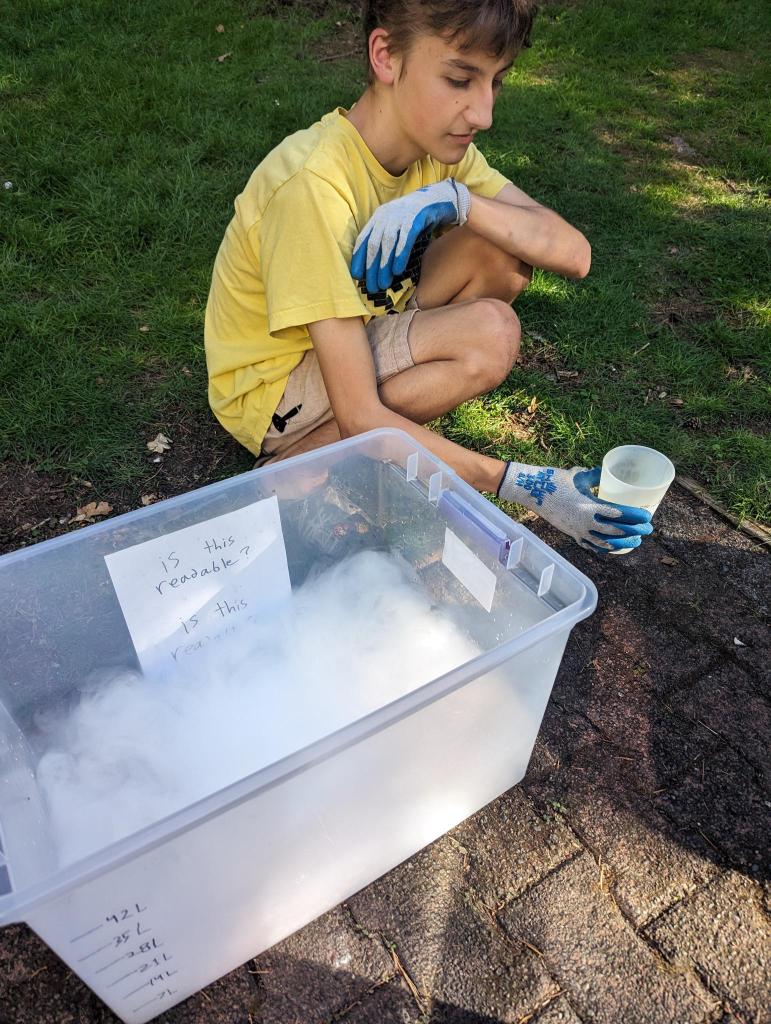
I have performed the experiment I described in my last post, with some adjustments. Instead of finding a plastic tube, I decided to use a clear plastic crate, since I have several in my house. To measure how high the fog would go, I filled a 7 liter pot with water several times, then emptied it into the container, so all of my measurements were based on the nearest multiple of 7. For the Dry Ice, I had a block of it weighing a pound, and I would put that in the crate, then pour a cup of water on it. I assume that using the same block didn’t change any results, as the water was the limiting factor, and I had a lot of Dry Ice leftover. And as you can see in the picture below, I am not just making everything up.
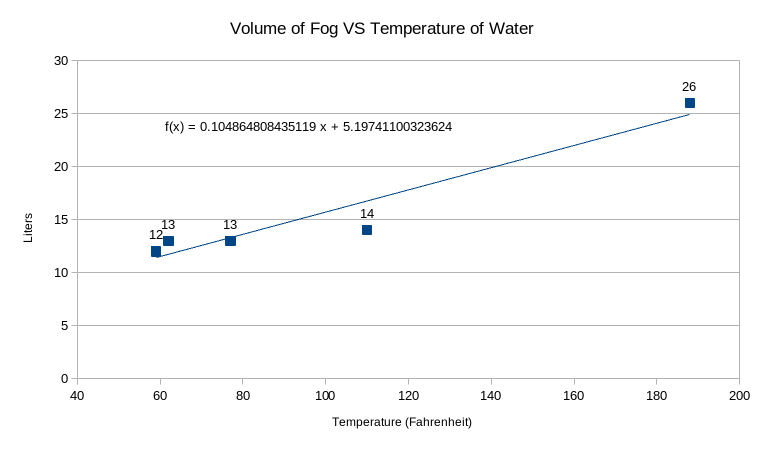
The first cup of water I poured on had been in the freezer, though not for very long, so it was at a temperature of about 59 degrees Fahrenheit, and as you can see on the graph the fog rose to what looked to me like 12 liters, as it was just below the 14 liter line. However, it was not very thick when looked down on, though I can’t really prove that as my drawing on the other side of the crate didn’t reach low enough to go below the fog.
My second cup of water had been in the fridge, and reached a temperature of 62 degrees Fahrenheit. The fog rose only very little, though it did visibly thicken, leading me to believe that the first result was somewhat flawed by the fogs lightness, leading it to float higher than it should have.
My third cup was room temperature, 77 degrees according to my thermometer, and once again there was very little increase in the volume of the fog, though this time the density didn’t change much either. However, it was visibly more agitated, swirling and rolling much more than the previous temperatures.
The next temperature was on the stove for a little bit, and reached 110 degrees. It came up to the 14 liter mark, and finally we could use my picture for density, which proved that you can not see through 15 inches of this fog. It looked to be the same density, though it was much calmer, leading me to believe that it was heavier than the previous fog.
The final temperature for the cup of water was 188 degrees Fahrenheit. It was the first temperature to greatly change the volume of the fog, as it rose all the way to just below the 28 mark, so I’m guessing it was a total of 26 liters. The density and volatility of the fog did not visibly change, so I presume it had the same mass as the 110 degree water, just more volume.
I put all this information into the graph above, and then added a trend line to it, which calculates the average for the rest of the graph based on the given points. For example, if you wanted to know roughly how much fog is made when you pour 160 degree water onto Dry Ice, you would go to the 160 mark on the bottom and trace it upwards until you found the trend line, which would tell you that there would be about 22 liters of fog made.
Unfortunately, these results are definitely not 100% accurate, for myriad reasons. First of all, my measurements were restricted to multiples of 7, meaning I had to guess from the nearest multiple of seven how much fog there was. Second, I live on a hill, and so my backyard is on a hill. This means that it’s more than possible that the height of the fog was not level throughout the crate, meaning my measurements were even less exact. I also had no good method of measuring the density of the first few fogs other than my eyes. This means that I don’t know exactly how much mass was in the same volume of fog trial to trial, though I do relate my assumptions and what I saw with my eyes with regards to the fog in each paragraph here. I am confident that my thermometer was correct with the temperatures of the water, as it is also used for my meals, which have not recently been over- or under cooked. However, it is possible that it was off a little, or that the temperatures cooled from the measuring of it to the pouring of it, which is more probable with the hotter temperatures. Other than these problems, I don’t have many concerns with the results of my experiment, the only really frustrating part of it being my lack of precision with the volume and mass of the fog.

 School Essays