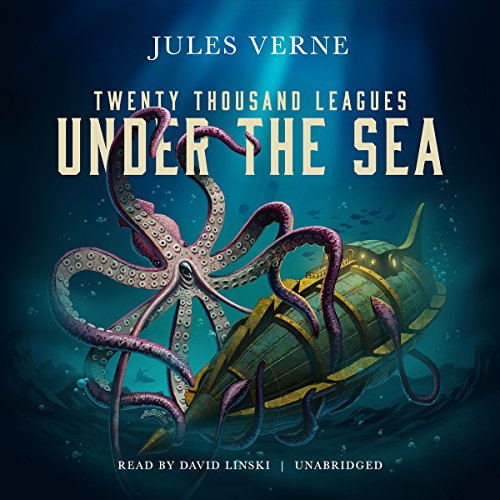
20,000 Leagues Under the Sea is a great book, written by Jules Verne, one of the first Science Fiction authors. 20,000 is, of course, a science fiction novel, though it’s somewhat hard to recognize as it was written in 1870, and is based around a very advanced submarine. While this isn’t groundbreaking today, it would have been incredible to think about back then, as they had only extremely primitive submarines.
It’s interesting to see the differences this predecessor to modern Science Fiction has to the modern genre. The most obvious difference is definitely the level of scientific reasoning in them. 20,000 Leagues spent a lot of time justifying and figuring out how it may be possible for a submarine on the level of the Nautilus to exist, and while there were a couple necessary blurry spots with regards to electricity and the power of the ship, it was extremely specific about the workings of the Nautilus. Compare this to the nearly unexplainable aliens and spaceships and plasma-lasers of today’s Science Fiction, and you can instantly see the differences. In addition to this, 20,000 Leagues Under the Sea spent a nearly a page per chapter classifying and explaining the differences between different families and genus’s of fish in different seas and oceans. Very few modern stories get into that level of specifics, and after seeing how many different fish there are, it may be for the best that authors don’t do that anymore, especially with aliens.
The book did a very good job with Captain Nemo, the mysterious captain and creator of the Nautilus, a lover of the sea and enemy of the land. His character is never really explained, and his history and real name are completely unknown, which adds a lot to his general aura. He has an obviously interesting background, especially as we know he once had a family, an incredible education, and blames the land and men in general for his probable loss. Nemo also contrasts quite nicely with Ned Land, a harpooner who loves the land and remains homesick throughout the book. While Ned dismisses most ocean life as food, is frank and is
more than a little blunt, Nemo is secretive and evades personal questions skillfully, while hating countries of men as much as he loves peaceful sea creatures.
I highly recommend this book, it’s very good even if you have to skim a bit over the classes of fish, and if you like classifying animals this is the perfect book!
 School Essays