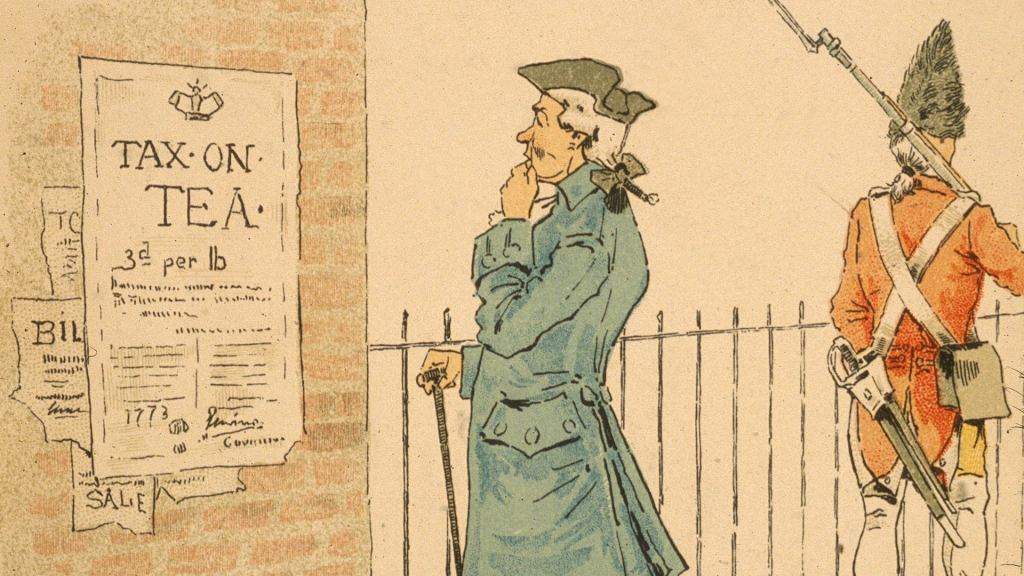
England founded and funded the 13 Colonies, which were groups of people living in the New World, also known as the Americas. This meant they owned and ruled the colonies and colonists. For a while this wasn’t much of a problem, especially since England gave them a pretty free rein, with only some taxes. This didn’t last forever, of course.
Great Britain quickly realized the colonies were pretty free, and didn’t pay a ridiculous amount of tax to Britain, meaning England wasn’t wringing as much money as it could from them. England liked money, so that was a problem. The first Act, or law, that raised a few protesters was the Navigation Act in 1651, under Oliver Cromwell’s government. It declared that any ships that traded between England and the colonies had to be an English or Colonial ship. This was frustrating to the colonies because it cut out any other ships, such as Spanish or French ships that would’ve been just as convenient and accessible in the colonies. If you disobeyed the Act, you were heavily fined, so much so few people could afford it. It was initially abolished by King Charles II, so that people would like him, but he brought it back in 1660. With the reissuing of the first Act, Charles added more, namely, that the crews of ships had to be ¾ English, and that no ships could trade with anyone other than England. Then, 1663, he added the fact that all goods had to be available in England before America, and only the leftovers could be sold in America. Obviously, this skyrocketed the prices of things and reduced their quality and quantity. Most merchants started to turn towards smuggling, the illegal sale of goods.
Then, after a lot of this, in 1733, the Molasses Act was passed. This meant that taxes were incredible for any sugar sold from anywhere other than England, which effectively gave English sugar growers a monopoly on sugar, despite their clear inferiority to the much closer Caribbean and Oceanic sugar growers. It was entirely ignored, of course, as the merchants all turned to smuggling, even the British soldiers. It was set to expire in 1763, but it was reissued in 1764 as the Sugar Act, which was half as expensive, so the soldiers started actually doing their jobs, since the tax wasn’t insane, resulting in far more money lost to taxes than the Molasses Act.
Due mostly to the Seven Years War, which was mostly caused by England, the colonists had to inflate their money to pay for this war, which angered the English merchants since they were getting less money for their goods, so the Currency Act was passed in 1751. It made it so that the colonists had to pay with gold and silver or British pounds, not American currency, again increasing American resentment. It was reissued more seriously in 1764.
Another year, another Act, 1765, one of the worst, was the Quartering Act. It declared the colonists were forced to house and feed any soldiers who might want it, with absolutely no recompense or repayment at all. Since many colonists were farmers or otherwise generally poor, this was incredibly bad, and it was inconvenient even for the well off. A more serious version was instituted in 1774 as a punishment for the Boston Tea Party.
1765, big year for taxes, also saw the Stamp Act, a bad choice for England. It taxed paper, and required all newspapers, legal documents, and trade agreements to use their taxed paper. This was a mistake because newspapers controlled the way people thought, and lawyers were the best people to legally fight England, while the merchants were continually getting more frustrated. The Press got people generally more angry with England, and the lawyers were able to get rid of the tax in the same year, though England made sure they couldn’t get rid of their next taxes, the Townshend Acts.
The Townshend Acts were made by Charles Townshend, and taxed tea, glass, lead, paper (again), and paint, as well as other items. They were not popular, of course, but Great Britain made the taxes directly pay the soldiers and government officials, making them enforce the Acts more and more, not allowing much smuggling, which had been commonplace. All these taxes finally resulted in freedom fighters, called the Sons of Liberty, who then performed the famous Boston Tea Party in 1773, throwing tea in the Boston Bay so they wouldn’t have to pay the taxes, but in 1774 they were punished with far more taxes, resulting in the beginning of the American Revolutionary War.

 School Essays
One thought on “England’s Taxes on The Colonies”