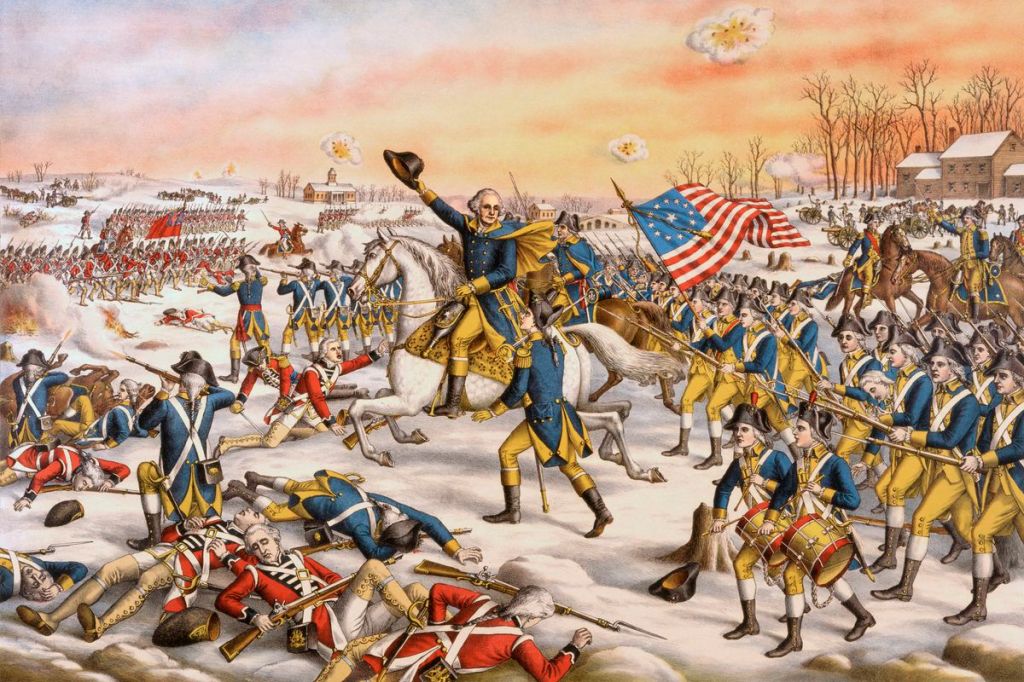
The American Revolutionary War was a war fought between the American colonists and their English rulers. The war was started by the Americans after the British started taxing nearly everything they owned, which I have described in my essay England’s Taxes on the Colonies. At first the war started as a rebellion against these taxes, but after the Boston Tea Party, England initiated even heavier taxes as punishment. This resulted in the beginning of the war, though the colonists didn’t initially want freedom in 1775, the beginning of the war, they just wanted less taxes. After England said they wouldn’t lessen the taxes, the colonists started stockpiling weapons, and learned how to use them against soldiers.
Britain heard about one of these stockpiles in Concord and sent a group of soldiers to take the weapons and warn the locals not to prepare for war again. The colonists learned of the British plan, and sent Paul Revere to warn the Concord locals. This was the famous ride of Paul Revere, and there was a famous poem written about it. This ride warned the locals at Lexington and Concord against the British, and the Battle of Lexington was the first in the war. It only lasted 15 or so minutes, since neither side was really expecting to fight. A slightly more lengthy battle happened at Concord, and because of Paul they were able to hide most of their guns, though the British were able to capture and break the few cannons the colonists collected. The colonists then began to defend their homes, pushing the British all the way to Boston, initiating the Siege of Boston. At this point most of the colonial army was able to come to Boston to help the Concord militia. During this siege the British tried to break out of Boston by taking Bunker Hill and Breed’s Hill. The British did take the hills, but lost 1,054 men, compared to the 367 that the colonists lost in defending the hills. Thereby both sides were able to claim a victory. Also in 1775 the colonists offered to stop fighting the English if they just took back some of the worst taxes, but England did not like the precedent of removing taxes, so they just kept fighting.the only difference was that the colonists now wanted total freedom.
During that winter of 1775-1776 Benedict Arnold, an impressive leader (though he would later betray the Americans), went up into Canada and took several forts and port towns, resulting in a lot of new cannons, bullets, guns, and even ships. Most of these supplies went south, where the cannons were used against besieged towns like Boston. The sea Battle of Valcour Island proved that the colonists could be a match for the British Navy, using the ships they took in Quebec. While this was a good start to the war, the British were able to keep Boston, take New York, and even Philadelphia. The end of the year saw the colonists win Trenton, Princeton, and the amazing victory of Saratoga, where general Horatio Gates was able to capture 5,700 English soldiers. This made Gates very popular, almost surpassing Washington and taking his place as leader of the Revolution, but Camden prevented that.
Washington got holed up in Pennsylvania during the winter of 1777-1778, along with a new Prussian ally, Baron von Steuben, who was able to train the army in the Prussian methods that let them (Prussia) equal the combined powers of Russia and Austria. So the British decided to focus on the southern colonies, and Horatio Gates. The British took Savannah and Charleston, as well as Camden, where Horatio Gates lost 1,900 men, and only took 300 English. This ended his popularity pretty quick, and Nathaniel Greene, Washington’s practical second in command, took control of the southern part of the war in 1780. Thanks to Francis Marion, an extreme guerrilla fighter, and Nathaniel’s strategy, the colonists won the Battles of Cowpens and King’s Mountain, backing the English soldiers against the coast, in Yorktown. They were expecting English ships to sail in and resupply them, but the colonists French allies came and chased the English ships towards New York, leaving Cornwallis and his soldiers to surrender to Nathaniel.
After this in 1781, the French fleet that helped Greene, and the few groups of French soldiers that were helping Washington in the north, went back to France. Nothing else really happened, other than the continual siege of a few major cities like New York, until King George III of Great Britain finally signed a treaty in 1783 that said the Americans were entirely free of English control, and were free to do as they would.

 School Essays