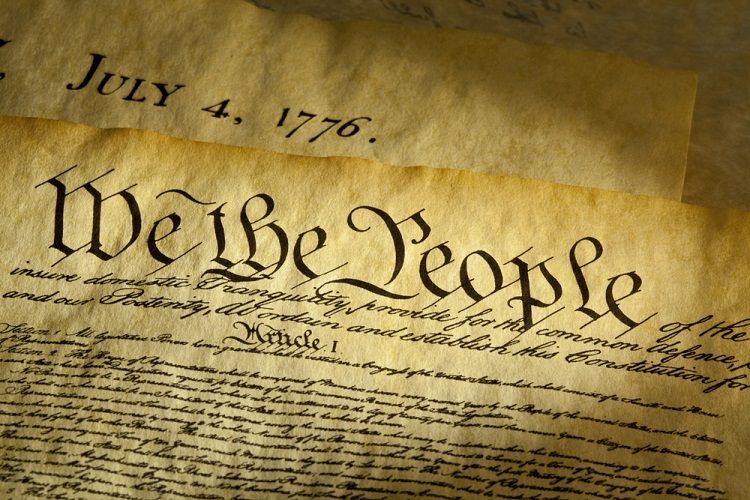
The Declaration of Independence was a declaration from the 13 colonies in 1776 that declared to Great Britain that they (Americans) were no longer ruled by them (Great Britain), and would instead form their own country with no relation to England. England objected to this, and proceeded to fight with the colonies for the next 7 years to reclaim the land. The declaration itself was rather short, only being some thousand words, and it got to the point quickly.
It had a short preamble, or introduction, that discussed the idea that all men are created equal, and that government should be designed to help its people, not harm them. It then said that when a country’s government begins to harm its people more than it helps them, the people under that government need to band together and remove the harmful government from themselves. They then end the preamble and move on to their list of grievances.
The list of grievances includes some 27 grievances, or injuries, that the colonists listed in the declaration as proof that the English king and his government were a harmful government, and needed to be overthrown if the colonies had any chance at all of becoming prosperous. The most important grievances were the ones pertaining to the king ignoring the rights of the colonists as citizens of England. Part of this was his passing taxes without their permission, the keeping of an army during their day-to-day lives, and the lack of attention he paid to their own laws and troubles. There were many more, and if you want to read about them, as well as the rest of the declaration, you can do so here. They also put heavy emphasis on the fact that the king had gone to war with them during the last year, 1775, after they had asked him to remove some of the taxes.
The end of the declaration then declares that they had repeatedly petitioned the king to remove or fix these grievances, and that they had told the British that they also needed to be rebelling due to these reasons, but to no avail. They then severed all ties with England, and declared themselves wholly independent. Of course, England objected to this, and the war that had already been going on for a year continued for another seven, starting in 1775 and going to 1783. It wasn’t until 1783 that Britain finally left the colonists, now the Americans, alone.
Technically, the final part of the declaration was the signatures of all the representatives of the 13 colonies, who then became the 13 states, which is what gave the paper the authority to declare the people independence. An interesting part of the declaration is that it constantly referred to the king, and not parliament. The king didn’t do much, it was mostly parliament who actually passed laws and taxes, but since they needed to disabuse the few remaining loyalists of the notion that the king was still a good guy, and that it was just parliament who was evil. To do this they pointed out that the king had never stopped parliament from doing any of the grievances mentioned, and even when he was contacted directly in a previous letter, and then the declaration, the king still sided with parliament, against the people.

 School Essays