After winning its independence and establishing itself as a considerable force to be reckoned with, America began looking at how the country would expand. This wasn’t a major pursuit until 1803, however, as there were a lot of Indians all around them, and besides, to the north was Canada, owned by the powerful British, to the east is sea, to the south is Mexico, owned by the powerful Spanish, and to the west was the Louisiana Territory, owned by the powerful French, so if Americans wanted to expand in any direction they would have to fight a powerful country or start a colony on the sea, neither of which they wanted to do. But in 1803 Napoleon Bonaparte, ruler of France, had run himself into debt by financing wars across all Europe, and his most profitable colony in the Caribbean had rebelled against France, turning all of France’s lands into a net loss. Then came Thomas Jefferson, wanting to buy a tiny corner of Napoleon’s land to get a better trade deal in New Orleans, and so Napoleon offered, and sold, all of the Louisiana Territory to him, and proceeded to spend all the money on more war in Europe.
Jefferson, however, gained a lot of land to the west that he was pretty sure he could get people to colonize, increasing the size and power of the U.S. He didn’t even know what the land looked like, however, and famously sent Lewis and Clark to investigate, as well as make peace with Native Americans. They came back in 1806 with the general layout of the western country, and thus started the major part of western expansion.
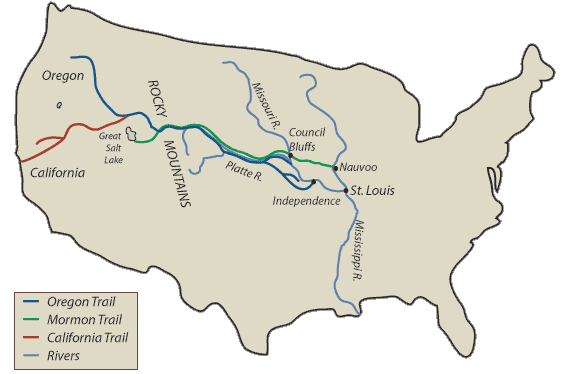
No matter where you were going back then, almost all settlers started their westward journey in Independence, Missouri as it was the biggest/westernest town in the states, and having a common starting point allowed people to join up and make the long, over 2,000 mile journey westwards together. Being together was a major benefit, as the area was extremely dangerous with all kinds of wildlife, particularly bison, which could destroy a wagon train in a stampede or feed it for days, and while most Indians were friendly, most does not mean all. The most famous trail, of course, and the longest, was the Oregon Trail. The Oregon Trail was 2,170 miles, going from Missouri to the west coast, and was initially made as more of a track than a trail, used by trappers and hunters to get plentiful western game. It didn’t become a major trail until covered wagons started using it in 1836.
Other trails include the California Trail, the Mormon Trail, and the Santa Fe Trail. The California Trail started in 1843, and followed along with the Oregon Trail until just north the the great salt lake, and winded down into California instead of Oregon. The Mormon Trail started in 1847, and started farther east than the Oregon Trail, as that had been where the Mormons lived, since they had been around longer than the rest of the western states, like Missouri. They were eventually all pushed out of their home, however, and so went westward, and joined with the people going to Oregon for the same reason that multiple people going to Oregon joined together: security in numbers. The Mormons stopped at the Great Salt Lake, and remain there to this day. The Santa Fe Trail isn’t on the map, but it started in 1821, making it the oldest of the American trails. It also started in Missouri, but didn’t follow Oregon’s lead. Instead it went south, to Santa Fe, New Mexico. It also met up with an old Spanish Trail in Santa Fe, made in the 1500s when the Spaniards were exploring from the western seaside. This trail was widened and provided a good connection to the west coast, specifically the site of Los Angeles.
The trails remained in use until 1869, when the Transcontinental Railroad was completed, allowing people to quickly and safely travel west. So while extremely useful during the time that they were used, the trails quickly lost popularity to the train system. But the trails still are the foundation of the towns and people in the west, particularly the west coast.

 School Essays