
John Davison Rockefeller was, and still holds the title for, Richest Man in America. He started out as nothing, however, being born into an extremely poor family, his father being a famous conman, and famous is not something you want to be as a conman. In addition to not providing for his family, he would often steal from his own children, saying he wanted to “make them sharp” a goal that fully succeeded with John. They were unable to keep a home in New York, and had to move to Ohio, where John started working as a grocer. He didn’t stay a grocer long, however, instead investing in an oil refinery in 1863 with several friends. None of them were as seriously minded as he was, however, and he managed to buy out his friends’ shares by 1865. By 1870 he had founded the Standard Oil Company, so named because he dreamed that it really would be the standard oil company for the whole of the United States, and as he bought out competitors and built more refineries, that dream became reality.
He would often make somewhat risky and often expensive decisions, like building massive pipelines from his refineries to major cities, which was expensive upfront, but cut out the railroads who had previously shipped the oil, cutting prices for his products, making him more money in the end. He was, however, so eager to cut costs and make money, that he was often cruel to his employees and opponents. When the government began to step in to deal with over the top monopolies, his was the first major business to be hit hard with lawsuits, ending standard oil. He, however, remained owner, or at least major owner of all the companies it turned into, giving him an unofficial monopoly even after his official one was ended.

Andrew Carnegie was born in Scotland in 1835, and while his father was much less horrible than Rockefeller’s, they were just as poor, and eventually managed to move to America in search of a better life. They moved to Pennsylvania in 1848, and Carnegie worked extremely poor jobs constantly, hoping to move ahead in the world. Eventually he won the attention of Tom Scott, a railroad business man, through his being the most efficient telegraph operator in the area. He became his secretary and apprentice, gaining him experience he would use throughout his life. He began investing in other companies, particularly bridge companies, where he was introduced to the material that would make him rich: Steel. Steel was difficult to mass produce at the time, but Carnegie found a process to turn iron to steel, and started Carnegie Steel Industry. He got rich, and became a major competitor to Rockefeller.
He was like John, in that he pushed his employees hard, but he wasn’t quite on the same level as Rockefeller, and when J. P. Morgan made an offer to buy his company, he took it, and spent the rest of his life living comfortably, though he left barely anything for his descendants, saying they should make their own way in the world. This is opposed to the Rockefellers, who are still rich off of John’s money to this day.
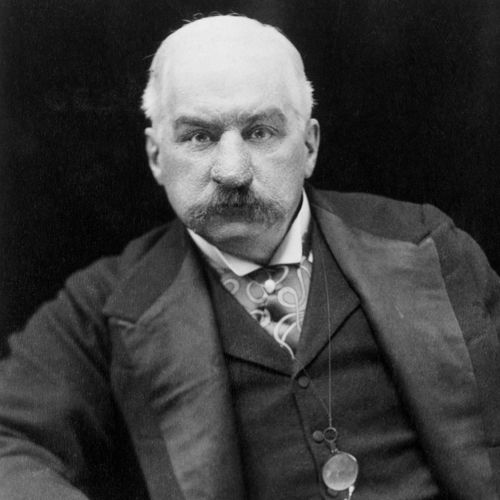
Unlike his rivals, Junius Pierpont Morgan was born to a rather wealthy banking family in 1837, and was groomed to take over the family business. He went to college in Switzerland and Germany, returning to America in 1857, further showing how rich he was. His father had been extremely careful, and had built up his fortune by consolidating multiple failing companies into one successful one, which the elder Morgan would be paid for working out the deals. When J.P. took charge of the company, he still made these deals, but began heavily investing in the companies, and requiring that he be put on the board of directors, or other important positions, as the price for helping out the companies. This made him wealthy, but he wasn’t on par with Rockefeller or Carnegie yet. In 1895 the United States treasury was very near depletion, and Morgan made a deal. He managed to force and convince all the other New York bankers to help him bail out the U.S. government. This made J.P. famous, and rocketed him forward in business. He also became riskier, and started investing in several things, the most famous of which being electricity, and he was a major backer of Thomas Edison.
His only real challenge came when Theodore Roosevelt became president. Roosevelt didn’t like the idea of one man having the power to bail out the government, and set about ending his monopolies with lawsuits the way Rockefeller’s monopoly had ended. Fortunately for Morgan, however, the economy hit a bump in 1907, and and a bank on Wall Street nearly went under, which would’ve been bad for the government and the rest of the economy. Theodore had to ask J.P. to save the bank, which he did, in exchange for immunity to the lawsuits that were being brought against him. The deal done, Morgan’s major companies U.S. Steel (he re-branded Carnegie Steel) and General Electric remain the two of most major companies to this day.

 School Essays