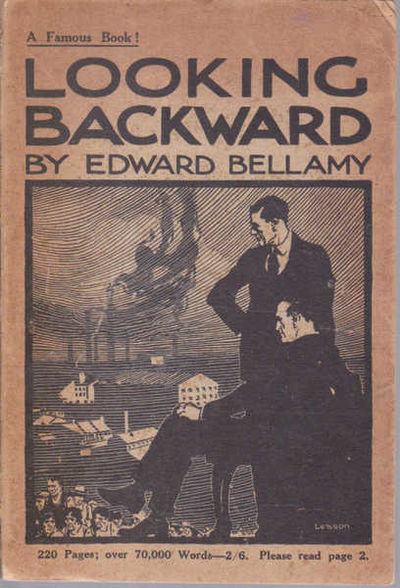
Looking Backward is Utopian literature, written in 1888 by Edward Bellamy, a Socialist. It was very popular in America when it was written, making it one of the only popular socialist works in America. Despite the many people who liked the book, and Bellamy’s best efforts, Socialism didn’t get popular, and has gotten pretty continuously less popular since the fall of nearly every communist and socialist country, with the exceptions of North Korea and Cuba.
It starts with the main character living in 1887 as a rich man, but is having troubles because of extreme strikes and riots going on in the workforce of America, and from the characters conversation, apparently all over the world. While there were a lot of strikes back then, they were not nearly so bad as Bellamy depicted, and had a totally different outcome. This main character had trouble sleeping, and so had a friend of his mesmerize him to put him to sleep. Somehow, the house burns down around him, but he’s safe because he slept in the basement, and is presumed dead. He then wakes up in an unknown room. Turns out, he slept for 113 years, and is only excavated in the year 2000. He finds that it is because Dr. Leete, the current owner of the land, was trying to build where the old house stood. Looking out at the city, he realizes that it has beyond a doubt changed, convincing him that he really slept 113 years. This is complete fiction, of course, and serves simply as a mechanic for Bellamy to contrast his 1887 culture and the Utopian one. So, while unbelievable, it wasn’t meant to be believable, and I don’t have any trouble with it.
What he did mean to be believable, however, is this Utopian society. Edward, through Leete, describes how the strikes were ended by assigning all jobs to be under one employer, the Government. This makes no Economic sense, as strikes exist as a retaliation against a lack of employers, trying to get them to change, as opposed to finding a new boss that would start with the demands met. He then goes on to say that all workers are paid the same, no matter the job worked, or the quality done. He contradicts this by later saying that less savory jobs don’t have to work as much, which begs the question, how can you claim both identical pay rates, and equality of outcome if the hours are different? Another contradiction that he has, is that supposedly the people can choose their job, and so certain (undefined) benefits may be granted to the less popular jobs until they are equal to the desirable vocations, so that people will naturally want to take those jobs. He also says that the state has the power to make people work any job if the benefits aren’t great enough, and that in any emergency (the State deciding what constitutes an emergency) the workforce can be changed and moved as they decide is needed. The biggest oversight in Bellamy’s Socialist ideal (so far, I’m barely a third of the way through the book) is probably the fact that the wages aren’t described. After dodging about the question of “How are wages decided?” Bellamy says that there would be no equivalent to wages in Utopia, despite him describing an exact one-to-one descendant to wages in his “credit” system. So if we try to answer the question that he couldn’t, we find that the pay can’t be decided by anything other than total subjectivity due to the fact that the government holds a monopoly on everything. Add tot his his contradictions on how people get paid the same amount, and his entire system has already fallen apart. Just like all attempted socialist societies.

 School Essays