The Mousetrap

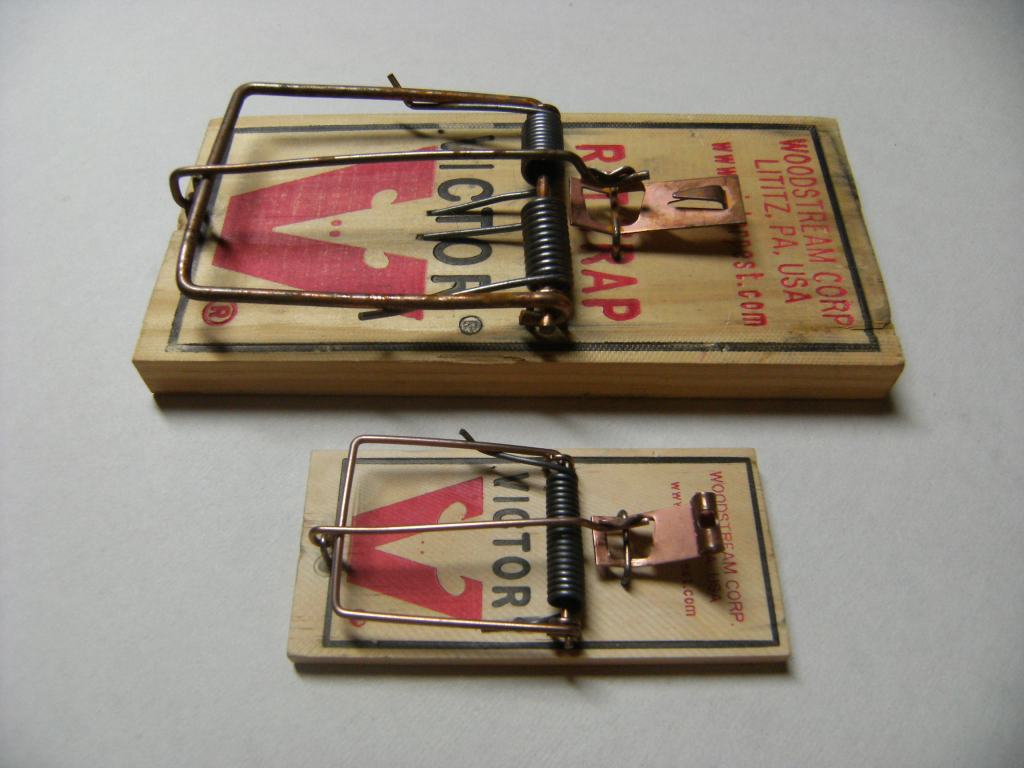
The top trap in the picture is a rat trap and the one on the bottom is a mouse trap. There is no change in how the traps work, but mice are much smaller than rats, so a mouse could be light enough to steal the cheese, and not set off the the rat trap. Rats are bigger and hardier, so even though it sets off the mouse trap, it doesn’t die. Therefore, you have to get a rattrap if you have rats, and a mousetrap if you have mice. You want to use a mousetrap or rattrap because mice and rats can get to the foundations of your house and will eat and chew the foundations into oblivion, which will make your house come crumbling down, which is not good. They can also carry disease, both directly and indirectly. They can spread disease directly by biting you, which will cut open a hole in your flesh, then their saliva will get in your cut and then you get sick. Another direct method is their urine. Their urine can evaporate and become a cloud of disease. An indirect method mice/rats use is their fleas. Their fleas live in their back fur and will hop off of them, jump onto you, bite you, and infect you with whatever disease they have. There have been thousands of mousetraps before the modern trap became commercially successful. Some of them did not kill the mice/rats but this is bad because it could scare the mouse into peeing which will cause disease and if you let the mouse/rat go, it will just get back in you house.
English 5 Lesson 140

Some very good advice I have received is to never, ever put my hand next to a blade someone is using or is spinning. A good extension to that is to be careful around blades in general, but even more so that aren’t going but have electricity running through them, and the utmost caution with blades in use. If I did put my hand next to a knife that’s chopping something, a saw that’s in use, or any other cutting tool I would probably lose some of my fingers, or my whole hand! If I lost my hand I would have to learn to write with my left hand and I couldn’t use it for anything other than punching.

Coca-Cola

John Pemberton was born in Georgia, 1831. He fought in the Civil War and in the battle of Columbus the second to last battle of the Civil War and he got a large sword slash across his chest. It was painful enough for the doctors to give him morphine to help relieve him of the pain caused by the wound. Fortunately for coke fans he got addicted to the drug. Since he had lots of experience in chemistry he tried to make something to help him off his morphine addiction and that thing was coca-cola. The original coca-cola a coca wine which is a wine infused with a small amount of cocaine. He sold it to business owners as a reliever of their stress when more competition popped up. He also sold it to other people addicted to drugs like morphine. His coca wine became illegal when Georgia put a ban on alcohol due to the Temperance movement in 1820s to the 1840s. The Temperance movement was a movement that outlawed alcohol and it was supported mainly by the wives of heavy drinkers. Because of the Temperance movement John had to formulate a different, alcohol free, version of his coca wine. His new version of coca wine was a soft drink that had kola nuts in it. The kola nuts provided caffeine to the drink that woke you up a bit. Even after alcohol became legal again he kept with the new version. After cocaine became illegal he had to buy the dedrugged version of the coca leaves so that the flavor stayed the same even if the drug wasn’t in it anymore.

The Dishwasher

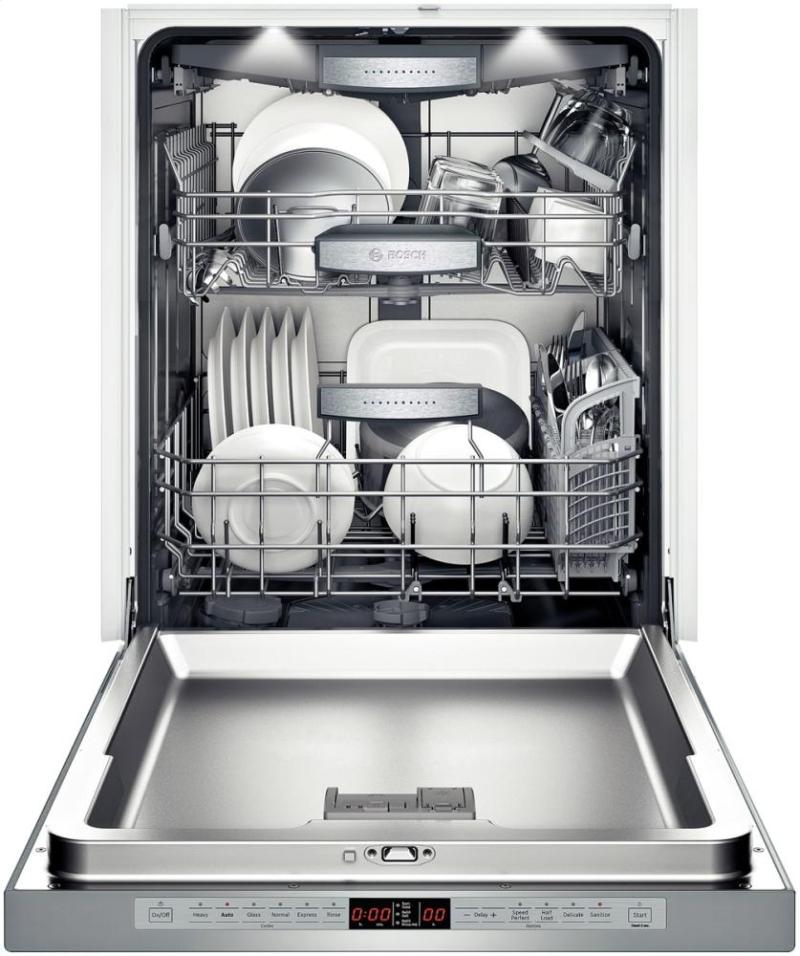
Hand washing dishes is a very labor intensive job. Back before the dishwasher was invented you would have had to go fetch water from the well outside, bring it to the scullery if you had one, heat the water, add soap, scrub the dish clean, then dry it with a cloth and repeat. A scullery is a small room offset from the main house that is designed for washing dishes. Its floor is sloped so that any spilt water runs down the floor into grates set along the perimeter of the room. Because of all the water the scullery is often moist or damp which, coupled with the grease and food leftovers made it a breeding ground for bacteria. Some families got seriously sick from their scullery. Hand washing dishes was also a big problem for restaurants since they had people using dishes all the time and had to wash the dishes all the time. Josephine Cochrane was born in Ohio, 1839. She married a man named William Cochrane who had started a dry goods business. He was very successful and bought a very big house. In that house they hosted lots of large parties. Josephine used her nice china plates and bowls at these parties. She got annoyed however, when her servants chipped her fancy china when washing them. She made the first dishwasher so that the servants did not chip the china. She made some for her friends and upon receiving good feedback she showed it off in the 1893 world’s fair in Chicago and began selling it.

English 5 Lesson 130

If I could live anywhere at all, I would live in Legoland. I would ride on all of the rides every day and explore all of the hotels and stores. I would trade mini figures with all the employees until I had the best and coolest mini figure collection in the world. I would also work at Legoland so that I could also know all the secrets at Legoland. that’s why I would live in Legoland

Cash Drawer

General stores were growing to match the increased number of transactions that they made each day. As the amount of cash changing hands grew, the business owners had to get more cash drawers and had to hire more employees to run the cash drawers. Having more employees running more cash drawers made it easier for the average employee to steal from their employer. Stealing then became a big problem for employers. James Ritty was born in 1836 and when he was 28 he opened a saloon. As the owner of the saloon he had a problem with his employees stealing from him. He brooded on this problem for a long time. One day he was taking a boat to Europe and he saw a machine that counted the number of times the propeller made a full rotation. He wondered if he could use that to keep his employees from stealing from him. The cash register counts how many times the cash drawer has been opened and it prints 2 receipts, 1 for the business owner and 1 for the buyer. If the employee opens the cash drawer to steal money, the register counts that as one more time the drawer was opened. At the end of the day when the owner is looking at his receipts he will see the drawer has been opened more times than there are receipts, telling him one of his employees has stolen from the cash drawer. And by adding the receipts and comparing it to the amount of money in drawer he can see how much was stolen.

Motion Pictures

Christian Huygens, the inventor of the pendulum clock, invented the magic lantern in 1659. The magic lantern does not use real magic but instead is a box with a light inside that will project a picture through the lens and onto a wall or curtain. This magic lantern was the first big step to a motion picture projector. Phenakistiscope was made in the 1830s and was a wheel that had a lot of pictures on it so that when you spun it fast enough it looked like the image was moving. Edward Muggeridge was an old bookshop owner who was born in England in 1830. He immigrated to the United States when he was 20 and lived in San Francisco where he set up shop. In 1860 he was going to go to England to buy some books for his shop, but he missed his boat. He couldn’t get another boat to take him to England so he traveled to New York to get another boat, but on his way his stagecoach crashed and left him severely hurt. His brain got damaged and his personality changed. His doctor told him of photography, and so Edward became a photographer. He became a very good photographer and got the attention of Leland Stanford who asked Muggeridge to help him put an end to the argument of whether a galloping horse takes all 4 feet off the ground at any time. Muggeridge set up 20 cameras in a row so that they could take a picture of the horse with 4 legs in the air at once. When Muggeridge played through all the pictures quickly it looked like a video. Motion pictures were born.

English 5 Lesson 120

Chickens are my favorite animal because they are funny animals. They will jump on anything low enough to jump onto. They are also very easy to raise and keep alive. They will also provide food by laying eggs which are very versatile as they can be hard boiled, scrambled, fried, and many more ways to cook them but chickens can also be butchered and cooked for their meat, which is used in many delicious recipes. Chickens also eat bugs and other pests.

I have had my own chickens for 7 days at the time I’m writing this. I have 4 chickens and each of them is named after a way to cook eggs: Scramble is an Ameraucana chicken, Omelette is also an Ameraucana, Pokey is a Buff Orpington, and so is Sunnyside. Something I didn’t know before I got chicks is that they poop everywhere. Chickens are the closest living relative to the Tyrannosaurus Rex and when you hold little chicks they feel like little dinosaurs in a bunny suit.

Riveted Blue Jeans

As people left the farm and started working in factories and making railroads it became evident that you needed more heavy duty clothes to protect you from the heavy machinery since there were sharp edges and hard metal. Of course, thick clothes wouldn’t stop a locomotive from crushing you if it ran you over but if hot steam sprayed on a shirt it will burn you but if you wear heavier clothes it wouldn’t hurt. Cowboys also needed thicker pants since they spend all day in the saddle which wears out their pants. Miners were rushing to California and they needed tough clothes since they would be using big tools and they would be working with lots of stone. Levi Strauss was born in Germany and moved to America with his mother and his two sisters. His two older brothers had already set up a dry goods shop in New York City so he came to work for them. Their shop was doing so well they decided to set up another in California and that Levi would run it. Instead of going from one end of the country to the other he took a boat down and around the southern tip of South America. So Levi set up shop in California. Jacob Davis was a talented tailor in California who made wagon covers and tents out of denim and when he was done he added copper rivets to strengthen them since they needed to stand up to the weather. He got the denim from Levi’s company. One day one of his customers asked him to make strong pants for mining and Davis did make the pants and put in rivets. He decided to patent it, but needed more money so he asked Levi if he wanted to partner to patent it, and Levi agreed.

The Mail Order Catalog

In the 1800s people in the city were able to get cheep prices on things since shop owners want to be in a city because more people were there so the likelihood people would buy their stuff is higher so there is more competition between the shops, leading to cheaper prices. There is also more diversity of products because more people means more people shopping. But in small farms out in the frontier there was normally only one store for a community of farmers that provided all of the necessities like rice, beans, potatoes, different animal furs and other things they could buy from farmers called a general store. But since the general store was the only store around it didn’t have to compete with other stores so it could raise prices since you either bought it high or starved. The general store also didn’t make sure their products were up to standard and didn’t do refunds if the product was bad. A man named Aaron Montgomery Ward became a traveling sales man and learned of the problem farmers had with the general store. The farmers number one problem seemed to be the high price the general store charged. So to lower the price Ward decided to cut out the middlemen like shopkeepers and salesmen. To do this Ward sent sheets of paper covered with advertisements and prices. Since he didn’t have to pay middlemen the price was lower and so farmers bought things through the mail and could get a refund if they didn’t like it. It was a success with farmers.