Lava Lamp

Bright, beautiful, boiling orbs of gel,

colorful wax withheld within a metal-glass shell,

raised by the heat of light from below,

the far, tall, lonely cold shall then bestow

the great orbs of waxy gel back to the boiling pit

of electric heat, to which the bright, colorful sphere shall submit,

turning to a massive hill, where it shall stay until it boils over,

returning then to a globe-like shape, rising ‘till it should over all tower.

One should never forget, however, the small drops formed between

the tip of the hill and the globe, which go up or down,

depending on seemingly nothing, so long as nothing intervenes.

The metal base is untouchable for heat,

but the cap is warm and is worn like the good king’s crown.

The lava lamp truly is one of the most mesmerizing machines.

As such it is fully doomed to ever go up and down, and ever repeat,

bouncing up and down as though it were a waxen clown.

Occasionally the orbs falling down and the orbs rising up

meet in the middle and hug it out until they form together like spoonfuls of syrup,

forming a bead completely unsure, will it go up or down, each half attempting

to gainsay the other, but with equal standing neither can belay, waiting

till one from above or one from below may decide their uncertain fate,

but thankfully for them they need not for long suffer a horrible wait,

for the small droplets are always eager to decide the fate of their larger brothers,

and while we watch this beautiful device we darest not a single word utter,

so mesmerizing is this glass, metal, and wax Lava Lamp.

The Great Awakening of 1720-1740

The majority of the colonies in America were formed because the colonists wanted religious freedom, like the Puritans, who decided the best way to get freedom was to remove themselves from the old and well controlled Europe. However, after a few generations the people living in America began to take it for granted and slowly left their religion behind. The preachers and church leaders began the “Great Awakening” to target those people that said they believed in Christianity but didn’t practice it. The awakening started in 1720 when Thomas Frelinghuyson (I can’t pronounce it either) went to New Jersey to preach. He was extremely strict and directly condemned the people that went to church but didn’t really listen. Since people don’t especially like being directly condemned, Thomas wasn’t very popular, and he didn’t reach many people. He did, however, get people used to it, which opened the way for other preachers like Jonathan Edwards and George Whitefield.

Jonathan Edwards (picture above) was born in 1703, and was born to a family of ministers on both sides of the family, and because of this he got a great education at a young age. He graduated from Yale College at the top of his class, and became a Minister only a couple of years later. He also married Sarah Piermont in the same year, and ended up having 11 children with her. He then preached in Boston in 1732 about holding true to your principles, and this led a great many to join his church, 300 joining in the first year, 1733. However, to get people to stop sinning, a fear campaign started that painted Hell as a very real and very horrible place. This caused many to commit suicide, though in 1741 Edwards preached his famous sermon “In the Hands of an Angry God” which recirculated the message of hope, not that you could tell by the title. He took in and helped poor people and Native Americans at the end of his life, eventually dying of a failed smallpox vaccine.

George Whitefield is generally accepted as the greatest pastor of the “Great Awakening” while Jonathan was the greatest theologian (he had the best understanding of the bible). George was a much poorer Englishman and went to Oxford as a servitor, where he would work for other students and teachers in exchange for sitting in on the classes. He joined a religious club imaginatively named the “Holy Club” He then went to the America’s to preach, and upon finding an orphanage decided to help it as best he could. He would preach in parks and other public places, so that he could reach as many people as possible. It’s said that his voice could be heard from five miles away, letting him preach to thousands of people. He also warned people to guard their freedom, because the King of England planned to send a Bishop to the Americas, ridding them of their religious freedom. He died in 1770, having helped many people better their lives (as far as I can tell).

The Odyssey: A Summary

The Odyssey is not a chronological story, and instead of starting at the beginning it starts in the middle, with chapters 1-4 covering Odysseus’ wife, Penelope, and his son Telemachus on Ithaca, Odysseus’ home, as they search for Odysseus, since he never returned home after winning the Trojan war. Eventually Telemachus finds some of his dad’s war buddies who tell him that he had in fact survived the war.

Chapters 5-8 described Odysseus’ journey from Ogygia, an Island paradise where he rested for some time, to the Phaeacian Kingdom, a neighbor to Ithaca. Very little happens on this journey, save for a bad storm, but once he reaches the Phaeacians he recounts his story to the King to get help in returning home.

This storytelling on the Odysseus’ part is chapters 9-12, and we finally get the story’s beginning. From Troy the ship made good time, having skirmishes with different cannibalistic tribes and such, until they reach Polyphemus’ island. Polyphemus was a Cyclops, a one-eyed giant, and he herded goats on his island. when Odysseus landed there for food they went into Polyphemus’ cave, but then the giant himself entered and ate a couple of the crew, having blocked the door with a boulder. This went on day after day for a while, until they had the bright idea to blind the Cyclops, but not kill him, since he was the only one able to open the door. Since he couldn’t see them, he couldn’t squash them, and they sneaked out easily when Polyphemus let out his sheep. However, he heard them as their boat was leaving, and he cursed them as they left, which is what turned the month-long journey into a decade-long adventure.

He sailed past the home of the wind god, Aeolus, but his crew’s stupidity cost him the god’s favor, turning the wind against them and further lengthening the adventure. He spent time at Circe’s island, where Circe was a witch that transformed men into animals, but thanks to Hermes, god of travelers, Odysseus bested her and rested on the isle for a while. He also sailed into the Underworld, the realm of the dead. While there he talked to his mother, several of his friends that died during the Trojan war, and dead prophets, who told him the best path to get home to Ithaca. From there they sailed past the Sirens, birdlike people who hypnotized sailors into drowning themselves, into the passage of Scylla and Charybdis.

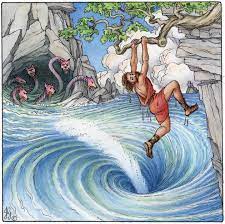
Scylla and Charybdis were two huge monsters that each took a side of a passage that Odysseus had to sail through. Scylla was a six-headed Hydra-like creature that would eat as many of the crew as possible. Charybdis was a living garbage disposal from a sink, as it sucked in and chewed up whatever possible, including ships. Odysseus, much to the displeasure of his crew, decided to sacrifice six of them to Scylla. Once they got through, however, one of the crew cursed Zeus, king of the gods, for forcing them to go through this. Zeus, who had done nothing of the sort, took that personally and blew them back through the passage into Charybdis, who happily munched on them and their ship. The only survivor was Odysseus, since he had immediately started praying upon hearing his retarded crew. He then washed up on Ogygia, Calypso’s island, where he rested until setting out to the Phaeacian kingdom, bringing us full circle to chapters 5-8.

Chapters 13-24, the second half of the book, don’t contain nearly as much material as those three chapters, but they did cover Penelope’s refusal to remarry, believing Odysseus to be alive, and Telemachus’ search for his father. Eventually Odysseus reaches home, but puts on a disguise after hearing about the many suitors that want to marry Penelope and take his kingdom. He goes in, and the only person to recognize him is his now over-20-year-old dog, which is adorable. He then challenges all of the suitors to an overly complex contest, reveals himself to everyone after winning, and kills all of the suitors in a father-son moment with Telemachus.

The Odyssey is a very good story, though it is very long, and quite hard to understand, being written in very old fashion, being translated from even older Greek, and being entirely written as a poem.

Virginia, Pennsylvania, and Georgia

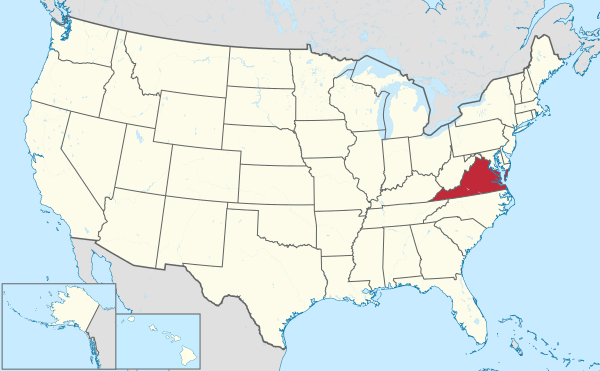
Virginia was the first of the famous 13 Colonies that England set up, with the first town being Jamestown, which also makes Jamestown the first permanent settlement in North America. Jamestown was started by the London Company for the purpose of finding gold or other resources and shipping them back to England. It was started in 1607 and has managed to survive, unlike many other settlements, all the way to the current day. It was also the capital of Virginia until 1699, when Williamsburg was built. It was turned into a crown colony, or royal colony, by King James I, since it was profitable enough that he wanted it for himself, and didn’t want the London Company getting all the proceeds. After that, many colonies were started or stolen by the crown.

Pennsylvania was a much later colony, being founded by Sir William Penn in 1681, and named it after himself, since Pennsylvania translates into “Penn’s woods” since Pennsylvania was a well forested area. Penn was a Quaker, an offshoot of the Protestants, but he was also extremely accepting of religions, and was fine with pretty much all monotheistic believers. It was also a much, much more peaceful colony with regards to the Native Americans, since it only ever bought land from them, not taking it by force. Pennsylvania never joined the Indian wars, and was extremely open to trade with the natives. Philadelphia, the early capital of Pennsylvania, was temporarily the most important city in North America, being the home of Benjamin Franklin, the site of the college of Philadelphia, and the eventual site of the continental congress, which was the seat of the rebellion against Britain.

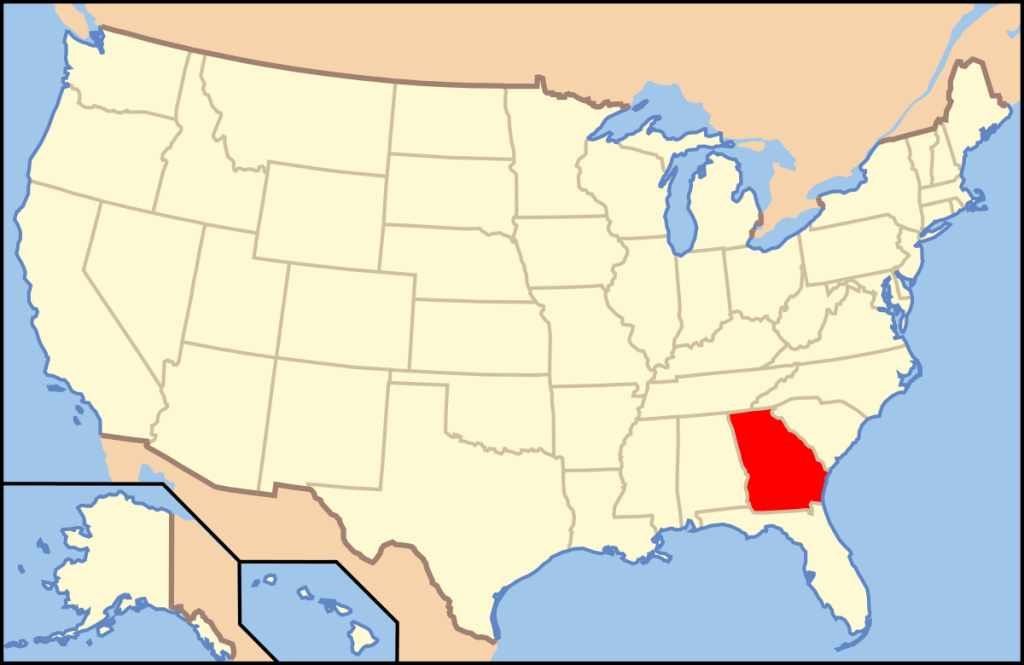
Georgia was the last of the colonies to be founded by England, and the farthest south. It was founded by General James (don’t laugh) Oglethorpe in 1732, and he intended it to be a place where the outcasts of society, the prisoners, those in debt, the idle fortune hunters, and the overall ne’er-do-wells. This may sound like a bad plan, and indeed it was, but not quite as bad as it sounds. By putting all the lazy and unproductive people in one place he forced them to be productive. He also attempted to force them into productivity by being extremely harsh, with a multitude of laws, such as no alcohol and no slaves, as well as regulating how much land a person could have. It took a while for him to realize people didn’t like it there, and that the restrictions were limiting Georgia’s growth, and that it would be better if they weren’t there. This was proven when the restrictions were lifted and the productivity and wealth of the people skyrocketed.

A Robin Hood Poem

This is solely meant to flow well, so I wrote it in slightly older English without trying to make it rhyme. That’s also the actual definition of poetry, who knew?

Noble Robin of the Hood was wronged in many ways by the terrible tyranny of the wicked king John, and so he joined many a goodly man to him to fight against this terrible tyranny, and called them all his merry men, for merry they were in deed and thought.

The terrible king John was of horrid temperament, for he had a great greed within him, which caused him to desire all the wealth within his kingdom, which caused his people to hate him greatly, for his men would oft’ times take all they had. Then did the great Robin appear, challenging their power, for he had gathered a great many men, all whom desired to be freed from the corrupt king. They lived well within a forest, the Sherwood forest, where they trained with their staves and bows, so that they might defeat the sinful soldiers that threatened the people’s freedom,

Robin then began stripping nobles of their wealth, and his forest began to be famed among the those who were excessive in their desire for wealth. He was also famed among the honest, hardworking, and oft robbed common people, for it was not uncommon to see the famed archer spreading his wealth among them, creating goodwill and helping them through the hard times, while those governor’s and corrupt Bishops’ coffers never managed to fill to the great height that they would wish them to.

King John was ever ill at ease because of this expert huntsman, and it filled many honest hearts with joy to see the heavy-handed tyrant brought so low, to the point that he dared not leave his castle without extensive guard, for the mighty Robin Hood was skilled at disguise, and John the first was never seen within bow range of the cheery forest, and for good reason too, for his son may have enjoyed the kingship for that much longer.

Charles I and the Divine Right of Kings

The Divine Right of Kings was the belief that the king of a country was divinely chosen by god for his position, and thus could do whatever he wanted, and not be in the wrong. This meant that the King was above the law, so Kings loved this idea, and just about everybody else hated it. It was practiced in ancient times like with the Egyptians, who believed their Pharaoh to literally be an incarnation of the god Horus, and in a score of other places, like the Roman Emperors who portrayed themselves as living gods. This changed when Christianity came along because there could only be one god, but it quickly shifted into the idea that God supported the King and everything he did, meaning he could do no wrong. Well, unfortunately for the kings that attempted to implement this form of ruling, the culture had changed. Feudalism had taken over since the fall of the Roman Empire and this put the social order into something like a step pyramid, with the common people being plentiful and at the bottom of the pyramid, then nobles and barons rising in power as there were fewer of them, and the King was the single man at the top of the pyramid. However, this made it easier for nobles to unite the people under them to rebel against the King, or for the people to fight the nobles, meaning the kings had to be of some good quality, or they were thrown out of the kingdom, or more likely, life. In England, people were not fond of the D.R.K, with basically the whole of plot of Robin Hood starting because John I took his rule too far, and while there were bad kings, and some probably did believe in the D.R.K, but none of them took it beyond the point of endurance for their people, until James I began spreading the idea.

Now, James didn’t actually take it too far, since when he tried to strut around his kingdoms doing what he wanted the Scottish and English taught him that was frowned on by nearly igniting a rebellion. For the rest of his reign James struggled with Parliament to do as much as he wanted without making the people hate him, and it worked pretty well, with him being remembered as an alright king, not as cool as his predecessor Elizabeth, but not a bad king. His successor was not nearly as successful at bargaining with Parliament.

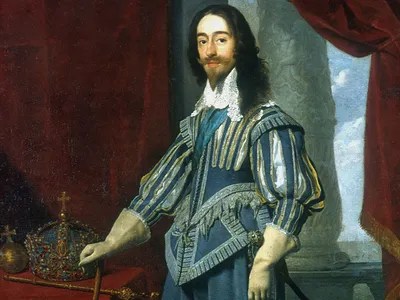
Charles I believed heavily in the D.R.K, and did push it too far. He was the second son of James, the first having died, and was made king in 1625. He began instituting the Episcopal, or Anglican, church across England and Scotland, which was still not Catholic, since that would give the Pope power, but much more Catholic than what the extremely protestant English and Scottish were used to. When Parliament tried to tell Charles to knock it off, he dismissed them. He then ruled for eleven years with no one checking his growth in power, commonly referred to as the Eleven Years of Tyranny. Those years ended only when the people revolted. The people fighting against Charles were called Roundheads, since they wore round helmets. The leader was called Oliver Cromwell, and it’s important to note that they were not fighting to get rid of the king, they just wanted to get the king to share power with Parliament, which was viewed as the voice of the people. The Scottish started a separate revolution, that was much more of a quiet resistance, but it was the English that killed Charles in 1649, and eventually instituted his son Charles II as a King in 1661.

So far, the Divine Right of Kings is not believed in, and is not in effect, as far as I know, at least in England.

Percival and the Red Dragon

“King Arthur! I come seeking a boon,”

“Speak, then.” Arthur vaguely wondered why he had to say this every single time a peasant came to him asking for a favor. He knew he was going to grant it, they knew he was going to grant it, but not until they told him what it was. Sir Kay, however, nudged him whenever he tried to take a short cut, like just nodding to them.

“A bandit came to our town, and has taken up abode there, eating our food stocks and killing anyone that does not continue farming for more food, often by burning them, as he calls himself the Red Dragon.”

This was different from the run of the mill bandits that Arthur had heard of. “If he is permanently based in your town, why doesn’t your local Baron take care of him?” That was usually what happened to bandits who stayed in one place too long, while Arthur’s knights tracked and killed the more elusive criminals.

“He tried, milord. His son is understandably hesitant to continue any attack upon him, for he is but a child.”

“Oh dear. Well, Lancelot just got back from a quest, so he’s tired, Gawain probably shouldn’t fight anyone else who’s based on a color, so… Percival!” Percival looked up from his breakfast.

“Yeah?”

“So you accept; wonderful. You can leave just after you finish your meal.” Percival blinked, then looked at his food. He then shrugged and started eating again.

“So that’s your town?” Percival asked. It was closer than he had thought, only being a few days journey.

“Yea, so it is, but not as much as there was when I left, for the outlaw does enjoy burning things.” Percival sighed, then started his horse down the trail, “What are you doing?” the peasant hissed.

“What?”

“You’re just going down there, without seeing him first?”

“Well yeah, what did thee expect me to do, shoot him with an arrow? That’d be unknightly.”

“So what’s to stop him from hitting thee, sir knight, with an arrow?” Percival stopped. “Maybe I’ll wait to see him without a bow in his hands.” “Yea, verily, that would be a good plan. Now mind telling me how thee haven’t been shot in all thou years as a knight?”

“I challenge thee, scarlet villain!” The Red Dragon wheeled around to look at his challenger, rubbing sleep out of his eyes. He took a light nap and then that fool of a noble popped up, he took another nap and now some knight looking guy showed up. He sighed. “I accept! We shall joust! Now let me get my horse.”

They both readied themselves, lifting up their lances and spurring their horses. They then charged each other. The Dragon’s lance however, was slightly longer, and made first contact, yet Percival was not any featherweight. Even as Percival was thrown to the ground, drawing his sword in the process, the shaft of the lance shattered, upsetting Red’s horse, throwing the Dragon from his saddle. Percival was up first, the Bandit being obviously surprised at his bad luck. Percival allowed him to get up, though the favor would not have been returned were positions reversed. The bandit put on a good show, but ultimately failed to match up to the sheer strength and skill of the Knight of the Round Table. When he was finally defeated, he chose death to Percival over going to Arthur’s court and being surely hanged.

“How can we ever repay you, fair Knight?”

“Oh don’t worry about it, though I would like to keep this armor of his… it’s good quality, and looks impressive.”

“Of course, of course, none of our people would take it, though he would like to sell the horse, to pay for what he has taken.”

“Yea, thee may have it. Not like I need a new horse anyway.” He then had to walk back to Camelot after failing to fully fight off a pack of wolves after making camp the next night.

Cardinal Richelieu

Cardinal Richelieu (Rish-a-lu) was probably the most influential person and politician in Europe, if not the world. He was a Chief Minister, a position that was extremely close to the modern day Prime Minister, and he was the one that started the return of France to an important country, since it had been at various states of decay since the 100 Years War, though King Louis XIV made France an important country just after Richelieu’s death.

Cardinal Richelieu was born in 1585 to a noble family in France, and was given an extensive education. He was originally planning to join the military as a commander, but instead decided to join the church. King Henry IV of France almost immediately recognized his ability, however, and in 1606 asked if he would become a bishop. It was extremely uncommon for someone so young (21 years) to become a bishop, since they usually had to wait until they were 35 years old at the least. Richelieu then had to ask the Pope for special permission to become a bishop. The Pope saw no reason not to grant the request, and granted it.

He quickly came to be known as a reformer, though this wasn’t entirely true, since he was the first bishop to start instituting the reforms declared by the Council of Trent in 1563. This Council was something like a revitalization of the Catholic church, and they defined several Protestant arguments. They didn’t adopt all the reforms, not nearly, but just enough to be reinstituted in places that were sitting on the fence of staying Catholic or turning Protestant. What this meant is that the Protestants hated him for being Catholic, and the Catholics hated him for being Protestant, which became something of a trend for him.

He quickly proved to be a successful politician and became the most powerful and important of the bishops, so in 1622 he became a cardinal, which meant he was next in importance to the Pope. For the same reason in 1624, when he would’ve been 39-40, the time he should’ve been becoming a bishop, he became the Chief Minister, the most important person in France, after the King, but since Louis XIII wasn’t a very capable king Richelieu was the most important person.

Richelieu then decided to centralize power in France, stripping titles and lands from the nobility, even ordering all nobles castles to be demolished, leaving only the King, and his Chief Minister, with power in France. The nobility rose up against this, of course, but were ineffective and incapable of fighting coherently against Richelieu, since they had so long fought each other. The Cardinal then took his time and quashed each rebellion in turn, getting his way.

He then looked outwards from France and decided the only people capable of defeating and taking this new France was the Hapsburg family, a family that was deeply ingrained in both the Holy Roman Empire and Spain. He then spent most of his life checking the Hapsburgs power and trying to abolish them for good. This was not accomplished, but he did manage an incredible amount while never directly going to war with them, since he was able to pay for much of the Netherlands revolt against Spain and northern Italy’s defense against the H.R.E.’s attempted invasion. He was also influential in the 30 years war which primarily occurred in the H.R.E.

However, all this funding of revolts, defenses, and squashing of rebellions meant that he had to raise taxes. Considerably. Since the church was exempt from taxes and the remaining nobles were close relations to the King, these taxes fell primarily, and heavily, on the poor people, meaning that in addition to the rich, the poor hated Richelieu.

Despite being hated by Catholics, Protestants, Nobles, common people, the most powerful family in Europe, and several other countries like England that just didn’t like France, Cardinal Richelieu managed to live as a cardinal and the Chief Minister until his natural death in 1642, at age 57. He was also included as the main antagonist of “The Three Musketeers” which is, somewhat funnily, probably what he is most well known for.

Macbeth Recap

Macbeth is one of William Shakespeare’s darker plays, definitely not one of his comedies. It takes place in Scotland in the 11th century AD, and is actually based on a real Scottish King, though Shakespeare blurs and sums up the “history” part of it, making it much more historical fiction than history. But Shakespeare himself probably didn’t know very much about Macbeth, since he never got a proper education, and his version is a lot cooler.

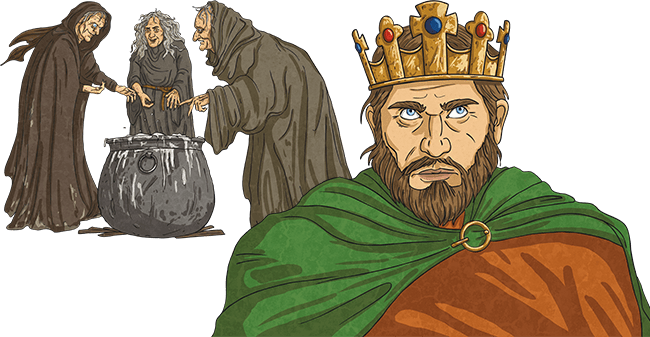
The play starts out with Macbeth and his friend Banquo returning from a battle in which they defeated an attempted rebellion against the King of Scotland, Duncan. They come across three witches who hail him (call him) the the Thane of Glamis (thanes were similar to governors), the Thane of Cawdor, which was the region that had just attempted a rebellion, and as the King of Scotland. He basically told them to go be weird somewhere else, so they told Banquo that his descendants would live to reach the throne, then left. They were prepared to dismiss the witches as crazy, but then a messenger from the King arrived and told Macbeth that he was the new Thane of Cawdor, making him treat the witches much more seriously.

Macbeth then goes home to his castle in Glamis and tells his Wife about what happened. They both interpret the prophecy as meaning they should kill the king and take the throne, which I think is odd since the King liked Macbeth well enough for him to have been made heir, but they decide to invite the King to their home, to thank him for the Thane-ship of Cawdor. Macbeth then kills Duncan in his sleep, and frames his (Duncan’s) sons, Malcolm and Macduff. He almost doesn’t go through with it, but his Wife convinced him it was for the best. This is different from the historical Macbeth, who killed Duncan in a battle. Macbeth then had Banquo killed, because he was getting paranoid and didn’t want anyone else to know about the witches, and he tries to kill Banquo’s son, but fails, resulting in the rest of the prophecy, though after the play takes place.

In the play only a year passes before Malcolm and Macduff return from England and Ireland respectively to fight for their inheritance, but in history Macbeth ruled for 17 years, and was a decent king, if not a good one, whereas Shakespeare’s Macbeth was paranoid and tyrannical, seeing the ghosts of Duncan and Banquo when he was overwhelmed by guilt. Malcolm and Macduff however, manage to raise an army to fight him, and after unknowingly fulfilling a different prophecy from the witches, Macduff kills Macbeth and becomes King, which is also historically accurate

Shakespeare definitely placed a lot of importance and stress on Macbeth’s psychology, which is lost in this summary, so I do recommend reading the play.

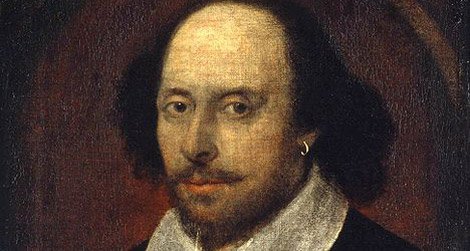
William Shakespeare

William Shakespeare is a well known name to most people, with his plays being the most famous and most commonly preformed in the world. It is not known when he was born, but we do know he was baptized on April 26th 1564, so many people attribute his birthday to the 23rd since that’s the day he died in 1616.

He was born in Stratford-upon-Avon, a small english town, and was most probably raised in Stratford, but we really don’t have much information about his early life, since he was simply a common peasant. He was married, however, at the age of 18, to his wife Anne Hathaway, who then gave birth to William’s eldest daughter six months later, implying they got married upon finding out she was pregnant. He then had a pair of twins two years later in 1585. we then continue to know nothing about his life until 1592, though some believe he was a school teacher for those years.

In 1592 however, his plays began appearing in various theaters until 1594, when he got picked up by the “Lord Chamberlain’s Men” an acting company that had an impressive theater called “The Globe Theater” because it was (surprise!) a theater shaped like a globe so that everyone could hear the actors equally well. It was based in London, so after his plays started to become obviously well liked they made him a partner, and gave him resources to write more plays. In 1596 his only son, one of the twins, died of unknown causes. In 1603 Queen Elizabeth 1st died, giving way to King James 1st who sponsored “The Lord Chamberlain’s Men” who then changed their very long name to the much more sensible “King’s Men”

Shakespeare split his time between Stratford and London, owning the second largest house in Stratford. He is probably most well known for his play “Romeo and Juliet” but he had many famous plays, such as Tempest, Macbeth, A Midsummer’s Night’s Dream, Henry VIII, Julius Caesar, and many others, but there are a recorded 39 plays that he wrote, commonly divided into Comedies, Histories, and Romances, none of which are entirely disliked, which shows how popular he was and still is.

There are some people who believe that Shakespeare was simply the publisher of the plays, since they believe someone so ill taught out of the common people couldn’t write such successful plays, and the major name that they put forward is Francis Bacon, an English chancellor and scientist. They believe that publishing them himself would’ve hurt his chances at election for chancellor, since they were seen as primarily frivolous, so he gave credit to William.

Either way, the plays that Shakespeare says he wrote are extremely popular, and have actually managed to alter English as we speak it today.