The Mystery genre is rather unique in its age, because most genres have been around since ancient times, with Sci-Fi being believed to have started in the 2nd century, and if you count mythology as part of fantasy then it’s been around since practically the beginning of stories, before even written stories were a thing and they were passed down orally. Horror has been around for as long as ghost stories by the fire, and comedy for as long as people have wanted to laugh. Mystery, also called crime, fiction is by comparison a newborn since it was only started in the 1800s. the reason for this is believed to be the fact that people didn’t live in huge cities until the 19th century, and so at most a town would have a constable or sheriff who knew everyone well, since the town was so small everyone knew everyone, meaning if there ever was a crime it would be solved extremely quickly, or not at all. it wasn’t until huge numbers of people started living all together that large police forces started forming, and then detectives and private detectives came to solve crimes that those police forces couldn’t. Arthur Conan Doyle is perhaps the most famous mystery author because he wrote the Sherlock Holmes books, and it’s argued that Sherlock is what gave Mystery fiction it’s popularity, and that the genre is still running off his success. The second most important Mystery author is considered to be Edward Stratemeyer, who wrote Nancy Drew and The Hardy Boys, and thus introduced Mystery to children and younger audiences. Personally, Crime is not my favorite genre, but I do enjoy them whenever I read them.
Blog Feed
The Hanseatic League
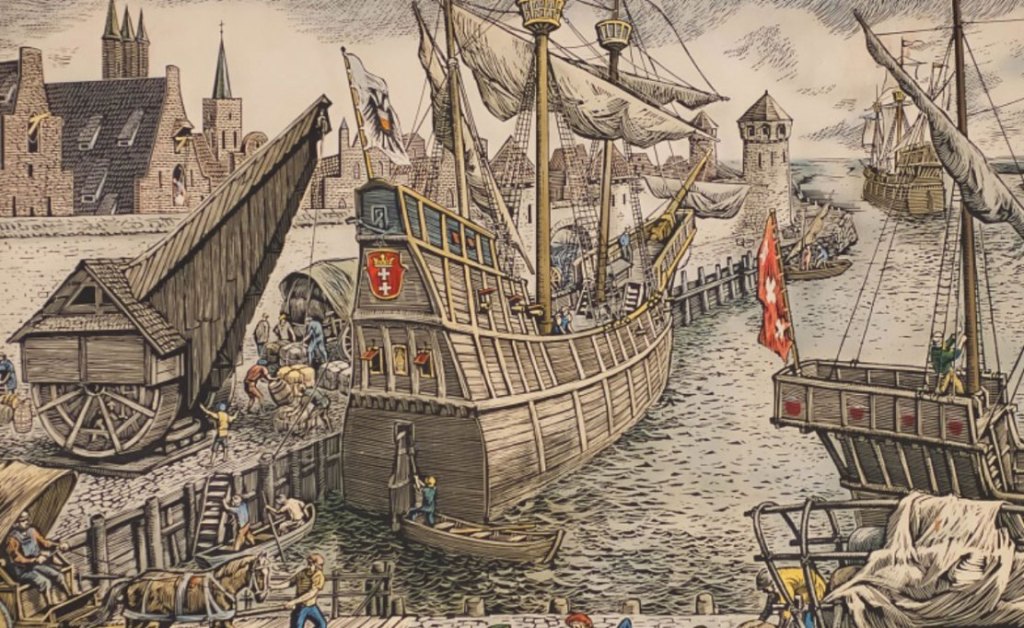
In the Middle Ages, also known as Medieval times, Merchants had to transport their goods by use of cargo ships (like the picture) when traveling over water, and caravans when going over land. Caravans often traveled in groups, called caravan trains, so that they could share in each others protection. The caravans would hire mercenaries or guards to escort them to where they were going, so as to guard them from bandits of brigands, who would capture and rob merchants without protection. This was obviously a big source of loss for the merchants, since the guards required considerable payment, so the traders were quite happy when the Hanseatic League popped up. It first started when Henry the Lion rebuilt a new Lubek over the fallen, original, 10th century town, and because of it’s location it became natural for traders to pass through it. Anyone going south to north, or north to south, would have been hard pressed not to go to Lubek, and while not as perfectly situated for east to west or west to east, many people would go there because there was so much trade already happening there. Eventually, the natives of Lubek, not the travelers, realized they could put taxes on anyone going through. They then decided to make deals with the merchants, where they would hire guards and protection in exchange for deals or percentages. This idea spread to other towns, and they realized they could pool their resources to get even better deals, forming a kind of merchant guild called the Hanseatic League in 1358. After this they realized that since they were in the north of Germany and so controlled trade that went through them to or from Scandinavia. They decided to take a monopoly over the salt fish trade, which was previously controlled by Scandinavia. Denmark, exactly north of them, was part of Scandinavia and didn’t like them taking their profits, so they went to war with the guild. The league was able to summon a powerful army, however, and defeated Denmark. After this the rest of Scandinavia made peaceful trade deals so as to avoid war. This time was the peak of the Hanseatic League, but it started to fall apart in the 1550s due to the cities focusing on themselves and not sending soldiers to protect the merchants, and due to this the merchants started leaving the league and cutting ties. It was then destroyed when the Swedish empire started progressing south at the same time Denmark broke free. But the Hanseatic League showed that an economic power could grow to be more powerful than a countries state, and was the most successful guild in Europe’s history at least.
Genres
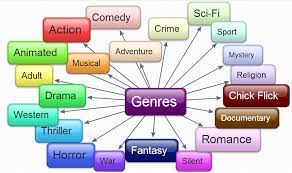
Genres are categories in which people divide literature into, “literature” meaning forms of entertainment such as books, movies, and music, though there are others. A genre is typically how the book is written, and is pretty vague. Examples of genres include Fantasy, Science-Fiction, Realistic Fiction, Horror, and Comedy, though there are hundreds of others, and some are specific to certain literature groups, like Rock belongs to music, and you can’t exactly find a Rock book that doesn’t talk about geology. Whereas Action belongs to books and movies while there are no action songs, though there are “Hardcore” or just plain loud equivalents. Fantasy has a definition of “the faculty or activity of imagining things, especially things that are impossible or improbable” which I think is rather stupid because that means that Sci-Fi (which is traditionally the genre advanced technology goes under) would be included in Fantasy, even though they’re traditionally opposites, since fantasy typically covers magic, dragons, and is often placed in medieval-like times. Examples of Fantasy include Harry Potter, Lord of the Rings, Percy Jackson, Ranger’s Apprentice, and my favorite book series, Skulduggery Pleasant. In case you didn’t notice, I like Fantasy. My other favorite genre is Comedy, which is also in Skulduggery Pleasant, Rangers Apprentice, a bit in Percy Jackson, is a more general genre, in that it can pair with most genres, though it can’t with Horror. Realistic Fiction is pretty large because everything from Robinson Crusoe to Michael Crichton books. Michael Crichton’s books are rather famous for their use of Sci-Fi and/or Realistic Fiction. There are a great many genres, and I didn’t talk about a fraction of them, though they were extremely common ones, so sorry if I didn’t cover your favorite genre.
The Story of William Tell

William Tell is an inspirational folk tale about a man in Switzerland who fought against the Holy Roman Empire, winning freedom for his country. If you know about Robin Hood, this is a bit like the German-Swiss version of that, though slightly different versions have been found in Scandinavia as well. It starts in 1307, after the H.R.E. had already taken over Switzerland. There was a town in which the governor, a man called Gessler, decided to test his subjects loyalty to him. He took off his hat and hung it on a pole, and anyone who passed the pole had to bow to the hat, simply to prove that not only were they loyal to Gessler, but also willing to bow to the concept of the ultimate ruler. William Tell and his son were in the town, probably selling furs and other hunting goods since he was a skilled hunter and marksmen with a crossbow. When he came to the hat he refused to bow to to it, and the guards, unsure of what to do, called Gessler. When he got there William refused to bow to him as well as the hat. Gessler ordered them arrested, but hearing that he was famous in the town for being a perfect marksman, he ordered a cruel punishment. William was to shoot an apple of the head of his son. If he hit the apple he would go free with his son, if he missed totally they would imprison both of them, if he killed his son they would imprison him, if he injured his son he would be imprisoned but his son would go free, and if he refused to shoot they would kill them both. Seeing no better option, he prepared to shoot. Miraculously, he made it perfectly, shooting the apple straight through the middle. Some versions of the story say that the post behind the son was the post with Gesslers hat, and that the shot knocked it off the post. Unfortunately for Tell Gessler noticed a second arrow in Will’s quiver, and asked what it was for. William told him that, should he have failed the shot, the second shot would not have missed Gessler. Furious, the governor arrested Tell again, and sent him in a boat to a prison under Gesslers manor on the other side of Lake Lucerne, where Gessler would go by land. However, the ship was struck by terrible storm, and the sailors expected the ship to crash or flounder, until Will claimed to have hunted in this area and could get the ship too safety. They freed him from his shackles and gave him control of the ship, and he managed to get them through the storm, and was able to escape into the woods. On the road he met Gessler, who was going to his manor. He then shot Gessler, killing him with the same arrow that he had meant to use at the archery contest. His story then becomes blurrier, but he was supposed to have led the Swiss revolution until his death in 1354. The Swiss rebellion did end up getting their freedom and independence in 1399, 45 years later. This legend is quite famous for it’s apple-shot, but it is unknown if it actually originated here, since it has been found in Denmark and other Scandinavian locations. Regardless, William Tell stands with Robin Hood and William Walace in legends of Freedom.
Tools for a Deserted Island
If I could bring any two tools to help me live on a deserted island I would probably bring a machete and a huge chunk of flint. I would want the flint for fire, obviously, since it would bring both light and warmth. The machete would allow me to cut and skin any animals I found, and I could use it to cut small amounts of wood, along with vines to make nets for fishing and even blankets. Best case scenario, I could even carve out a bow and use a vine as the string. I decided against bringing fruit and vegetables to plant because I’m assuming there are coconuts and other recognizable plant foods already there. I also went against a hatchet because a machete would be much more useful in the skinning and disemboweling of animals, while a hatchet would be cumbersome. While cutting wood would be annoying with a machete, I think that it’s more than counterbalanced by the other benefits. I went against a bow because I could make one, and if I couldn’t I’m confident I could trap animals. I went against a gun because of the limited nature of bullets and gunpowder, and matches and a lighter fell into the same problem. I went against a fishing pole because I could make nets out of the vines, and nets would be more efficient than a pole. I’m forgoing animals like chickens, because I think I could tame any animals on the island, but if I wasn’t sure of that chickens would probably replace flint. That’s what I would bring, and my reasoning for it, but if you think something else would work well, go ahead and say so!
Genghis Khan
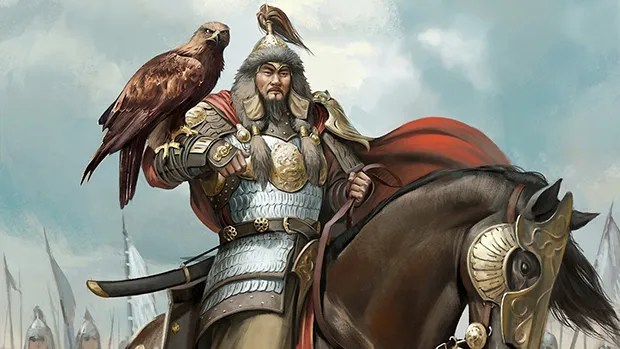
Genghis Khan was the founder of the Mongol Empire, which is agreed upon as the largest (in amount of land) Empire in the world, and is possibly the most well known conquerer in the world. He started out with the name Temujin, and as the son of a successful general in the Borjigin tribe, but at the age of nine his father was killed by the Tatars, enemies of the Borjigin. After this the tribe leaves his family and journey elsewhere, abandoning his family. Now as outcasts they lived in the mountains, hunting and trapping and animals they could, and foraging for berries. During this time Temujin’s half-brother Behter tried to assert dominance as the eldest born, but Temujin and his full brother Qasar kill him with their bows. After this Temujin offered himself as an adopted son to his fathers former ally, Ong Khan. He also became a blood-brother to a prince of another tribe, Jamukha. After this, Temujin’s first wife, Borte, was kidnapped by another tribe. Calling on both Ong Khan and Jemukha, who was now the Khan of his own tribe, they decimated the enemy and rescued Borte. Unfortunately he and Jamukha became bitter rivals, because of a fundamental rift in their mindset. Jamukha, being from a long line of Khans and noblemen, believed in the aristocracy that was predominant in early Mongolia, while Temujin had scraped himself from the ground to be successful, so he believed in having people earn their stations in life, not be born into them. Eventually this came to a head in the battle of Dalan Balzhut, and though he won, Jamukha alienated many allies by boiling the commanding officers alive. Returning to Ong Khan Temujin consolidated his power and moved east, conquering other tribes. In this the early Khan differed from other tribes in many ways. He would post officers to there positions based on loyalty and ability, instead of their family. When preforming the raid, the standard was for the individual warriors to take what prizes they could and scram, killing any in their way. Temujin instead insisted that no one could take prizes until after all the warriors that resisted were killed. After this they were to find all valuables in the village and place them in an inventory, where the goods would be distributed evenly, with higher officers taking higher prizes, and you became a higher officer by being more loyal and better at the fighting. After this other tribes would simply leave, allowing the other tribe to heal and get ready for round two. The entrepreneur Temujin, of course, changed this. He instead took the aristocracy and leaders and executed them soas to prevent revenge, in stark contrast to the west’s system of ransoming the leaders. After this mass execution Temujin would take the survivors, mostly the young and the women, and add them to his tribe, instead of turning them loose to gather help in revenge. In case you didn’t notice, Mongolia was big on revenge. After several conquests Temujin asked Ong Khan to have his daughter marry the others son, thus solidifying their friendship. However, Senggum, the eldest son of Ong Khan, didn’t like Temujins friendship with his father, and advised him to say no. Strangely, Ong Khan listened and refused Temujin’s request. This was a major breach in protocol and Ong Khan actually defected to Jamukha’s side. However, Ong Khans men liked the young leader and rebelled, killing Ong Khan and defeating Jamukha. After this Temujin was named Genghis Khan, Universal Leader. And indeed, he had little to no difficulty in conquering the rest of the nomad tribes, who were still unused to his strange tactics. After that he went on to the lands surrounding him, and found to his surprise castles and permanent towns. His nomadic men were actually well equipped to sieges, however, since each man hunted for his own and provided his own equipment, so that a single leader didn’t have to coordinate a whole army for a long length of time. They also experimented with diverting rivers to drown the town, but this usually backfired and drowned their camp. Using these strategies the successful Khan quickly captured huge swathes of land, until he died of unknown causes and left his son to rule and grow the empire.
A Robin Hood Story
This is my own Robin Hood story, and if you don’t know Robin Hood well, this won’t make much sense to you.
“Will!” Robin Hood called out. Both Will Stutely and Will Scarlet raised their heads from fletching arrows and taking a nap respectively.
“Just Stutely” Robin corrected after a chuckle. While Scarlet went back to his nap, Stutley went over to Robin. “Yeah Robin?” he asked when he got there.
“It occurred to me that we haven’t been keeping up on the roads to Locksley, particularly the western one. so I think I could take the east road and you could take the western one.” Hood intoned, while examining the fletching on an arrow. “We don’t keep up on it because it’s little more (or less) than a large game trail, not a ‘road'” Will reasoned.
“And that’s exactly why someone like the Sheriff would use it.” Robin argued.
“The Bishop wouldn’t, he’s too fancy for that.” Robin raised an eyebrow. “Which is why I didn’t say ‘someone like the Bishop.'” Will sighed, and capitulated.
“Sure, I’ll take some of the men and check up on that road. Much! Midge! Arthur! David! Get over here!” Will called. The men all came over, Midge putting aside his bowl of soup. Will saw Friar Tuck head over there, but didn’t say anything.
“We’re heading out towards the west road of Locksley.” He announced. Almost instantly there were groans. “Nobody uses the west road!” David exclaimed. “Yeah, but everyone knows that we know that no one uses the west road, which is why they would use the west road.” Will explained. “So, because people don’t use the west road, people will use the west road?” Much asked. “Exactly.”
When they got to the road they walked along it for a ways before climbing some trees and preparing their bows. “So, do you really think that anyone will show?” It was David. Will sighed.”No, not really. But there’s a chance.” just then they heard a cart clattering through the wood. “Shh!” Will hissed at David. That was when the cart came into view. It had smooth wood, and was obviously not something a farmer would own. Beside that, the horse driving it was large and healthy, as opposed to a farmers mule. “Well I’ll be, Robin was right.” David whispered. Grinning, Will shushed him and drew and fired his bow. it struck the backrest of the cart, right next to the man horribly disguised as a farmer, seeing as the hat, boots, shirt and overalls were new. The man cursed, then pulled the reins to halt the horse. Will jumped down and turned to the “farmer”.
“Hello there friend! Where might you be headed?” “To Locksley. and why are you stopping me?” he responded. “Only to ask a little toll of you. You see, I’m with a little band of outlaws who take much from the rich and little from the poor.” “Well that’s perfect! you don’t have to take anything from me, seeing as I’m down on my luck.” at a signal, Midge sent an arrow into the other side of the backrest. “Fine! Fine! I work for the Sheriff of Nottingham! I’ve been collecting the taxes by traveling unused roads!” with that, the tax collector slumped in his seat. Will called down Much to check the back of the cart. “This clever fellow put bags of hay over it! but there is a sizable sum here.” Will bowed to the collector. “then I shan’t hold you any longer fair sir, since this is a more than adequate toll.” He went over and helped Much carry out the chest. “oh, and I’ll take the horse.” “but-but then I can’t drive the cart.” “Shame” was his only response.
When they got back to the Greenwood tree Robin Hood was already there. “Any luck?” Will asked him. “No, and it’s the strangest thing. The only people on the path were honest workers. How about you?” “Only a little traffic.” Will reported.
The Magna Carta
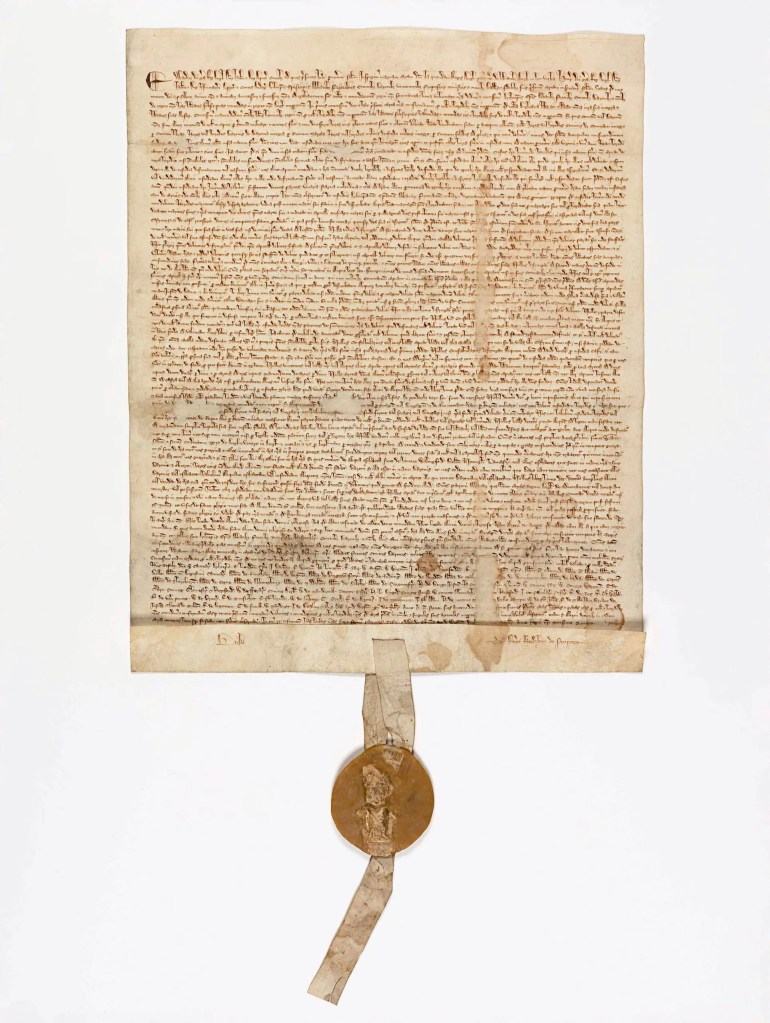
The Magna Carta was a document written in 1215 AD, and is often considered one of the most important documents in the world. In 1199 King John I of England became the king of England, after his brother Richard died. He has been nicknamed John “Lackland” because he was the youngest of eight siblings, and was thus never expected to gain any land, but since all his siblings had claimed other land, and Richard died by a crossbow bolt John got his chance to be king. He is always remembered as a horrible king, and oftentimes serves as an antagonist for Robin Hood. While John would go on to be a bad king, the population would dislike him right of the bat simply because he was replacing Richard, since Richard Lionheart was well loved by his people, this eventuality wouldn’t play out. The reason for this was that while Richard was fighting in the Third Crusade John was left as regent, or temporary ruler. While regent John attempted to buy the barons favor and depose Richard while he was in the holy land. This failed, and left John more hated than ever. This meant that the population of England disliked and verged on hating their new ruler when he had barely had the crown. It would have taken a miracle to get the population to like him again, but John wasn’t interested in miracles. The first of his acts as king was to demand the right to appoint the next Archbishop of Canterbury in 1205, an important position in the church. The Pope responded by saying that only the Pope could appoint church officials, and when John pressed the matter the Pope excommunicated him. This meant that John was officially excluded from the church, and though he tried to fight it, he eventually capitulated in 1213. In 1215 he tried raising taxes among the whole of England, and this was the final straw for the barons. The barons of the different parts of England all came together because the king was supposed to get support from the majority, if not all, of the barons before raising taxes, but John had ignored their place in the feudal system entirely on this matter. The barons drafted their armies together (which wasn’t too hard) and laid siege to London. When they got inside (which didn’t take long, seeing as John was a poor strategist) they demanded John sign the Magna Carta, or “Great Charter” which said, among other things, that the king couldn’t tax people without approval of a council, that no matter the position all criminals would be tried by a jury (so John couldn’t throw anyone in jail, and could be thrown in jail), that the king could not interfere in the church, and that the king was to abide by his own laws (he was no longer above the law). The Magna Carta was completely ignored during Johns life and he went on to die during a war with his barons in 1216. Despite this the Magna Carta was the first time people had officially said that the king was not all-powerful. The Magna Carta would go on to be revised and actually, y’know, enforced, later on, but this charter was the first time any idea of independence was introduced to the people, and it would go on to influence many important law systems, including the American Declaration of Independence.
Novels, Novellas, and Short Stories
Novels, novellas, short stories are all known as forms of literature. This means that stories and writings can come in these forms, though not only these forms, for there are many other forms of literature but overall these are the major ones you’re likely to find in a bookstore or library. Novels are probably the most well known, and they’re oftentimes the longest of these forms, but the forms are not decided by length, only the number of plot points. Novels have many plot points, which is to mean they have a complex story line, while short stories normally have an extremely simple story line with only one or two plot points, and this rarely leaves any room for character development or even background development, so they are normally not stand offs and are instead something that happens in an already successful series of novels. Not only that, but are normally sold in collections of short stories. These are both true for “The Last Wish” in the Witcher book series, or “Armageddon Outta Here” for the Skulduggery Pleasant series. Novellas are ill defined, and are normally considered simply as longer than a short story but less complex than a novel. There are many books like this, and quite often the first book in a series will be a novella, but they are often mistaken for novels, such as “Call of the Wild”. Personally, I favor novels, but I do enjoy short stories, with novellas mostly being too simple to interest me.
The First Crusade
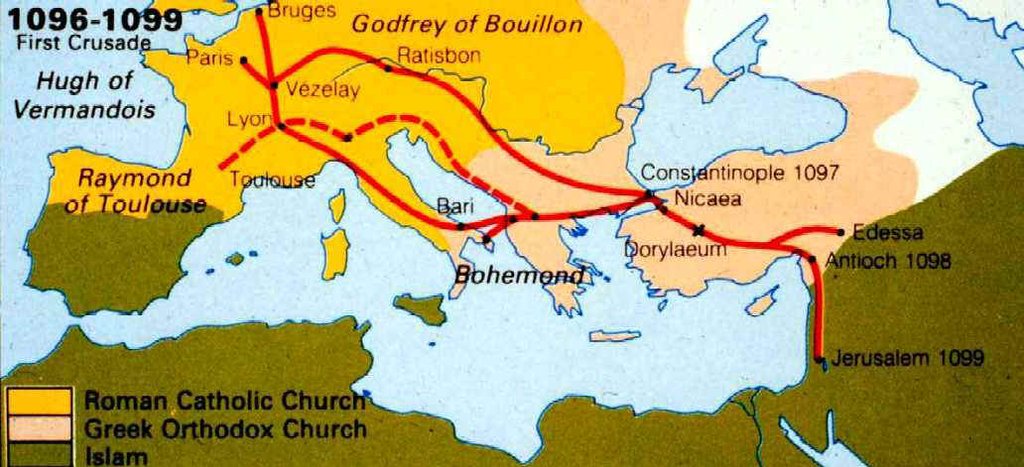
In 1095 Pope Urban II gave a speech at the Council of Clermont, and this speech talked about all atrocities being committed by the heretic Muslims, about how they tortured and murdered any Christians that went to the holy land, and how these Muslims were constantly expanding their borders and threatening all of Christendom, and this speech was so rousing that it moved huge numbers of Europeans to march out to the holy land and take it back. The speech was so rousing it ended in a long chant of “Deus lo Vult!” or “God wills it!” Most of what was in the speech was false, The Muslims had conquered the Holy Lands, but they weren’t stopping the Christians from making pilgrimages there, and certainly weren’t torturing them, after all, they shared many principals with the Christens. The reason most historians have come up with for this speech was that the Byzantine Emperor Alexios Komnenos was feeling threatened by the Muslim armies, and rightly so because after they conquered the Holy Lands the next obvious target was the Byzantine Empire, so it’s suspected that he bribed Urban to raise an army to fight the Muslims for him. Urban’s idea of stirring the population into sending knights did work, but what he didn’t expect was the peasants getting riled up, and under Peter the Hermit, a preacher, over 40,000 peasants started out to Jerusalem, though not before mishaps. Peter’s group consisted wholly upon impoverished knights and poor peasants, all willing to go out a kill people in the middle east, so maybe it isn’t surprising that they decided to pillage and plunder many christian towns on their way. Peter didn’t approve of this, but he didn’t really control them either, so this continued all the way to Constantinople. Alexios, confronted with an army of 40,000 peasants, didn’t know what to do, since he didn’t expect an army until 1196, a year later, decided to let them into the Middle East, and once there the Germans and Italians had an argument and split from the French and English. Peter had lost all control at this point and went to Constantinople to wait for the real crusaders. The two splits, Germans and French, both pillaged and plundered different towns, controlled both by the Muslims, and by their allies. Eventually the Muslim army went to deal with this army in the north, and when they got there they easily slaughtered everybody in the Peoples Crusade. This left only Peter and his 3,000 alive in Constantinople. Five armies left Europe and traveled different paths until uniting at Constantinople, where Alexios got oaths from them all to restore to him all previous Byzantine lands. After that they went out and conquered the City of Nicaea after an attack by the Muslims. After Nicaea they captured Antioch after an eight month siege. After defending against the Sultans army they went down to Jerusalem and after a month long siege the commander of the city let them in in exchange for passage to another city. This was the First Crusade, and the only entirely successful Crusade, since the Third resulted in a treaty and the Sixth was only temporary. All the others were failures, leaving 1 crusade successful, 2 crusades partly successful, and 5 total failures.
 School Essays