This picture is of a ruler we stuck in the snow to measure it, but this isn’t the highest it got.
In 2019, I was living in Springfield Oregon when there was a Snowpocalypse, with higher snow levels since 1917. And it wasn’t just by a small amount either, the 1917 record was 4 inches, while 2019 got a full 12.5 inches, more than a foot! Now, most people in places that are really anywhere farther north than that, like Montana and New Hampshire, probably aren’t impressed with that, but for Springfeild Oregon which didn’t even get snow some years, this was an insane amount of snow. Most people didn’t go out of their homes, and several businesses offered a $250 bonus just to drive to work and not go on leave. School was obviously cancelled, and me and my family stayed home and drank a lot of hot chocolate while playing in the snow.
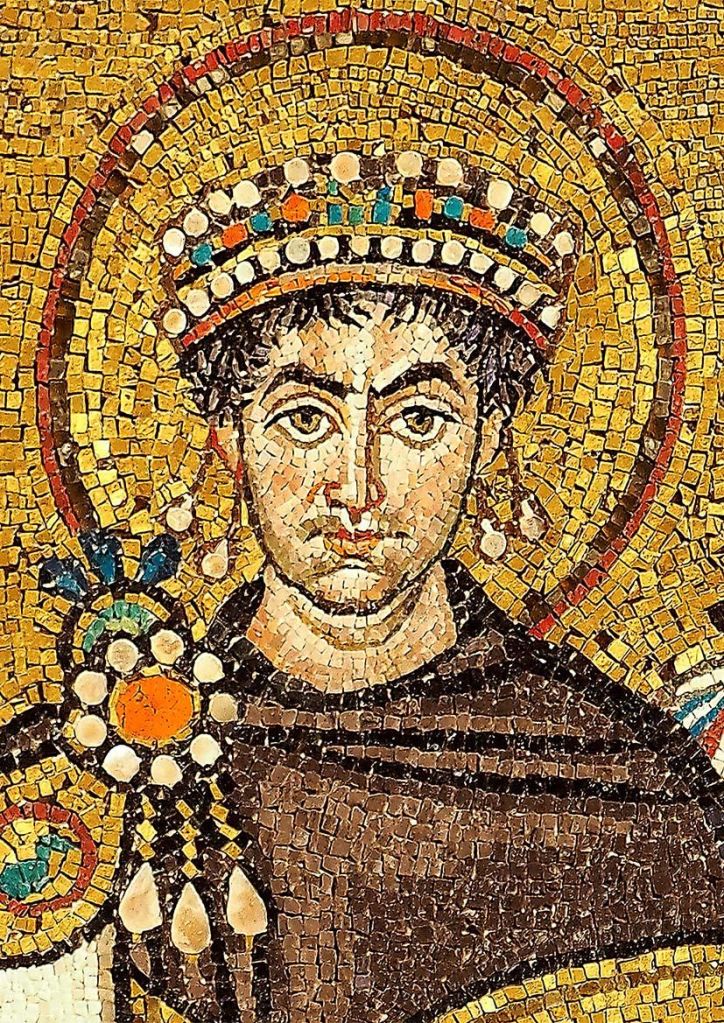
Rome was the centre of civilization for close to 500 years, but at the end of that time, 476 AD, a German general named Odoacer came and captured the city of Rome, which ended the western Roman Empire, but the eastern Roman Empire, also known as the Byzantine Empire continued for another thousand years. Despite this it is often overlooked in western culture, though the people in those areas are still greatly effected by this empire. After Odoacer cut off the west from them there were four emperors that didn’t do much that warrants research, but then came Justinian 1st, also known as Justinian the Great. This Justinian was, according to the history books that were written during his time, which was odd, originally a farm boy who happened to be the nephew of a soldier in the palace guard in the capitol, Constantinople (modern day Istanbul). The uncle, Justin 1st, was very good at his job and quickly rose up to be the commander of the palace guard. It was soon after this that Justinian went to see his uncle and to ask for an education, which he couldn’t get without being related to an official. His uncle didn’t have children and decided to take his nephew as his heir, so he gave Justinian the best education in Byzantium. Anastanias, who was the current emperor, fell ill and died in 518, leaving the throne to Justin. Justin lasted for nine years before his death in 527 AD but these nine years was enough for Justinian to reach high places of authority, which was simple for him, being charismatic and popular along with being close to his popular uncle, the emperor. All this made him an even better prospect for the throne, and in 527 he got it. Justinian immediately went to work on the neighbouring kingdom of Persia, whom the empire had been having land issues with for awhile, and at least three different wars had been fought over this border. Justinian, after winning several victories, made a treaty with the Persian emperor, which divvied out the towns and borders, and made Persia allow Christianity for the first time, as long as Byzantium paid an annual tax. With that problem settled he was able to send his best general, Belisarius, to deal with the troublesome Vandals that ruled North Africa. After they were defeated Justinian quickly conquered the rest of the Mediterranean. He gained all of North Africa, southern Spain, Greece, and Italy. He never claimed France, Germany, or Britain, which we can presume was annoying to him. He also improved the legal system, which had, until this time, been a mouldy old book that contained every law since the republic days of Rome, despite the fact that many laws would conflict and even be outright opposites of each other, while other laws where not even practical or practicable. So he hired 10 lawyers to sort through all of it and make actually usable and comprehensive. They did this and it became known as the Justinian Code. In addition to all this he spent a huge amount of money making monuments and public works like the Hagia Sophia. Unfortunately for the empire all this money being spent meant future generations wouldn’t be able to fund the military, and this showed when the very next emperor, Justin 2nd, lost most of these lands to the natives. It continued like this for a long time, until the Empire became a simple country. I think it’s great what Justinian tried to accomplish by taking back the west, and what he did with remaking the law code, but he didn’t have the foresight to save his money.
A Connecticut Yankee in King Arthur’s Court uses the setting of the story to great effect, and it is the major factor that the story uses. The main character, Hank, is a Yankee from Connecticut in the 1800s, where he was the head superintendent of a gun manufacturing plant. He then got in a fight with one of his men and got knocked out. When he came to he was in Britain in the year 528. This is the time that King Arthur was alive, and so Hank got captured by a knight who brought him back to Camelot. They then sentenced him to death by hanging on the 21st of June for no reason other than the fact the knight told them Hank had attacked him. The main character then escapes this hanging by predicting an eclipse, but making them believe that he had summoned it. This makes the court believe he is a sorcerer, which radically changes his milieu, or social setting. A major aspect of the book is about how he uses science and simple things in modern day times, but are radically strange and “magical” in Arthur’s time. These “spells” are most often used to improve and cement his social standing in Arthur’s court, so that he can preform his end goal of getting rid of the monarchy and installing a republic. His milieu, however, is complicated by the fact that all the people in medieval Britain believe in casts, which is the idea that how far you can go in life is determined by a persons parentage, so that any commoner will always be below the nobility. This made Hank an oddity because he was a commoner (in his own time, which would have carried over) but he had preformed impressive magical feats, earning him respect. Overall it is this tenuous social setting which drives the story, although the physical setting was also rather important. The main character goes out several journeys through the kingdom, the first taking him to Morgan Le Fay, whom he is able to control to a degree by using his reputation alone. Another journey takes him to a holy temple, which has a holy well that had sprung a leak, he fixed it easily but used all sorts of special effects to make it look like magic. His most exiting journey, however, was when he journeyed with the king under the guise of peasants. Him and the king explore and meet many commoners who are friendly with them until the main character gets too pushy about their wages and they get sold as slaves to a slave master. They have this adventure, and afterwards Arthur abolishes slavery. It’s not till the end of the book that the world Hank had built up in this time comes crumbling down as the Church, the all-powerful church, descends on him and puts an interdict on him. All the knights in the country come to fight him and he kills them all using mines and electric wire. In this book the most important part of the story comes from the setting, whether it be the location, the time, or the social standing. It is a wonderful book, even if it does drag on at times.
There was a boy walking through the forest when he found a rock. He touched the rock and he passed out. When he came to he went home, but his home was not there. Instead he found a wooden house which was exceptionally long and was only one story tall. there were people in this house, and they came out to look at him and ask why he was staring at their home. He saw that they were wearing leathers and furs, but didn’t comment. Instead he told them that it was his home, “Though I don’t know what you did to it.” The leader of them, an older man, told him to “Get out of here, we don’t want a crazy person like you cluttering our yard!” The rather stupid boy then attempted to force his way into what he believed to be his home, but stopped short when the man puled out an axe. He backed up quickly and left, deciding to figure out what had happened to his home. He found another, friendlier-looking, person who he struck up a conversation with. “So, what happened here?” he asked. “Well now, what do you mean? Nothing out of the ordinary has happened here, except you of course.” “What do you mean? I’m the only normal person here! You’re shepherding goats!” The man looked at him oddly after this, and he pointed out the fact that most of the other people here were also shepherding goats, and that nobody else was wearing such eccentric clothing as the boy. “Well of course!” the boy shouted “It’s all of you who’re dressed like we’re in medieval times!” This was when it occurred to him that he might be in medieval times. “What year is it?” The man looked at him oddly, but at this point the boy was well used to it and didn’t think of it. “It’s 816” the boy looked down at the ground and then back at the man. Oh boy, he thought. Well, do you know anyone who would take me in? The man then asked “Don’t you have a family?” “Not any more, or at least, not yet.” the man sighed, concluding that the boy was a crazy runaway. “I suppose I could house you for a night he said. “Thank you” the boy said. “Look after my goats, I’ll be back soonish.” “Wait! Where are you going?” “To have a drink.” “But why?” The man looked at him as if he was stupid. “Because I have someone to watch my goats.” He walked away. The boy then walked over to another goatherd and asked where they were. “In the field.” “No, I mean what country are we in?” The goatherd paused and asked if the boy was sane. “Of course I am! Now tell me where we are!” “Norway.” He said, and walked away. Later in the day, with evening coming on, the original goatherd came over and led the boy and goats to his home. The boy entered, and was immediately confused. He turned around and asked the man where he should sleep, since there was only one room. The goatherd sighed and pointed to the bed in the corner. “And where will you sleep?” the goatherd was now heartily sick of this boy and simply drove his goats into the one room house. “What are you doing!?” “Don’t you want to be warm tonight?” was his only answer. Thinking back to earlier that day he then asked “Where are all the Vikings?” “The Vikings? You mean the warriors that go down south?” “Yes” “Well, there aren’t A lot of them are there? I mean, a few people left with Bjiorn and his ship a year ago, including my uncle, but people have got lives here and don’t want to go sailing around.” “Oh.” He went to sleep and in the morning he woke up to find a bowl of soup waiting for him. When he asked what was in it, the shepherd told him that there was some deer, along with beans and onion. The boy then asked how many different foods he ate, since he had always thought that medieval people had a very limited diet. The goatherd told him that he normally had a soup but sometimes had a burger or a steak. And when it was soup it was never the same soup since there was so many things he could put in it. “Now get out of here! I’m sick of you’re questions.” the boy left and went to the forest, where he found the same rock that had brought him there. He grabbed it eagerly and went back to his own time.
When people think of the Vikings they normally think of the seafaring warriors that raided the coasts of Europe, which makes sense since they where the people in Europe met with, but the Vikings were a surprisingly small percentage of the Scandinavian population, with the majority of them being farmers, fishermen, and peaceful traders. Life in ancient Scandinavia was surprisingly good and was extremely family focused. All close family (husbands, wives, brothers, and sisters) would all live in the same home with the extended family (uncles, aunts, and grandparents) in the neighbouring homes next to you. This is different from common day living because today families often live in completely different sections of a town or city, and sometimes even several states or countries apart. Another strange thing about the homes of these people is that they were almost entirely one-room affairs. There would often be 2-3 beds in the building with a partially walled off section in the back that would have a cooking pit and a chimney. This would function as the kitchen, and be where the meals are cooked. This is radically different from the modern day houses where there is normally at least one if not two living rooms, a kitchen, two to four personal rooms for each member of the family, and often times a large garage. The last but possibly most disturbing thing about these homes is the fact that they normally slept with their animals. And I don’t just mean dogs and cats, though they were probably in there too, I mean farm animals such as goats, cows, and chickens. This probably meant that it was hard to sleep in old Scandinavia but maybe the Vikings were deep sleepers. Among these animals the Vikings had an extremely diverse diet which included cow, goat, chicken and eggs, sheep, lamb, elk, reindeer, horse, pork, fish, and even bear on a rare day. In addition to this meat they also had carrots, beans, cabbage, apple, and onion. So while they didn’t have nearly the diversity we have today they had the foremost diet in ancient times. And despite what many people believe about these “pagans” women where allowed to divorce their husbands and reach high positions in the culture. Overall I believe the ancient Scandinavians had a wonderful culture that was extremely happy and easygoing. I believe that I would greatly enjoy living in ancient Scandinavia with a few changes, namely sleeping with the goats.
In early Christianity there were many splits and fissures in the overall religion, with many people introducing new ideas and different understandings of the teachings of Jesus Christ, and it continued like this until the council of Nicaea. The most notable and important of these splits is the “heresy” of Arianism. Arianism was started by a man named Arius, an important theologian of his time, and it stated that Jesus Christ could not be fully god if he was also fully man, which is obviously common sense since it is mathematically impossible for something to be 100% one thing and 100% another. Arius then pointed out that if you said Jesus was equal parts God and man, then he would be half of each, or 50% God and 50% man. Arius then makes a U-turn on how much sense he was making (from my point of view) and says that Jesus therefore could not be any percent God as long as he was any percent man, because that would taint and disfigure the divinity of God, meaning Jesus must be 100% man and 0% God. Many other Christians were extremely opposed to this view, most notable among them being Athanasius of Alexandria, who was also the off and on bishop of Alexandria. Athanasius is the most important of Arius’ enemies, and he makes it his life mission to get rid of Arianism. Before he does this, however, the Emperor of Rome Constantine decided to put it to a vote among all the Christian leaders of the day on whether or not to include Arianism in the Bible and in the orthodoxy. On Athanasius’ side a whopping 300 people voted against it and a measly 3 people voted for it to be included. So Arianism was branded as heresy and not included in the Bible which says Jesus is 100% man and God, math and common sense be damned. During this Arius himself was banished from the Roman empire for the rest of his life. I think that Arianism made some very good points and was absolutely correct up until it says that being 50% man would “taint” God.
The Celtic people were the predominate culture in ancient Europe. And by “ancient Europe” I mean Pre-Roman Empire, because the Romans conquered a considerable amount of their homeland, meaning that they only lived in Ireland and Scotland after the Roman Empire. The Celts lived all over Europe, with predominant colonies being in Spain, Germany/Austria/Czech, Britain, and northwest Turkey. A unique thing about these people and their culture, however, is that they didn’t get to all these places through war and conquest like Roman culture and people, they simply spread out independently across the land with no centralized government. They only thought for what was best for the clan, with the only government type thing being the religion, which was kept by the priests, or druids as they called themselves.
Yet even this wasn’t a governmental or controlling thing like the Greek religion, it was simply a belief in higher powers that normally manifest as nature, so the main method of worship was giving gifts in the wild. For example: There’s a group of hunters going through the forest, and they can’t find any deer, so the Celts would pray to the nature around them (most of the time a god named Woden) to give them some deer to hunt. They believe that the they would then find a pack of deer, and if they did, cut off a leg or the head and leave it on a rock or tree stump as a thank you to the gods.
Strangely, we find little to no reference to the Druids in the eastern and southern areas such as Turkey and Spain. It’s in Turkey (a place without Druids) that the first Celtic people adopted Christianity, and they did this while Jesus was alive, which was strange. Those who didn’t go down to Turkey met a different people, the Aryans.
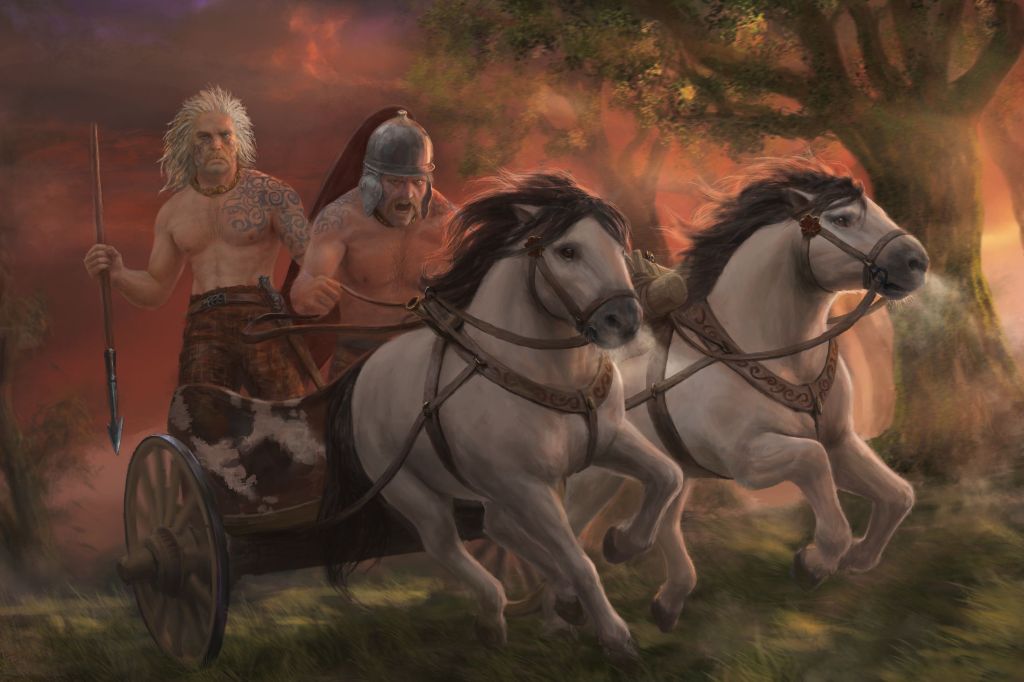
The Aryans were an overall nomadic people, meaning they didn’t live in any one place, ranging from India to Germany, but it is believed that they originated in southern Russia, because the oldest evidence of their culture is there, but the Celts knew them as coming from the Ukraine area. However, the Aryans brought several major qualities and distinctions to the Celts, such as iron working and chariot riding.
Iron working is probably the most famous part of Celtic culture, so much so that we can see how the Celtic word for iron “Isarnom” became the Proto-German word “Isarna” which turned into the English word “Iron”. The Romans, when they came up to Europe, were surprised by how the Celts used iron weapons even though they were “barbarians” according to the Romans. Another thing that surprised and inspired the early Romans was the chariots that these “barbarians” used, such as the one in the picture above. The Romans designed their chariots off these, and then the Romans spread the design across their empire.
Overall, I think the Celtic people were an amazing people, and were extremely advanced in their culture, philosophy, and fighting skills. I am proud to be one of their descendants.
There are five common parts of a plot that you can normally recognize when reading a book or story: the exposition, the rising action, the climax, the falling action, and the resolution. The exposition is how the story starts and how the main characters are normally introduced. In the first Skulduggery Pleasant book, written by Derek Landy, the exposition starts with the main character, Stephanie, attending her uncles funeral and inheriting his estate. The rising action normally takes up the majority of the book, sometimes even 80% of the book. It is strongly signaled in Skulduggery because a mercenary tries to kill Stephanie. This leads to the rest of the story, which uses much detective work. The climax eventually happens when the main bad guy, Nefarian Serpine, collects a magical weapon and uses it to invade the good guys main base. The falling action is where everything calms down and finds it’s place after the climax. This is usually short, only being one or two chapters, but the Skulduggery book didn’t even have one, it just jumped into the resolution, which is where everything ends, usually having an inspirational quote if it’s a single book, or revelation if it’s a series. In the first Skulduggery there was a revelation, which was that (spoiler alert!) the main character could do magic.
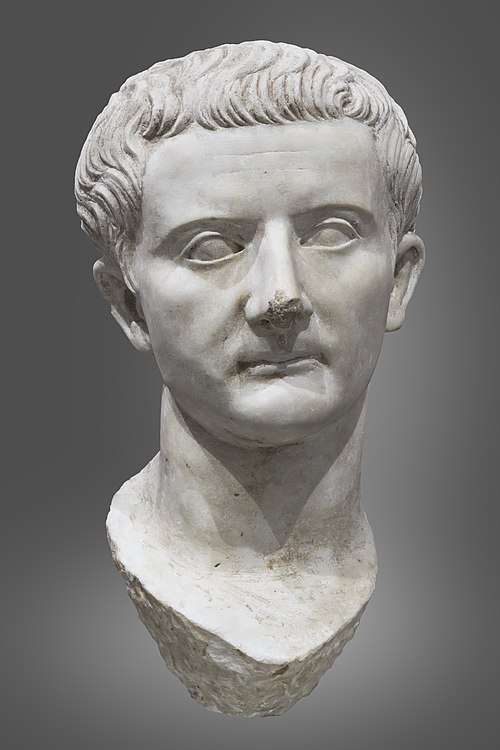
Tiberius Caesar Augustus is remembered as the gloomiest of emperors, but everything I’ve learned about him seems to point at his being the most conniving and conspiratorial of emperors. It starts with his adoptive father, Octavian Caesar Augustus, the first Roman Emperor. When Octavian fell ill in 23 B.C. there came up the problem of succession, since there was no precedent for how it would work, his being the first emperor. He decided to have his friend Marcus Vipsanius Agrippa, a military general, be the next emperor. Because of this he had his adoptive son Tiberius marry Marcus’ daughter Vipsania Agrippina, which Tiberius was happy to do. Marcus then when to Pannonia (a land northeast of Italy) to conquer it and improve himself in the public eye, when he died swiftly and surprisingly of illness. This is extremely coincidental, though it does not immediately implicate Tiberius. After Marcus’ death the next candidate for Emperor was in fact the sons of Marcus, who Octavian had helped raise, Gaius and Lucius Caesar. Which one would have eventually been emperor is unknown, because shortly after their fathers death they went on a diplomatic mission to Gaul and, surprise surprise, both fall ill, dying only two years apart. With this happening Octavian decided to have Tiberius more solidly integrated into his family, so he had Tiberius divorce Vipsania and marry Julia Caesar Filia, Octavian’s biological daughter, Tiberius’ adoptive sister. Neither one was very happy with this arrangement and this began Tiberius’ slide into depression. The reason why Octavian wanted Tiberius firmly in his family was in fact Tiberius’ son, Drusus Julius Caesar, who was charismatic and ideal for the throne. Not only that, but he was best friends with Germanicus Julius Caesar, an extremely popular war hero, which would be ideal for Drusus keeping the army under control. Unfortunately for the good of the empire, Drusus had a falling out with his fathers top man, Sejanus, and it is widely believed that Sejanus poisoned Drusus to death. While there was a concern for a political position that could’ve started this animosity, I believe it is more likely that Tiberius had his best friend kill his (Tiberius’) own son so that he could inherit the crown. After all this time Octavian is seriously close to dying, so he accepts Tiberius as his heir on one condition: Tiberius accept Germanicus as his heir. Tiberius promises to do this and Octavian dies peacefully. As emperor Tiberius immediately banishes his wife Julia out of the empire on the grounds that she had slept with another man. Later on Germanicus dies of poisoning, and officially Tiberius is infuriated and sentences the poisoner, a governor, to death. However, I think that Tiberius hired the man to poison Germanicus and then stabbed him (the governor) in the back and had him killed so that no one would know what he had done. After this he raised Germanicus’ son as his own, later installing him as emperor Caligula. For more on him I have another blog post about his life. Overall though Tiberius didn’t do much during the greater part of his reign, only the beginning and end as I have stated here. Though none of this conspiracy from Tiberius is official I believe that the coincidences line up too well. That’s why I think Tiberius is the most conniving and disgusting Roman Emperor.
Ancient Germans were a very strong and stubborn people. They are believed to have come from the Middle East, then headed northwest to modern day Germany. They then stayed there for awhile and developed their culture. There were several clans that fought each other that were all the same people in respects to their culture, just different individuals. A couple of the larger clans moved north into Norway and Sweden, which is why there are several cultural similarities and parallels in Scandinavian and German cultures. The Germans quickly came down from the north, however, when they found their southern border was being attacked by the Romans. At this time it was just the republic, but still a threat. The Germans had a continuous battle with the Romans for a while, despite the Germans having poor quality weapons and next to no armor and the Romans were the most professional fighters in the ancient world. The war ended for a time when Julius Caesar was assigned as the general fighting the Germans. Julius quickly conquered France, which was directly west of Germany, meaning the Romans were attacking from two angles, threatening the Germans. It wasn’t until the time of the emperor Tiberius that the Germans were defeated. This defeat did not last long however, because 15 years later when the Germans led a successful ambush at Teutoburg Forest, which destroyed 3 legions of Roman soldiers. Many historians claim that this ambush is the worst Roman defeat in the whole of it’s history. Due to this the Romans left the Germans alone for a while. During this period the German tribes began fighting each other again, which gave the Romans an idea. They decided to trade and give money to tall the tribes, so that they can all destroy each other until they were weak enough to be defeated by the Romans. However, this plan backfired when Rome started to fall before the Germans. Eventually, a group of Middle Eastern nomads called “The Huns” invaded Germany, pushing them into a weakened Rome. A German leader named Odoacer then marched into Rome and became the ruler of Italy. Eventually the nomads, being nomads, left Germany and allowed the Germans back into their land.


 School Essays