The Berlin Blockade

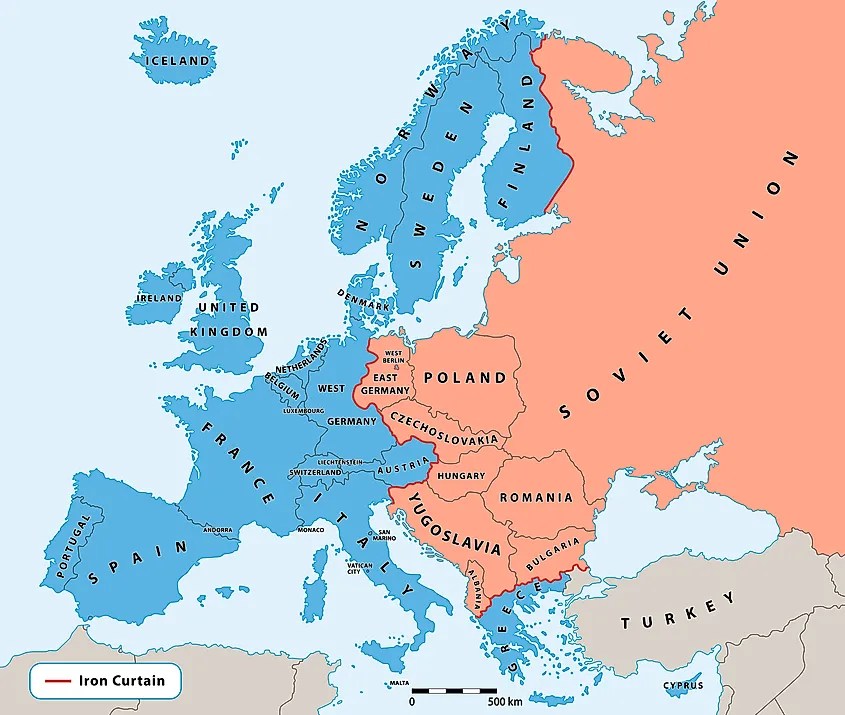
After World War II, the Allies decided to start rebuilding Europe. However, they realized that they had two very different ideas on how to rebuild Europe. The two different ideas were most obviously employed by the U.S.A and the U.S.S.R. The U.S.A approved of a capitalist goal, and gave the lands back to each of it’s native countries, while the U.S.S.R preferred communism, and absorbed the lands into itself.

When Germany was defeated, it was decided that the country would be divided in half, the west side going to the western countries like America, France, and England, while the Eastern half went to Russia. The capital of Germany itself would be divided into quarters, each to be given to one of the countries mentioned, despite the city (Berlin) being in Eastern Germany, and therefore under the control of Russia. This only lasted a few years, and in 1948 Britain, France, and the U.S.A gave their chunks of Germany back to the Germans, who formed a new state called West Germany. Russia however, did not want to relinquish their new German land, and kept it. The same happened in Berlin, so the west half was ruled by Germany and the east half was ruled by Russia.

Later that year Russia would set up the Berlin Blockade in an attempt to completely capture Berlin, by stationing tanks and military personnel at all the entrances to the city, particularly the ones that faced towards Western Germany. Supposedly this was because the Allies had instituted a new currency in West Germany, the Deutschemark, and the U.S.S.R did not like the fact that there was now a competing currency in one half of a city it had control over. When the blockade was started, they threatened to starve west Berlin if the Deutschemark was not removed, but the Allies instead flew planes over Berlin and dropped supplies down to them. This allowed the people to live, and even do well, as the airdrops were even more effective than the allies thought they would be. The Russians, assuming this wouldn’t work, tried minimally to stop the allies, which would end up being a mistake. After 15 months of this blockade, the Russians finally stopped, and allowed west Germany to have access to Berlin once again.

While no obvious consequences came from this, it raised tensions between Russia and the rest of Europe (and America) considerably, helping accentuate the cold war, a fifty year long non-violent war between America and Russia.
Build-Up to World War 1

World War I, also called the “war to end all wars” by those who were unaware of World War II, was a pretty big war, though not particularly long (it started in 1914 and ended in 1918), and the causes for this war started as far back as 1817. In 1817, Serbia, Greece, and several other Balkan countries separated from the Ottoman Empire, which had been weakening for a while at this point, and began scraping out some independence for themselves. After a good long while, the Balkan States managed to completely shove the Ottomans out of Europe and into the Middle East in 1913. This sounds great, but they all then weakened themselves by fighting over the land left by the retreating Ottoman troops. Again, doesn’t sound too bad, but then Austria-Hungary got hungry for land, invaded Serbia’s neighbor Bosnia, and began looking greedily at Serbia. Serbia, rightfully scared, hastened to make a deal with a powerful country, who ended up being Russia. Russia agreed to help Serbia if Austria-Hungary ever threatened them, with the only reward to Russia being it’s continued influence in Eastern Europe.

This’ll be important in a bit, but for now, let’s look at the history of Prussia. Prussia had been a noticeable country until 1866, had been quite important awhile ago, but was generally not impressive until 1866 when it won a war against Austria, who was the previous powerhouse of central Europe. Prussia, now the top dog, didn’t want to have to deal with outside threats and instead wanted to build up it’s infrastructure and economy. Toward this end, it arranged the League of Three Emperors in 1873, a treaty between Austria-Hungary, Prussia, and Russia. Serbia officially became a sovereign country in 1878, and Austria started looking at Serbia, leading Russia to leave the League. Prussia then arranged the Dual Alliance between themselves and Austria-Hungary, but updated it to include Italy in 1882 since Italy, like Prussia, didn’t want to have to deal with a war all by itself, so they joined this powerful Triple Alliance. Prussia, thanks to this focus on economics was second only to Britain in most all categories, and had started challenging Britain’s colonies around the world.

Looking back at Russia for a second, they now felt very threatened by the fact that Austria-Hungary, who was clearly planning to fight their (Russia’s) ally Serbia, had enlisted the help of powerhouse Prussia and the weaker but not dismissible Italy, so they made a deal with France, Prussia’s closest neighbor other than Russia and Austria, in 1894. France was eager to join this alliance because of how threatening Prussia was, and was mostly unaware of the high tensions between Serbia and Austria-Hungary.

Now remember how Prussia had been antagonistic to Britain? That really came back to bite them, because it gave Great Britain a reason to engage in treaties with both France (in 1904)and Russia (in 1907) to help it fight Prussia.

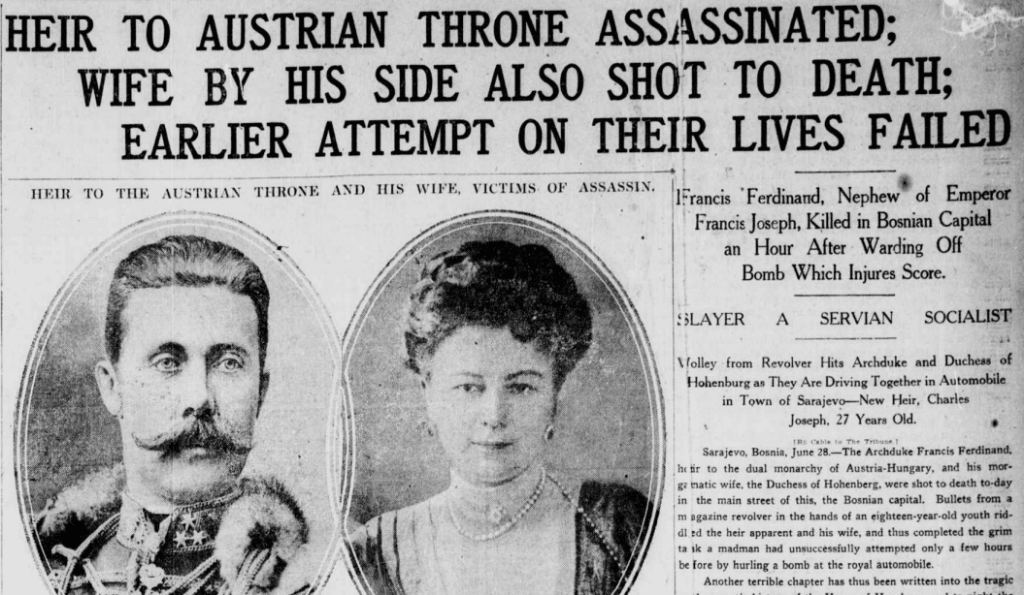
So, coming to 1914, the beginning of the war, you have Russia, France, and England making what is known as the Triple Entente, as well as Serbia allied to Russia, and Prussia, Austria-Hungary, and Italy making up the Triple Alliance. This made up the sides of the war, but we’ve yet to discuss the direct cause of the war. One day, the 28th of June, 1914, Archduke Franz Ferdinand, heir to Austria, was driving through Austria’s territory of Bosnia, when a Serbian who particularly didn’t like Austria threw a grenade at Franz’s car. It went off, though didn’t kill, or even injure, either Ferdinand. They visited the governor’s home, rested awhile, but then decided to visit those whom the bomb had hurt in the hospital. It was there that the would-be assassin’s co-conspirator saw them, and shot both, stone dead. This caused Austrian outrage, and they declared war on Serbia, who enlisted Russia, who brought France and England, and Austria gathered it’s own friends, Prussia and Italy. Thus, the war began.