If you want to know how the war got started, then please read my previous post, Build Up to World War 1. After the Archduke of Austria got assassinated, Austria declared war on Serbia, leading to all the countries preparing to fight one another. However, everyone assumed that Austria would start the first battle, presumably against Serbia or Russia, seeing as that was what started the war. What the allies didn’t expect was for the first act of aggression to come from Germany, and they certainly didn’t expect for them to invade, not France, not Britain, not Russia, not even one of the allies, but Belgium, a completely neutral country that just happened to be between Germany and France. Germany could’ve reached France by going a little south, but marching through Belgium was a straight line to Paris, capital of France. So Germany on August 5, 1914, hoping to end France with a single blow and possibly end the war with the same blow, decided to march through Belgium and into Paris before any of the Allied countries could prepare their armies for the defense of Paris. Unfortunately for Germany, who had hoped for a short Battle of Liege (Liege being the capital of Belgium) ended up fighting an 11 day Siege of Liege. This, while fairly short, was not nearly short enough too allow the Germans a surprise attack against Paris. In fact, the attack against a neutral territory convinced Britain to send far more aid to France then they probably would have otherwise, reinforcing the border between Germany and France, resulting in a dragged out war.
Russia formed up its own armies, the huge First and Second armies, and began marching on Germany. However, the Germans were expecting this and sent out their own army to fight them. The Russians were extremely unwieldy and slow, though massive. The Germans took advantage of this by making their own eastern army as fast as possible, and on the 23rd of August the Germans passed by the First Army and destroyed the Second Army, who were thoroughly unprepared for an attack. They then began a series of fights throughout the rest of August, finishing the Second Army and defeating the First. This is referred to as the Battle of Tannenberg and kept the Russians out of most of the rest of the war.
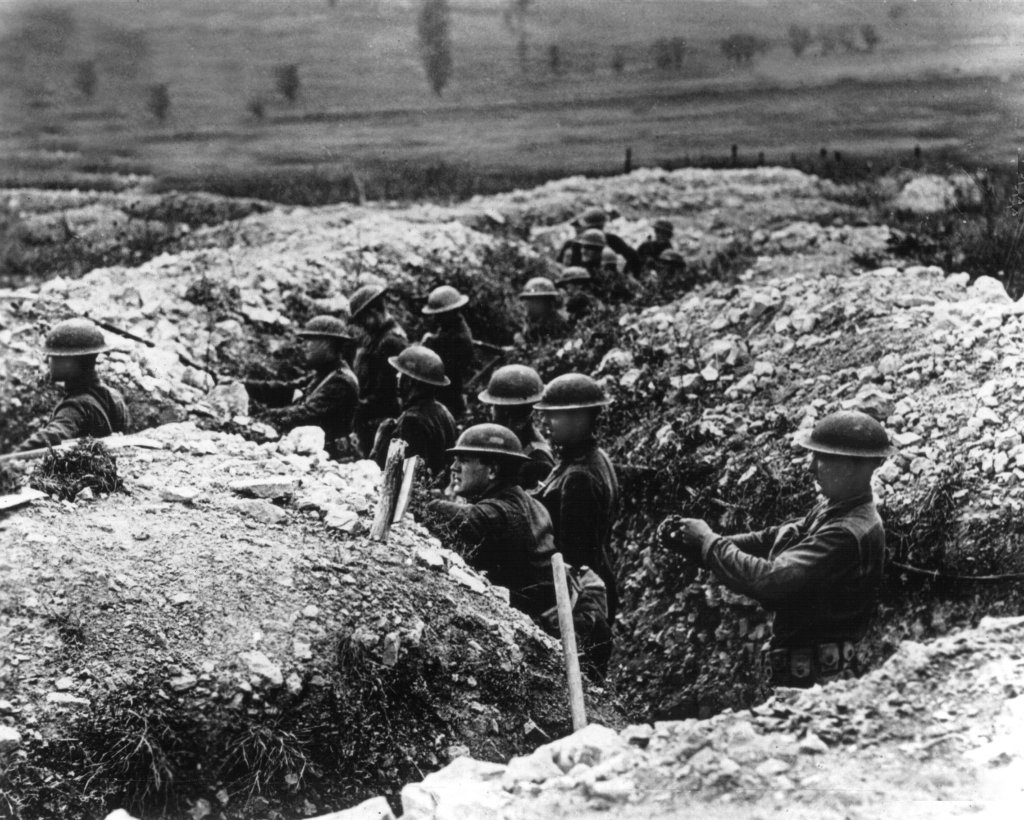
Back on the western front, the French/British forces and the Germans both realized that this would be a prolonged war after the failure to sack Paris quickly. They both began digging trenches and building small fortifications to get some advantage against the other. Nothing else really happened until 1915 when the Austrians managed to conquer Serbia. It wasn’t much trouble since they were so small, and no repercussions came from the Russians due to the whole their-army-was-decimated-thing. The British Navy began blockading Germany and keeping ships from trading with them. This continued throughout the war, with only occasional attacks from German submarines interrupting the blockade, and a single battle. The British colony of South Africa also conquered the German colony of Namibia, as well as other small colonies.
The Ottoman Empire, which had been driven out of Europe by Serbia and the other Balkan countries, decided to enter the War on the Prussian side, since Germany had been supporting and helping the empire for quite some time, though an official treaty never came out of it until the war. The British decided the Ottomans had to be stopped from aiding Germany, and so launched the Gallipoli Campaign. Since all of their soldiers were aiding France in Europe, the English recruited men from their colonies in Australia and New Zealand to fight the Ottoman forces. They failed spectacularly, however, and the campaign ended in early 1916. Also in 1916 were the Battles of Jutland and Verdun, Jutland being the only real naval battle in the war and Verdun being the first real German loss. The battle of Jutland was fought off the coast of Denmark (a neutral country) by 151 English ships and 99 German ships. The British ended up retreating after losing 14 ships to only 11 German ships. Despite this victory, the German Navy spent the rest of the war collecting dust, as the naval commander was so scared to lose any ships they were never used. Verdun was fought between French defenders and German attackers, and ended up being the bloodiest battle in a war known for its bloodshed. The Germans surrounded the fort on three sides and attacked it 4 times before backing off for a bit. The total lives lost for no change in the battle lines went over 700,000.
Belgium hadn’t stopped fighting Germany, however, and they fought three battles in Ypres, also known as Flanders, attempting to free themselves from Prussia. None of the attempts worked, but the did interrupt a few German offensives against France. Ever since the Battle of Tannenberg, Russia had been attempting to get back on its feet, but due to political struggles and sabotage by the Germans, Russia underwent a revolution. They wrote up a quick treaty with Germany in 1917 and stayed out of the rest of the war, dealing with the Bolshevik Revolution.
Speaking of countries that barely did anything in the war, let’s look at Italy. If you read the Build Up to World War 1, then you know that Italy was allied to both Austria and Prussia. However, they got scared on the outset of the war and backed out of the alliance. Unfortunately for them, the Allies pressured Italy into fighting the Germans in 1916, and they ended up fight the Prussians and Austrians in 1917 in the Battle of Caporetto. They were right to be scared. Their army was decimated by the Germans, and at least 265,000 soldiers were taken prisoner, ending Italy’s portion of the war effort.
The Americans also joined the war in 1917, on the grounds that Germany had been too carefree with their submarines and sunk innocent American civilian ships, even though many of those ships were sending aid to the British and French. The first battle with Americans was also the first battle with tanks, and was known as the Battle of Cambrai. Despite the two new advantages, it was a solid German victory.
However, despite all these German victories, the final battle of the war came in 1918, known as the Battle of Amiens, or the Hundred days offensive. It lasted ninety-five days, and it beat the Germans all the way back into Prussia. The Germans signed a cease-fire on November 11th, which we celebrate every year on Veterans day. Later the Treaty of Versailles was written and signed, putting an end to World War 1, and setting the stage for World War 2. The total military and civilian casualties ended up being at least 40 million lives, due mostly to the new inventions in the war, like tanks, machine guns, flamethrowers, poison gas, fighter planes, and others, turning a fairly standard European war into an incredibly horrible waste of many lives.
 School Essays