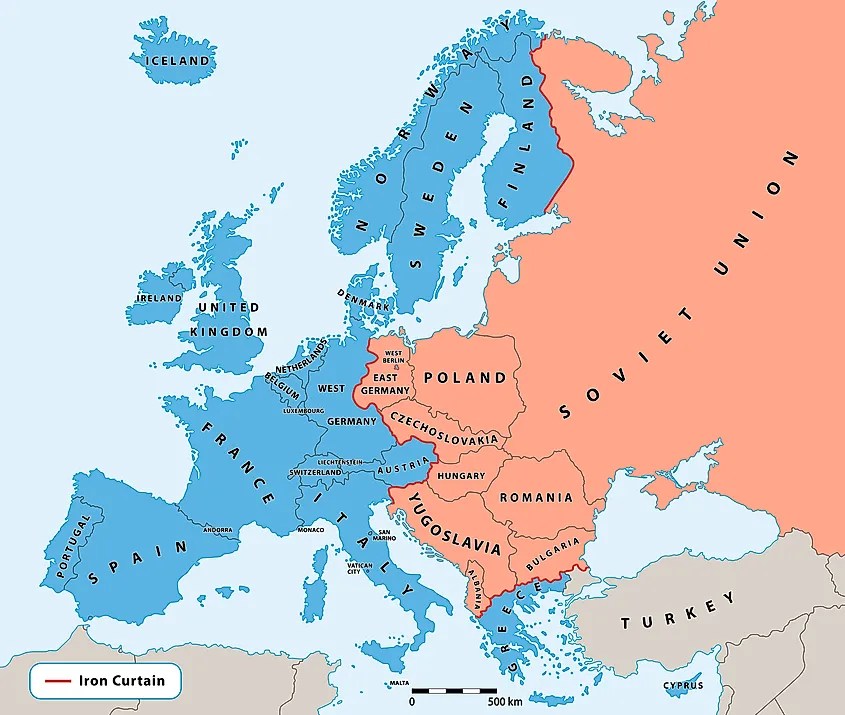
After World War II, the Allies decided to start rebuilding Europe. However, they realized that they had two very different ideas on how to rebuild Europe. The two different ideas were most obviously employed by the U.S.A and the U.S.S.R. The U.S.A approved of a capitalist goal, and gave the lands back to each of it’s native countries, while the U.S.S.R preferred communism, and absorbed the lands into itself.
When Germany was defeated, it was decided that the country would be divided in half, the west side going to the western countries like America, France, and England, while the Eastern half went to Russia. The capital of Germany itself would be divided into quarters, each to be given to one of the countries mentioned, despite the city (Berlin) being in Eastern Germany, and therefore under the control of Russia. This only lasted a few years, and in 1948 Britain, France, and the U.S.A gave their chunks of Germany back to the Germans, who formed a new state called West Germany. Russia however, did not want to relinquish their new German land, and kept it. The same happened in Berlin, so the west half was ruled by Germany and the east half was ruled by Russia.
Later that year Russia would set up the Berlin Blockade in an attempt to completely capture Berlin, by stationing tanks and military personnel at all the entrances to the city, particularly the ones that faced towards Western Germany. Supposedly this was because the Allies had instituted a new currency in West Germany, the Deutschemark, and the U.S.S.R did not like the fact that there was now a competing currency in one half of a city it had control over. When the blockade was started, they threatened to starve west Berlin if the Deutschemark was not removed, but the Allies instead flew planes over Berlin and dropped supplies down to them. This allowed the people to live, and even do well, as the airdrops were even more effective than the allies thought they would be. The Russians, assuming this wouldn’t work, tried minimally to stop the allies, which would end up being a mistake. After 15 months of this blockade, the Russians finally stopped, and allowed west Germany to have access to Berlin once again.
While no obvious consequences came from this, it raised tensions between Russia and the rest of Europe (and America) considerably, helping accentuate the cold war, a fifty year long non-violent war between America and Russia.
World War II was officially started in 1939, when Germany captured Poland and added it to the Nazi Empire. The tensions that led to the war had started as early as 1918, when Germany lost World War I, and the Allies organized the Treaty of Versailles, and used it to mistreat the Germans, forcing them to pay drastic reparations to the Allies, unable to make or organize military machines and troops, as well as several other punishments that served only to cause unrest among the german people. One of the terms was the splitting of Germany into several countries, such as Poland and Czechoslovakia. The uniting of these Germanic countries was the first order of business for Hitler when he decided on conquering Europe. He held an almost-certainly rigged vote among the German people and the Austrian people in 1938, resulting in more than 99% of the people wanting to join the two countries into one. With this he was able to convince the Allies that it was alright to join the countries, though they could see plainly that the vote had been tampered with. They didn’t say anything, however, not wishing for WWII. When Adolf asked for Czechoslovakia later in 1938 in the Munich Agreement, the Allies tentatively agreed to his terms, but no more. So when Hitler took Poland and added it to the quickly growing Germany, Britain and France finally decided enough was enough, and declared war.
However, Germany had been building war machines and organizing Armies in secret, and attacked europe with a new war strategy, known as blitzkrieg. Blitzkrieg is german for “lightning war” or “fast war” and used it extremely well, conquering Belgium, the Netherlands, and France in barely over a month. It reached the height of it’s power in 1942, before anyone could engage them in war, though Britain did begin preparing for massive efforts. The first failure for Nazi Germany was the Battle of Britain, in 1940, when Germany began continuous air-bombing Britain, but failed to conquer it. The first major failure, however, came in 1941, when project Barbarossa didn’t conquer Russia, costing the Third Reich some million soldiers, though they slayed some 4 million Russians. The reason that they failed wasn’t really because of the Russians, but because it took to long to conquer Moscow, and the cold winter came and guarded the Russian landscape.
1942 is when the Allies began to take back ground against the Germans, and America joined the fight in earnest. Germany’s ally, Italy, fell to the allies in 1943 when Benito Mussolini was killed. In 1944 the Allies fought and captured land in Normandy, a French territory, on what is now known as D-Day. From there the Germans were pushed back to Berlin in 1945, where the Russian Army landed the final blow at the Battle of Berlin. Hitler committed suicide, and Germany surrendered.
The war wasn’t over yet, however, since Germany had another Ally, not in Europe at all, but Asia. The Japanese Empire was extensive, and powerful, and originally planned to conquer all of the Pacific Ocean. Unfortunately for them, the USA had many holdings in the Pacific Ocean, such as the Philippines and Hawaii. America had a military base in Hawaii, Pearl Harbor, and Japan bombed it in 1941. This gave America an excuse to get into the war, and despite their slow start in the fighting and few early successes, the Japanese were slowly rolled back from their territories, until 1945, when the Japanese began digging their heels into the ground (sea?) and making the Americans fight for every inch. Then, in May, 1945, an Atomic Bomb was dropped on Hiroshima, a Japanese city, destroying it. When they still refused to surrender, a second bomb was dropped on Nagasaki, Destroying another city. Finally, Japan surrendered, and the most deadly war in history was over.
If you want to know how the war got started, then please read my previous post, Build Up to World War 1. After the Archduke of Austria got assassinated, Austria declared war on Serbia, leading to all the countries preparing to fight one another. However, everyone assumed that Austria would start the first battle, presumably against Serbia or Russia, seeing as that was what started the war. What the allies didn’t expect was for the first act of aggression to come from Germany, and they certainly didn’t expect for them to invade, not France, not Britain, not Russia, not even one of the allies, but Belgium, a completely neutral country that just happened to be between Germany and France. Germany could’ve reached France by going a little south, but marching through Belgium was a straight line to Paris, capital of France. So Germany on August 5, 1914, hoping to end France with a single blow and possibly end the war with the same blow, decided to march through Belgium and into Paris before any of the Allied countries could prepare their armies for the defense of Paris. Unfortunately for Germany, who had hoped for a short Battle of Liege (Liege being the capital of Belgium) ended up fighting an 11 day Siege of Liege. This, while fairly short, was not nearly short enough too allow the Germans a surprise attack against Paris. In fact, the attack against a neutral territory convinced Britain to send far more aid to France then they probably would have otherwise, reinforcing the border between Germany and France, resulting in a dragged out war.
Russia formed up its own armies, the huge First and Second armies, and began marching on Germany. However, the Germans were expecting this and sent out their own army to fight them. The Russians were extremely unwieldy and slow, though massive. The Germans took advantage of this by making their own eastern army as fast as possible, and on the 23rd of August the Germans passed by the First Army and destroyed the Second Army, who were thoroughly unprepared for an attack. They then began a series of fights throughout the rest of August, finishing the Second Army and defeating the First. This is referred to as the Battle of Tannenberg and kept the Russians out of most of the rest of the war.
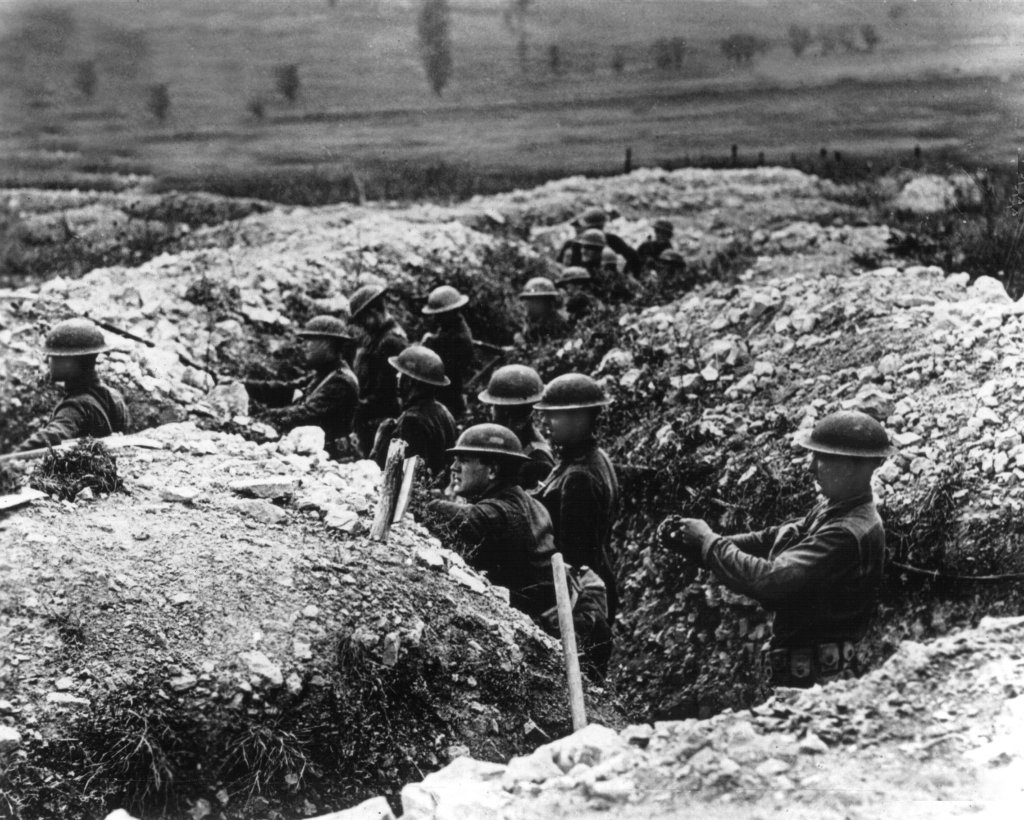
Back on the western front, the French/British forces and the Germans both realized that this would be a prolonged war after the failure to sack Paris quickly. They both began digging trenches and building small fortifications to get some advantage against the other. Nothing else really happened until 1915 when the Austrians managed to conquer Serbia. It wasn’t much trouble since they were so small, and no repercussions came from the Russians due to the whole their-army-was-decimated-thing. The British Navy began blockading Germany and keeping ships from trading with them. This continued throughout the war, with only occasional attacks from German submarines interrupting the blockade, and a single battle. The British colony of South Africa also conquered the German colony of Namibia, as well as other small colonies.
The Ottoman Empire, which had been driven out of Europe by Serbia and the other Balkan countries, decided to enter the War on the Prussian side, since Germany had been supporting and helping the empire for quite some time, though an official treaty never came out of it until the war. The British decided the Ottomans had to be stopped from aiding Germany, and so launched the Gallipoli Campaign. Since all of their soldiers were aiding France in Europe, the English recruited men from their colonies in Australia and New Zealand to fight the Ottoman forces. They failed spectacularly, however, and the campaign ended in early 1916. Also in 1916 were the Battles of Jutland and Verdun, Jutland being the only real naval battle in the war and Verdun being the first real German loss. The battle of Jutland was fought off the coast of Denmark (a neutral country) by 151 English ships and 99 German ships. The British ended up retreating after losing 14 ships to only 11 German ships. Despite this victory, the German Navy spent the rest of the war collecting dust, as the naval commander was so scared to lose any ships they were never used. Verdun was fought between French defenders and German attackers, and ended up being the bloodiest battle in a war known for its bloodshed. The Germans surrounded the fort on three sides and attacked it 4 times before backing off for a bit. The total lives lost for no change in the battle lines went over 700,000.
Belgium hadn’t stopped fighting Germany, however, and they fought three battles in Ypres, also known as Flanders, attempting to free themselves from Prussia. None of the attempts worked, but the did interrupt a few German offensives against France. Ever since the Battle of Tannenberg, Russia had been attempting to get back on its feet, but due to political struggles and sabotage by the Germans, Russia underwent a revolution. They wrote up a quick treaty with Germany in 1917 and stayed out of the rest of the war, dealing with the Bolshevik Revolution.
Speaking of countries that barely did anything in the war, let’s look at Italy. If you read the Build Up to World War 1, then you know that Italy was allied to both Austria and Prussia. However, they got scared on the outset of the war and backed out of the alliance. Unfortunately for them, the Allies pressured Italy into fighting the Germans in 1916, and they ended up fight the Prussians and Austrians in 1917 in the Battle of Caporetto. They were right to be scared. Their army was decimated by the Germans, and at least 265,000 soldiers were taken prisoner, ending Italy’s portion of the war effort.
The Americans also joined the war in 1917, on the grounds that Germany had been too carefree with their submarines and sunk innocent American civilian ships, even though many of those ships were sending aid to the British and French. The first battle with Americans was also the first battle with tanks, and was known as the Battle of Cambrai. Despite the two new advantages, it was a solid German victory.
However, despite all these German victories, the final battle of the war came in 1918, known as the Battle of Amiens, or the Hundred days offensive. It lasted ninety-five days, and it beat the Germans all the way back into Prussia. The Germans signed a cease-fire on November 11th, which we celebrate every year on Veterans day. Later the Treaty of Versailles was written and signed, putting an end to World War 1, and setting the stage for World War 2. The total military and civilian casualties ended up being at least 40 million lives, due mostly to the new inventions in the war, like tanks, machine guns, flamethrowers, poison gas, fighter planes, and others, turning a fairly standard European war into an incredibly horrible waste of many lives.


 School Essays