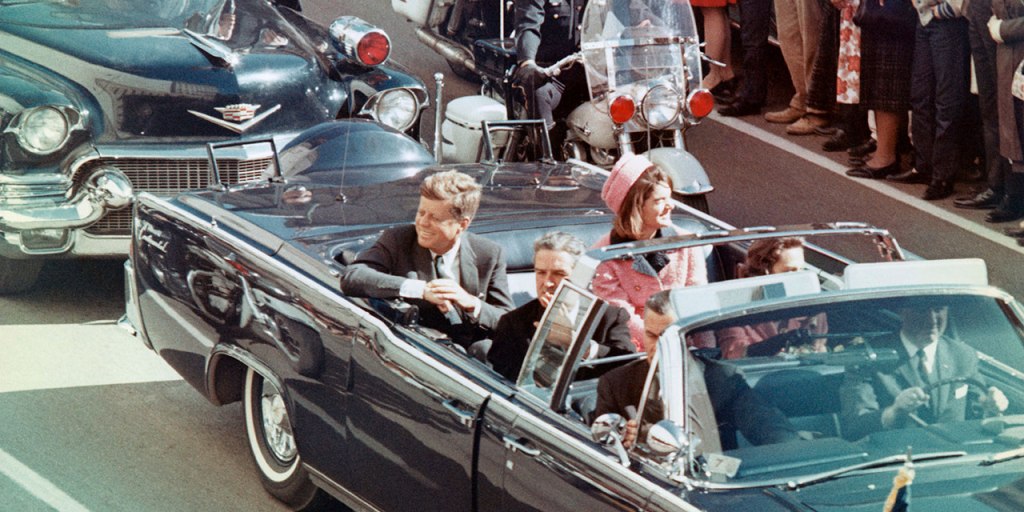
John Fitzgerald Kennedy was the first president to be born in the 20th century, the youngest president to be elected, and the first Catholic President. He was the second oldest of 8 siblings, all of whom became well respected figures. Thanks to his fathers money and influence, John was able to make many connections with European powers, and while he was smart, he wouldn’t try all that hard in school, caring more for pranks and having a good time.
His father was appointed as the ambassador to London, and JFK would often attend meetings or votes in his fathers name. Thanks to this connection to England, John was able to right a thesis on England’s response to Hitler and why they were so under prepared. It was published and became incredibly popular.
During WWII JFK joined the Navy, and was the secretary of the Navy at the time of Pearl Harbor. He joined the fight in a gunboat, but suffered a back injury after a submarine attack, and was honorably discharged just before the Japanese surrender in 1945.
after this, he turned to politics. He won a seat in the House in his home state of Massachusetts in 1946, then won a Senate seat in 1952. He married his wife, Jacqueline Bouvier, the next year. He had numerous surgeries for his back over these years as a Senator, and received the catholic last rites more than once. It was partially because of these surgeries, and partly because of his less-than-serious disposition that he isn’t remembered for anything during this time.
He then ran for president in 1960, defeating the former vice president Richard Nixon. He is famous for saying at his inaugural address “Ask not what your country can do for you- ask what you can do for your country.” Both him and his wife were somewhat unique, as they were not only the president and first lady, but celebrities. They set many fashion trends, and JFK was a huge supporter of Television and Radio. They also refurnished and refurbished the White House, which was uncommon. Their time in the White House is sometimes referred to as the Camelot Era, in reference to king Arthur and his noble court.
Cuba had come under the control of Fidel Castro, and become communist, and both Eisenhower and Kennedy saw Cuba as far too close to America for safety. So they planned an invasion, referred to as the Bay of Pigs Invasion in 1961. The American-trained Cubans took control for two days before Castro regained Cuba, and forced Kennedy to pay up 53 million dollars in food and supplies for 1,113 men remaining of the 1,500 sent. This was a horrible embarrassment, and raised tensions with Fidel.
In 1962 Cuba became important once again, this time thanks to the Soviets, who installed nuclear missiles in Cuba, pointed at the US. Nuclear war nearly broke out, but Kennedy and his administration managed to get the Russians to back off and dismantle the bombs.
Also with the Russians, the Space Race had started, and Russia had managed to send up Sputnik 1, a satellite, into Space during Eisenhower’s presidency. He started NASA, but they didn’t do much under him, and it wasn’t until John declared that they would put a man on the moon within the decade in 1962 that NASA started working overtime to meet this promise. And in 1969, right before JFK’s deadline, Neil Armstrong set foot on the moon. Unfortunately, it was past JFK’s own personal deadline.
In 1963 JFK was traveling in a limousine in Dallas when the picture above was taken. A moment later, Lee Harvey Oswald’s bullet blew his brains out. It’s believed that he was apart of a conspiracy, as he claimed he had not shot anyone, but he was killed two days after his arrest by one Jack Ruby. It’s nearly certain that there was a conspiracy thanks to evidence at the crime scene, but nobody knows for sure what happened, so conspiracy theories abound.
Generally remembered as a good guy, and one of the best presidents, he left a good legacy, despite the Bay of Pigs mishap. Despite his immense popularity, he was killed, and the States were clearly left in poorer hands when his vice president, Lyndon Johnson, stepped up.
 School Essays