The Fall of the U.S.S.R.

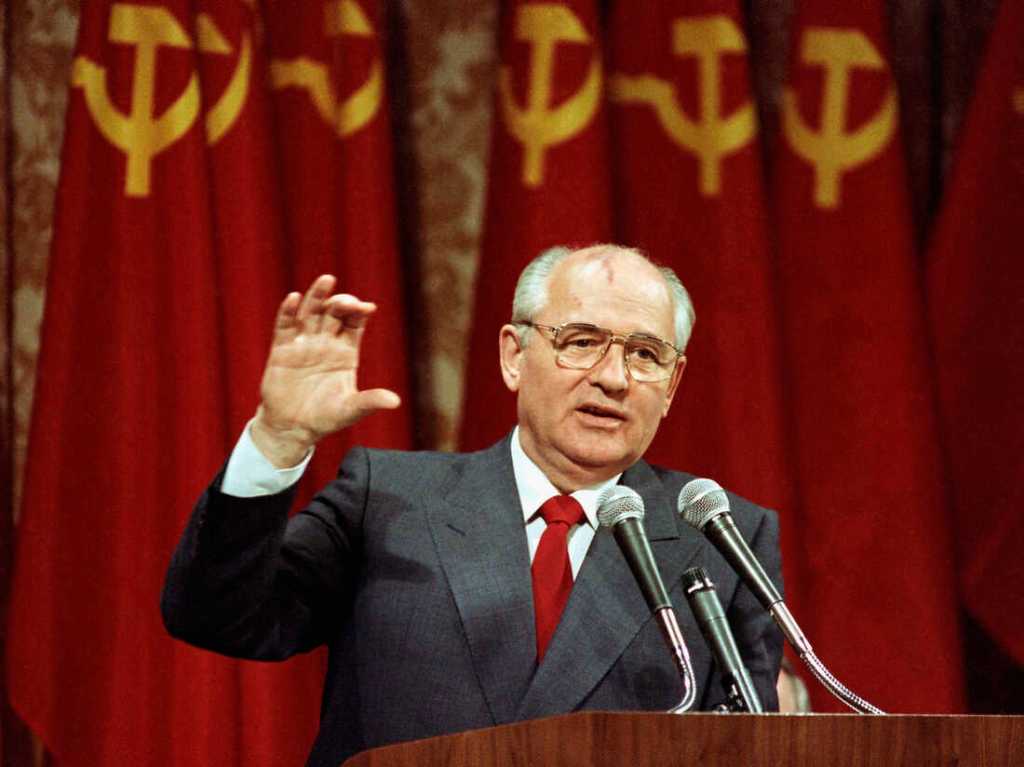
Soviet President Mikhail Gorbachev

Started in 1919 after the Bolshevik Revolution, the Soviet Union finally fell in 1991, 72 years later. Technically speaking, the U.S.S.R. wasn’t started until 1922 when Joseph Stalin united all the communist parties that had been started by Lenin’s Bolshevik Revolution in 1919. Stalin ruled the Soviet Empire with a heavy hand until his death in 1953.

Then, Nikita Khrushchev quietly moved Stalin’s successor out of the way and took over. He instituted much less controlling policies, though was clearly still a dictator. The new policies helped improve relations with the U.S.A, who had engaged in a Cold war with Stalin’s government, until the Cuban missile crisis in 1962. The crisis started when communist Cuba began installing Nuclear Missiles on their island, given to them by the Soviets. This was incredibly dangerous for the U.S.A. since Cuba is practically a next door neighbor. Frantic negotiations were carried out, that nearly resulted in nuclear annihilation. However, it instead brokered a deal that stated the Russians would remove their missiles from Cuba, if the Americans removed their missiles from Turkey, and promised not to invade Cuba. Things calmed down from there, and nothing very important happened until 1979, under the reign of Leonid Brezhnev, who took power in 1964.

In 1979 the Soviet war on Afghanistan began, and the U.S.A, who didn’t want the Russians to expand, funded the Afghans. They didn’t outright go to war with Russia because that would initiate Nuclear death, but instead funded the people Russia was already trying to fight. Eventually, in 1989, under Mikhail Gorbachev, the war was ended, since no real conclusion was to be found, and the U.S.S.R. couldn’t afford a continual drain on their resources. But then, in 1990, Iraq attempted to conquer Kuwait, an oil rich country, and was funded by the Soviets, while America and many other countries decided to keep Iraq out of Kuwait. Despite the Russians best support, Iraq fell inside of a year. This was the final blow that showed that the Soviet Union was well behind the Capitalist world.

Then, Gorbachev decided to try making the Union less dictatorial, instituting several reforms. He then held a poll in 1991 to see if the Empire wanted to break up the U.S.S.R. After finding an overwhelming majority of the population supported the idea, he decided to do it. However, the remaining Communists did not like this idea. They decided to stage a coup, and rolled in on tanks to depose Mikhail. When faced with the rest of Russia’s military, however, they backed down pretty quick, and the communist party was ended in Russia.

Gorbachev resigned on Christmas day, 1991, and the entire soviet country collapsed and disintegrated. Out of it’s remains 15 new countries were formed: Armenia, Azerbaijan, Belarus, Estonia, Georgia, Kazakhstan, Kyrgyzstan, Latvia, Lithuania, Moldova, Russia, Tajikistan, Turkmenistan, Ukraine, and Uzbekistan. America’s position with Russia and the rest of these countries has been quite strong, though friendly ties to Russia have began to deteriorate in modern days over it’s treatment of Ukraine.

Mao Zedong and Communist China

Mao Zedong was born in 1893 to a peasant family in a farming village, where he experienced the difficulties that came with being poor in China at the time. He began studying to become a teacher as he grew older. He joined a political party called the Kuomintang, which managed to become rather respectable as a part of the government. However, he heard about communism at the schools where he was learning and decided that it sounded better. Before he could find a job, news of the success of the Bolshevik revolution came in, exciting interest in communism. Mao saw this as his opportunity to start a communist party in China, and by 1925 he had become a significant figure in the party and had grown it to be quite large. However, in 1925 a new leader came to power in China. He was a member of the Kuomintang, and did not have the same feelings about communism as the previous leader. This man decided to wipe out Mao’s party, who fled to a mountainous region of China, where the communists remained until 1934. it was then that another push to kill the commies came, and they were forced out of the mountains. Mao convinced them to run away to a whole different region of China. This was known as the “Long March” (real creative name, I know) as it was an 8,000 mile journey through harsh conditions. It took a year for the journey to be completed, and 70% of the people who started the journey died. Despite this, Mao managed to make himself the undisputed leader through sweet-talking the lower-ranked commies.

The Japanese were expanding their empire at this time, and decided to try their hand at invading china, seeing the conflict that was going on inside their borders, but instead of fighting individually, the Kuomintang and the communist joined forces to fight the Japanese. When WWII ended in 1945 this truce ended, but now the communists had a lot more resources, and were on even footing with the Kuomintang. This led to a brutal 4-year long civil war, in which Mao became leader of China in 1949.

This was the most successful part of Mao’s life, and he managed to increase women’s rights, double the schooling system, and increase healthcare, and all of it was pretty good quality. This was for the rural areas, however, as the well populated areas already had these things, and disapproved of having to pay taxes to help people other than themselves. Mao tried opening a complaint department, where people could complain and make requests on how the government should be run, but after seeing a good deal of complaints he began to fear that he would be overthrown by his people. He closed the complaint departments and began cracking down on the people, executing and imprisoning hundreds of thousands of people. Realizing that this was hurting the people, he began the “Great Leap Forward” (another imaginative name, but at least it was better than the last one). Mao tried organizing workers and regulating farming, in an attempt to make up for the previous crackdowns and to get china’s economy on par with the west’s, which had surpassed China. The great leap forward failed miserably, however, combined with a few years of naturally poor farming years, and caused the worst man-made famine in recorded history, causing the death of 40 million people.

He was quietly removed from power by his fellow communists in 1962, and didn’t expect anything from him, since he was 69 years old. He managed to form a following, unfortunately, in 1966 among the youth of china, who did not remember the great fall back, or the seemingly underwhelming benefits of communism. He managed to get back into position as the head of the country, and this time, made sure he would not be brushed away again. He closed all the schools and executed all of the intellectuals who didn’t openly support him, so that there could be no opposition to him. This was a far more extreme version of the crackdowns before, and much worse. This time period of total dictatorship is what Mao is most known for. He died in 1976, but China remained a communist dictatorship. Chen Yun, personal assistant of Mao once said that “Had Mao died in 1956, his achievements would have been immortal. Had he died in 1966, he would still have been a great man but flawed. But he died in 1976. Alas, what can one say?”