Fog is an odd natural phenomenon that is known as a ground cloud, or a cloud that touches the ground. Fog and clouds are made out of small water droplets, floating through the air and obscuring your vision whenever you try to see through it. Fog comes in a few different types, though all of them require extreme humidity, or wetness, in the air. The most common type are Radiation Fog and Advection Fog. The only difference between fog and mist is that fog is thicker, cutting your sight around you to 1 kilometer or less, while mist lets you see farther than a kilometer.
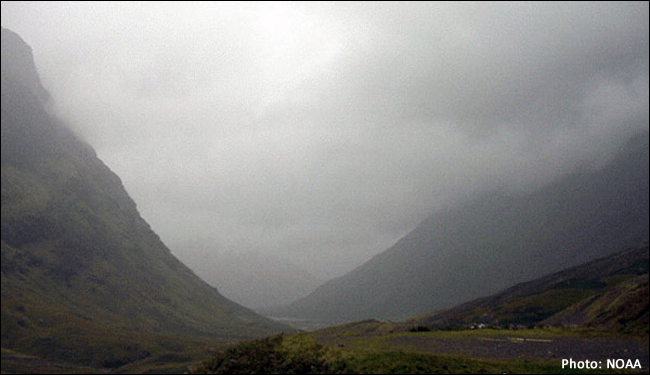
Radiation Fog occurs at night, when the sun disappears beyond the horizon and the ground cools off. For the ground to cool off, the heat has to go somewhere, which is the air, since it’s so conveniently right above said ground. As the warm air from the ground meets the cooler, moist air above the ground, water droplets form around bits of dust and matter in the air, resulting in floating water droplets that don’t drop to the ground due to the slight thermal drafts, and don’t condense together due to the surface tension of the water. Valley Fog, such as in the picture above, is Radiation fog that forms on the tops of the ridges of valleys and rolls down into the depression. Radiation fog often disappears in the morning as the sun applies regular heat to the ground and air.
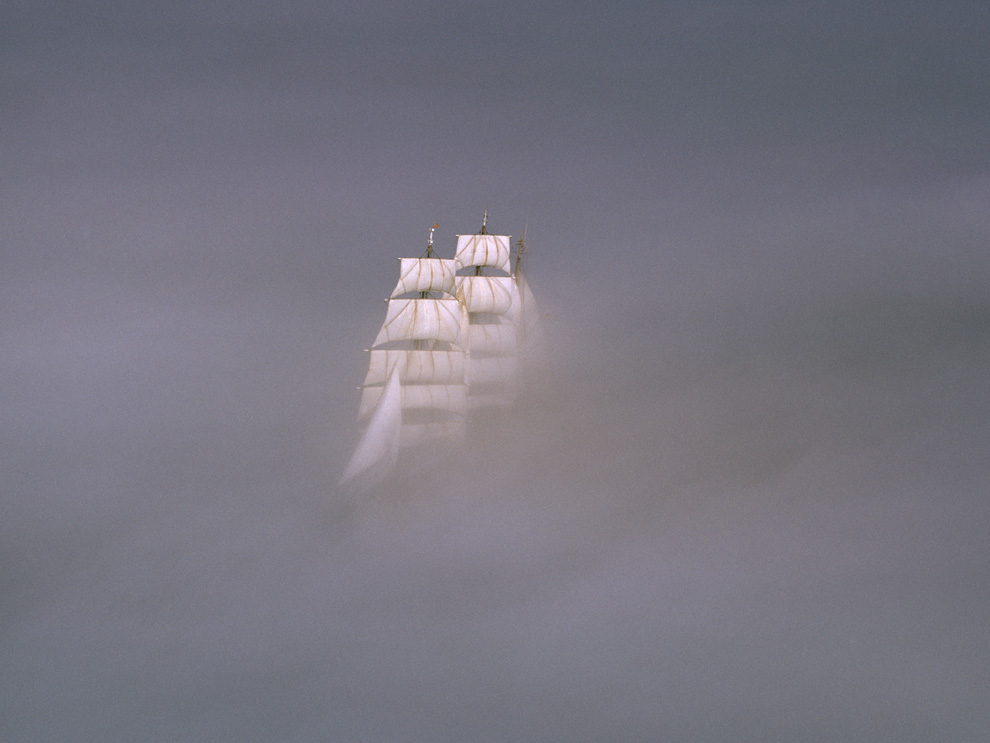
Advection Fog comes when warm air or water comes into contact with cooler air or water, and the temperature changes result in fog forming around bits of dust or salt, salt especially when taking into account warmer and cooler sea currents, which mix into sea fog like in the picture below. Advection fog normally ignores the time of day, as currents are warm and cool regardless of the sun, so it is more oftentimes seen than Radiation Fog. My explanations for these kinds of fogs and their causes came from these National Geographic and National Weather Service websites.
Due to the need for moisture, fog often forms around coasts or rivers in any of its forms, though places with heavy rainfall are more than adequate. One town famous for its fog is London, with fog coming from the river Thames, which runs straight through the city. However, London is not nearly as foggy as is commonly believed, at least, not anymore. Fog requires some particle for the water to form around, which can be dust, dirt, salt, or even burnt coal. Starting as early as the 13th century “Pea-soupers” were a known phenomenon where fog would build up on the burnt coal floating through the air. They were called pea-soupers due to their color, namely, a muddy yellow. Based on that, I, for one, am quite glad not to have ever had pea soup. The major problem with these fogs was that coal is poisonous to inhale, and now there was a ton of it floating in the air, where people happened to breath. it wasn’t too much of a problem until the 1600s, however, when coal started to be used plentifully, and even then nothing was done about the not quite huge numbers of people dying of poisonous water/air until 1952. the reason for the sudden interest was the Great Smog of London, a five day-long pea-souper of immense proportions, and poisons. it’s currently estimated that 4,000 people died during the fog, and the total lives taken by the fog to be around 12,000 lives. I got this info from the Britannica. After the smog, coal was used more sparingly and further from the main city, resulting in only normal fogs from there on out. But famous books from authors like Charles Dickens and Arthur Conan Doyle were written before the fogs died down, and so London has been immortalized as being constantly fog-covered.


