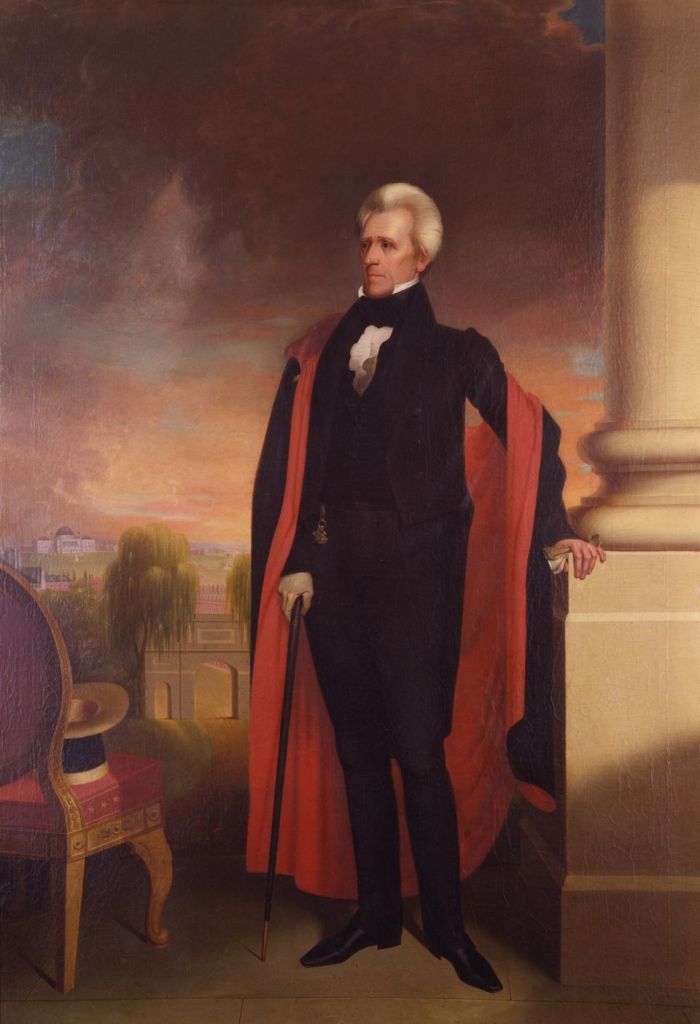
President Andrew Jackson was the 7th president of the United States, and has his face printed on the twenty dollar bill, which is why you might’ve thought you recognized the picture above. He was born in 1767 and is the only president to have served in both the Revolutionary War and the War of 1812. He was only 13 years old during the Revolutionary War, and so served only as a courier for the local militia, which both of his brothers served in. In 1779 his brother Hugh died in the battle of Stono Ferry, and in 1781 both Andrew and Robert where captured by British soldiers. After refusing to shine a British officer’s boots, the officer slashed Andrew with his sword, scarring him for life, though he only beat Robert for the same offense. A few months later they were released in a prisoner exchange, though Robert died a few days later. Andrew’s mother then became a nurse for other militia men who contracted diseases, and died herself soon afterwards, leaving Andrew an orphan at 14 years old. He hated the British, for obvious reasons, but didn’t rejoin the war effort, instead working to become a lawyer and start a life for himself, as his family’s small farm wasn’t for him.
He then traveled to Tennessee where he met his wife-to-be, Rachel Jackson, as well as started his own plantation, and quickly became a dominant politician in Tennessee as an anti-federalist. He was also against Native Americans, and did his best to acquire rights for people to hunt and fight them. In 1806 he got into a duel with Charles Dickinson, who had insulted his wife after an argument about a horse race. Jackson allowed Charles to shoot first, and his bullet lodged into his (Andrew’s) chest, next to his heart, and remained there for the rest of his life. Andrew, unfazed, then shot Charles, also in the chest, but this time it was a killing shot.
In the War of 1812 Jackson offered to recruit and lead men immediately, but the government waited until 1813 to take him up on it. Andrew immediately recruited some 2,000 men and marched to help New Orleans. General Wilkinson (who Andrew Jackson had accused of treason earlier), was in charge of New Orleans, and said that Andrew should go home, and that he wasn’t needed, but Jackson said he was needed, and marched to a group of Native Americans who had been helping the British in the war. This unbending personality earned him the nickname of “Old Hickory” among his troops, as well as the fact that he would beat lazy soldiers with his hickory wood cane. Later, after receiving word that the British would try to take New Orleans, he marched there, and defended the city so well that the British lost over 2,000 soldiers, their general among them, while Jackson lost almost 60. He then took control of New Orleans and enacted strict martial law, executing 6 deserters, banning french people after they tried to leave due to their nationality, and arresting his critics in the city. He then left extremely peacefully after receiving word of a treaty with Britain, which was made before the Battle of New Orleans.
He returned to his plantation, and lived peaceful-ish, until he ran for president in 1824. He wasn’t thought to be a real candidate, just a body to draw Tennessee votes away from another candidate, but due to his battle prowess in the War of 1812, he, John Quincy Adams, and Henry Clay made a three-way tie. Henry then backed out, and supported John, granting him the presidency. Jackson claimed they had made a corrupt deal, and he was probably right, as Adams made Henry his Secretary of State.
Andrew did win the next election, and actually invited the public to a party at the White House to celebrate, which worked out just as you might think it would. He was the first president to use the veto power a lot, dismissing all laws he disliked. He also hated the official bank, and didn’t renew it’s charter when the time came. Thanks to this, he was able to, with much difficulty, get rid of all federal debt in the United States of America in 1835, while 1836, his last year as president, was also the last debt-free year in American history. In 1833, he also became the first president to suffer an assassination attempt. The assassin had two guns, both decided to be in perfect condition after the attack, and both misfired, giving Jackson enough time to run up to him and beat him unconscious with his hickory wood cane, until his bodyguards pulled him off the failed assassin.
Andrew Jackson left office in 1837, and lived in his old plantation until 1845, when he died, surrounded by his children and loved ones and he was buried with his loving wife. When asked if he had any regrets after his presidency, he said he had only two: “I regret I was unable to shoot Henry Clay (his previous political rival and federalist) or to hang John Calhoun (an extremely similar man)”


