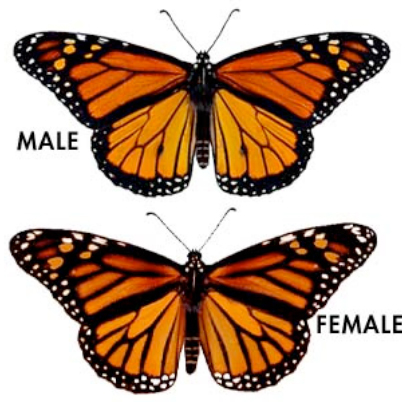
Monarch Butterflies are beautiful butterflies with four orange wings, with a black vein pattern on all four, as well as white spots around the edges of all the wings. but how do they come to be butterflies? Well, they start as eggs.
Their egg is a round ball shape, with white ridges running up and down it. They’re always laid singly on a milkweed plant. The milkweed plant is it’s best option because it’s actually poisonous to most creatures, allowing the caterpillar eggs to be safe from predators and passive herbivores. While all eggs will be laid on milkweed plants, and the mother monarch will lay many eggs, from 300 to 1000 over her life, no eggs will be laid on the same plant. This is to ensure that each caterpillar has enough food to get it past its baby stage, and should they be laid together, they would probably starve each other.
Once the caterpillar hatches from it’s egg, it will immediately begin eating the plant. The plant doesn’t normally survive this, because having small insect eating you isn’t conducive for the health, even for plants, and the caterpillar will move on, and eat from other plants. They don’t have to worry about going to the same area like the mother had to when she was laying the eggs, because so few caterpillars survive the first part of their lives, and there’s food enough for everyone after the first deaths. The caterpillars will also become poisonous to their predators due to how much milkweed it eats.
After eating as much as it can, normally some 200 times its weight in leaves, which can take a varying amount of time to find, the caterpillar will spin itself into a cocoon on the underside of a sturdy object, which can be anything from a tree branch to a rocky overhang. The monarch will sit in this cocoon, called a chrysalis, and turn into caterpillar soup, which will then reform and turn into a full butterfly after 10-14 days.
Once it hatches from the chrysalis, the butterfly will wait for its wings, wet from the whole being-soup thing, to dry out. Once they are dry, it can fly, and it will go out looking for more food. The adult butterflies can’t eat the leaves like they used to, though. Now, they’re restricted to nectar from flowers, though they are still poisonous from the milkweed they ate before transforming. The male butterflies have black spots on the bottom of their wings, while the females have thicker veins, and those are pretty much the only visible differences. Male butterflies will release a pheromone scent from the black spots on its bottom wings, and should a female wish to mate, they will undergo the mating process, which can take anywhere between a few seconds and a few hours, depending on how ready the female is. The mating often occurs whenever they migrate, so about twice a year, when they reach Canada in the summer and Mexico in the winter, though they can easily mate more than that. Since some won’t be able to migrate simply due to when they were born, monarchs can live 5-10 weeks if they stay, or 8-9 months if they migrate.
Works used in the making of this page:
Lagidze, Nato. “Monarch Butterfly Life Cycle” Learn About Nature. 25 April 2022. Web. 29 November 2023. {https://www.learnaboutnature.com/insects/butterflies/monarch-butterfly-life-cycle/}
“Butterfly Eggs” Enchanted Learning. Web. 29 November 2023. {https://www.enchantedlearning.com/subjects/butterfly/lifecycle/Egg.shtml}
“Monarch Butterfly” Enchanted Learning. Web. 30 November 2023. {https://www.enchantedlearning.com/subjects/butterfly/species/Monarch.shtml}


