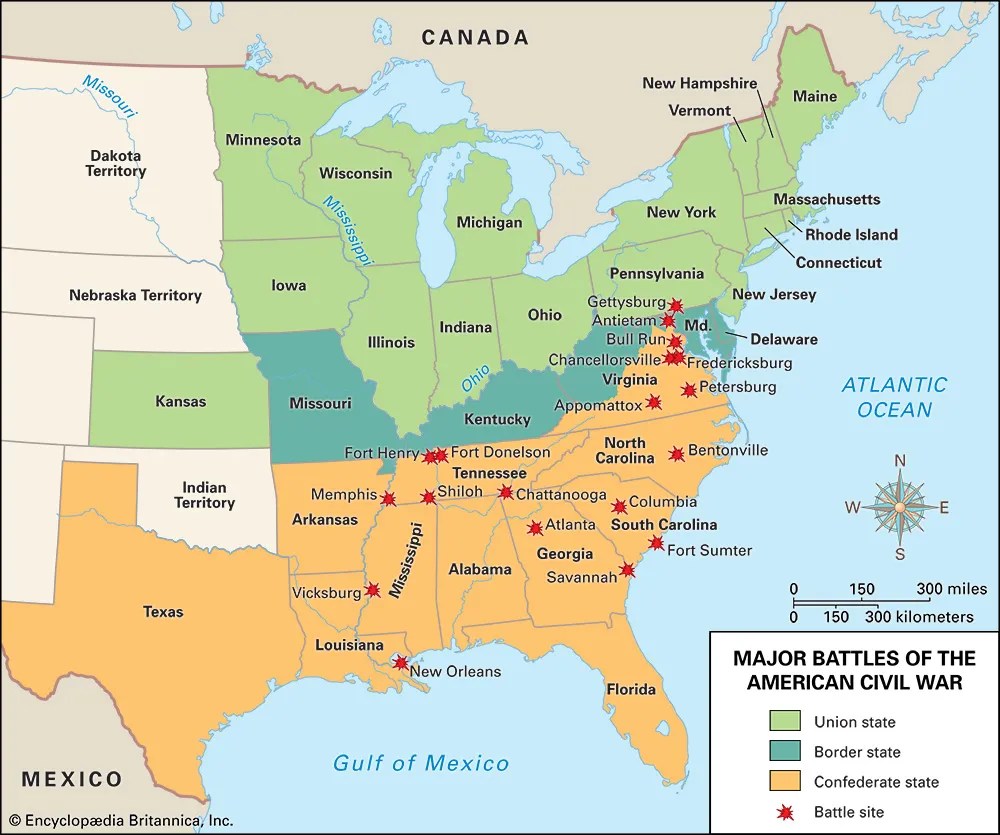
The American Civil War was a war fought between the northern United States of America, and the southern Confederate States of America, the latter of which seceded from the older union to form their own group, the confederacy. The original States to secede and form the confederacy were Texas, Louisiana, Mississippi, Alabama, Georgia, Florida, and South Carolina. These seven states were joined by four more, however, after the first battle of the war. Those four were: Arkansas, Tennessee, North Carolina, and Virginia. West Virginia, however, left Virginia halfway through the war to become a border state, meaning it didn’t immediately join up with the union. The only other states to do this were Delaware, Missouri, Kentucky, and Maryland. These states didn’t support Abraham Lincoln, the leader of the union states, but didn’t secede because of him either. They suffered quite a bit of internal dissension, however, as their population fought itself and individuals moved to join other state’s militias. The United States consisted of Maine, New Hampshire, Vermont, Massachusetts, Rhode Island, Connecticut, New Jersey, New York, Pennsylvania, Ohio, Michigan, Indiana, Illinois, Wisconsin, Minnesota, Iowa, and Kansas. These states all stayed in the union and supported Abraham Lincoln, while the confederates were led by a man named Jefferson Davis.
The popular reason given for the secession of the Confederate States from the Union is the matter of slavery, which they allowed, while the north did not. This was not the only reason, however, as is clear to anyone looking at history. After all, Britain and other European countries were able to abolish slavery without wars, and the States had been at peace on the issue for quite a while, though they were admittedly uneasy in their peace. The war was caused not so much by slavery, as by the secession of the lower states. Now, you may say that they seceded because the north was trying to abolish their slavery, but I don’t think that’s the whole picture, especially since slavery wasn’t totally abolished until 1863, after two years of war. There was a much deeper cultural chasm between the North and South than I think is normally touched on, and that the confederacy was a little more understandable, and inevitable, than is popularly imagined.
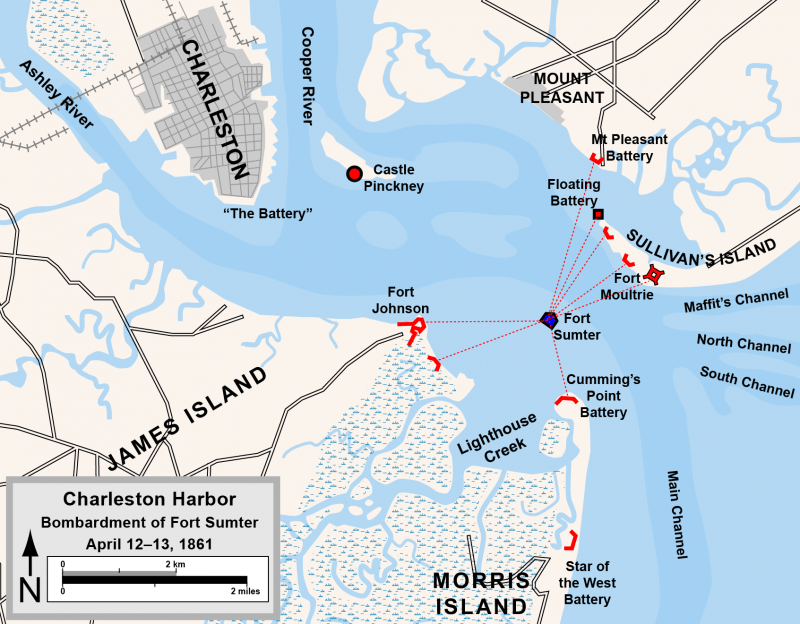
The first battle of the war was in 1861, and was the battle of Fort Sumter. Union soldiers quietly sneaked into Fort Sumter, a fort in the middle of Charleston Harbor, confederate territory. The Confederate leaders called for them to evacuate the fort, and asked Lincoln to order his men out of the fort several times, but Lincoln instead ordered supply ships to reinforce the fort. When these ships were seen by Brigadier General P.G.T. Beauregard, he began a 34-hour artillery barrage on the fort, from forts in sight of Sumter. The image above shows just how many forts were firing on Sumter. After 34-hours the men agreed to surrender and leave the fort. There were no deaths during this battle, except for one during the procession out of the fort, when a union soldier accidentally killed himself firing a cannon in salute of his fellows. After this siege, Abraham called for volunteers to help take the war to the confederates. This estranged the four states already mentioned, and they then joined the Confederacy.
There were many more battles in the war as it stretched from 1861 to 1865, with close to 20 major battles, and many, many more minor skirmishes between militias. Since it was a war between Americans, all lives lost in the battles were American lives, making this the war with the most American lives lost. Not only this, but with some 620,000 Americans dead, it’s almost the same as every other war and battle that America has been involved in before or since, with a total of 684,253, or close to that number. Part of the reason the Union won is because they had a much larger group of soldiers, since they recruited from the free black men as well as white, at least from 1863 onwards, as well as the fact that the south looked on the north as countrymen more so than the north looked on the south. After winning the war, the union re-assimilated the confederate states back into the union rather peacefully, and without executing the southern leaders, an uncommon event for a civil war. The north grew richer and more popular, while the south’s culture got decimated, and it still hasn’t fully recovered from the loss. All the slaves in the south were freed, of course, and have been ever since.

 School Essays