Blog Feed

The Seven Years War

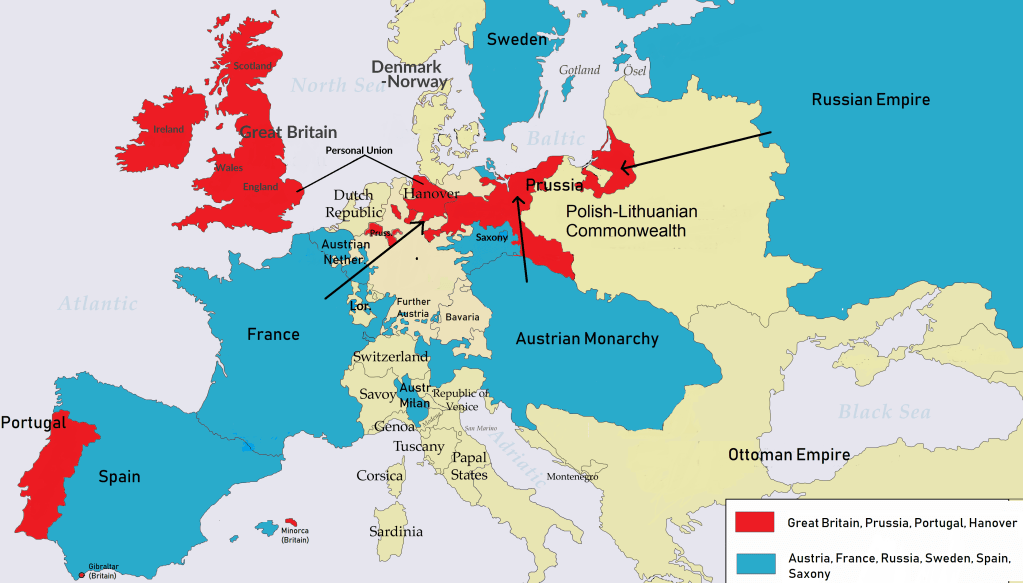
The Seven Years War was a war fought in the mid-1700s, unofficially lasting 9 years from 1754 to 1763, and officially lasting 7 years from 1756 to 1763. The Seven Years War was really the first World War, as it was fought in all the major continents, namely, North and South America, Africa, Asia, and Europe. It was mostly a fight between Great Britain and France, but they managed to drag most other major countries into the war. England and Prussia were the major players on one side, and while Portugal did help, their capital had been hit by a major earthquake, so they weren’t a big player. Hanover was owned by England, so they also fought with them, but they didn’t do much other than stalemate France in Europe. France teamed with Austria and Russia, mostly because they didn’t like how strong Prussia was. Saxony was so small it was virtually instantly demolished by Prussia, so they didn’t do much. Spain didn’t really want to fight, and so didn’t do much other than mess with Portugal in South America and mess with Britain in the Caribbean sea. Sweden did even less, only really helping because they had a couple treaties with Russia and Austria.

The war unofficially started in North America, when the English started building a fort next to Canada, which was owned by France in 1754. France drove off the workers, but the English soldiers fought in a battle called the Battle of Jumonville Glen. This was fairly normal, but after that battle some Indians working with the English killed French officers, the most important was Jumonville himself, which was an incredibly inappropriate action for the English to take, but normal to the Indians. This didn’t officially start the war, but it definitely raised tensions between the two countries. France officially started the war in 1756 by invading a British island in the Mediterranean, known as Minorca. In North America, and across the world, the French won against the British in nearly every battle until 1759. That year the British made a comeback and conquered nearly all of Canada, so when the war ended in 1763 France gave the rest of Canada to Britain. It then gave its southern territories to Spain, basically giving up the Americas.

In South America, basically the only countries were Spain and Portugal, and all Spain did was capture two Portuguese Forts while their capital was reeling from an earthquake, and then they gave the forts back when the war ended.

In Europe, the major stage of the war, France did nearly nothing, since they couldn’t reach any major battles without defeating Hanover, which they consistently failed to do. Britain also did nothing, as their army was extremely weak and could barely even get off their island, instead focusing on their navy and colonies. Prussia, however, was being ruled by Frederick the Second, also known as Frederick the Great, son of Frederick the first, who was known as the Soldier King. Due to the soldierly nature of his father, Fred 2 had a huge army and nothing to do except expand his borders. Unfortunately for him, those borders were controlled by Russia and Austria, two powerful countries who didn’t particularly like Prussia. Like Hanover and France, though, the three countries ended up stalemating each other for most of the war. Near the end in 1762, Prussia was nearly beaten, but the Empress of Russia keeled over, and led to a small scuffle for the throne. Because of this, Prussia actually had a good chance against Austria, but Britain had won lands across the globe and wanted the war to end before they lost those lands, so Prussia agreed to a treaty in 1763. Sadly for Prussia, this treaty reverted all borders in Europe back to the way they were before the war, so nothing really changed in Europe except for Russia to become a little more impressive, Prussia to weaken, and Spain and Portugal to become somewhat irrelevant.

In Africa and India much the same thing happened as in North America, where France won every battle until 1759, then lost nearly everything. Since the treaty didn’t include the borders of the rest of the world, Britain kept nearly everything the French owned in West Africa and India, which was quite a bit. Britain also took Manila, the Spanish capital of the Philippines, but returned it after the war.

As you can see, most of the world was involved in this war, the only major countries who steered clear of it being Italy and Holland, which was weird for Italy since they liked to mess with people, and really weird for Holland, since they had colonies in all of these places, the exception being Africa. Because of this I often refer to this war as World War 0.
20,000 Leagues Under the Sea Review

20,000 Leagues Under the Sea is a great book, written by Jules Verne, one of the first Science Fiction authors. 20,000 is, of course, a science fiction novel, though it’s somewhat hard to recognize as it was written in 1870, and is based around a very advanced submarine. While this isn’t groundbreaking today, it would have been incredible to think about back then, as they had only extremely primitive submarines.

It’s interesting to see the differences this predecessor to modern Science Fiction has to the modern genre. The most obvious difference is definitely the level of scientific reasoning in them. 20,000 Leagues spent a lot of time justifying and figuring out how it may be possible for a submarine on the level of the Nautilus to exist, and while there were a couple necessary blurry spots with regards to electricity and the power of the ship, it was extremely specific about the workings of the Nautilus. Compare this to the nearly unexplainable aliens and spaceships and plasma-lasers of today’s Science Fiction, and you can instantly see the differences. In addition to this, 20,000 Leagues Under the Sea spent a nearly a page per chapter classifying and explaining the differences between different families and genus’s of fish in different seas and oceans. Very few modern stories get into that level of specifics, and after seeing how many different fish there are, it may be for the best that authors don’t do that anymore, especially with aliens.

The book did a very good job with Captain Nemo, the mysterious captain and creator of the Nautilus, a lover of the sea and enemy of the land. His character is never really explained, and his history and real name are completely unknown, which adds a lot to his general aura. He has an obviously interesting background, especially as we know he once had a family, an incredible education, and blames the land and men in general for his probable loss. Nemo also contrasts quite nicely with Ned Land, a harpooner who loves the land and remains homesick throughout the book. While Ned dismisses most ocean life as food, is frank and is

more than a little blunt, Nemo is secretive and evades personal questions skillfully, while hating countries of men as much as he loves peaceful sea creatures.

I highly recommend this book, it’s very good even if you have to skim a bit over the classes of fish, and if you like classifying animals this is the perfect book!

My Fog Project Results

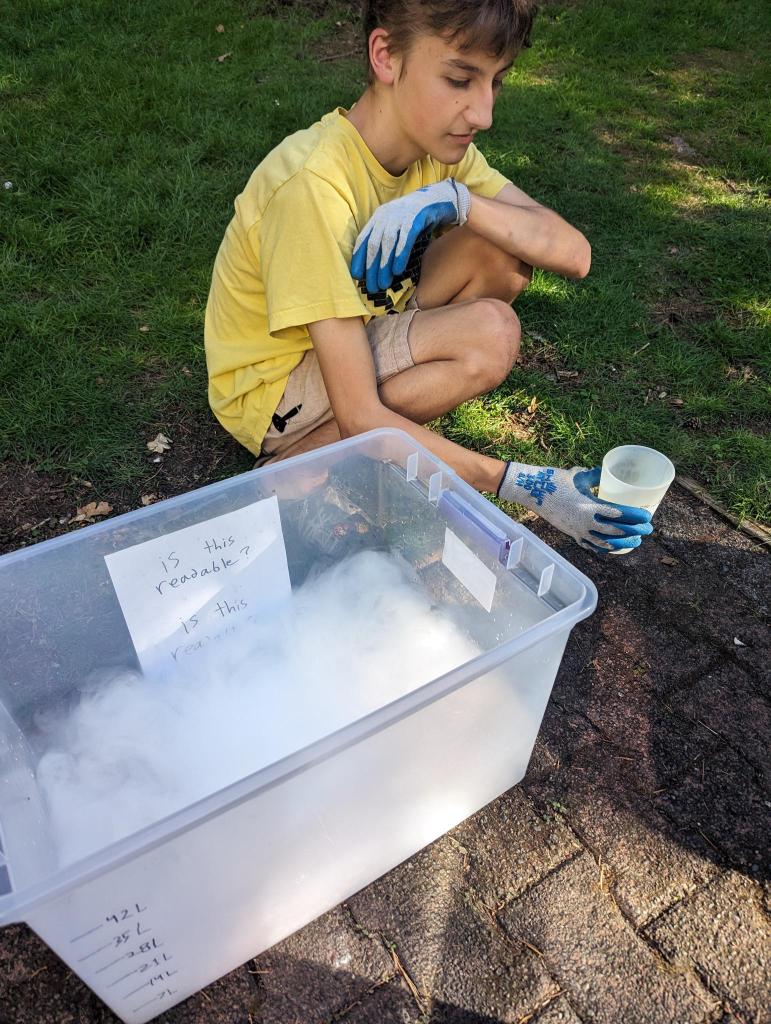
I have performed the experiment I described in my last post, with some adjustments. Instead of finding a plastic tube, I decided to use a clear plastic crate, since I have several in my house. To measure how high the fog would go, I filled a 7 liter pot with water several times, then emptied it into the container, so all of my measurements were based on the nearest multiple of 7. For the Dry Ice, I had a block of it weighing a pound, and I would put that in the crate, then pour a cup of water on it. I assume that using the same block didn’t change any results, as the water was the limiting factor, and I had a lot of Dry Ice leftover. And as you can see in the picture below, I am not just making everything up.

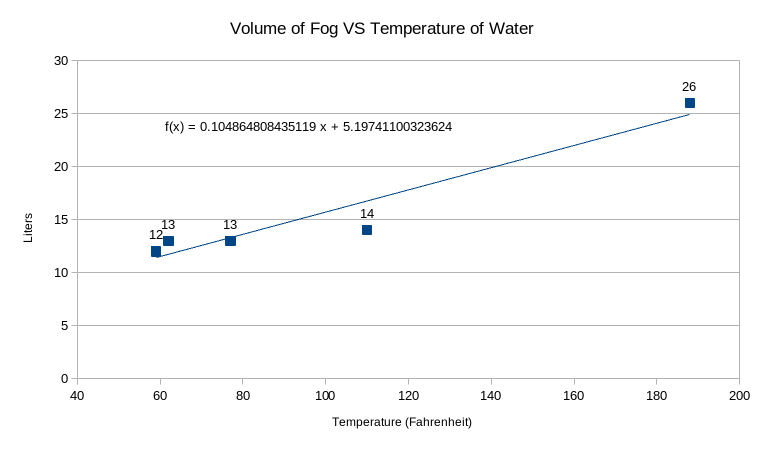
The first cup of water I poured on had been in the freezer, though not for very long, so it was at a temperature of about 59 degrees Fahrenheit, and as you can see on the graph the fog rose to what looked to me like 12 liters, as it was just below the 14 liter line. However, it was not very thick when looked down on, though I can’t really prove that as my drawing on the other side of the crate didn’t reach low enough to go below the fog.

My second cup of water had been in the fridge, and reached a temperature of 62 degrees Fahrenheit. The fog rose only very little, though it did visibly thicken, leading me to believe that the first result was somewhat flawed by the fogs lightness, leading it to float higher than it should have.

My third cup was room temperature, 77 degrees according to my thermometer, and once again there was very little increase in the volume of the fog, though this time the density didn’t change much either. However, it was visibly more agitated, swirling and rolling much more than the previous temperatures.

The next temperature was on the stove for a little bit, and reached 110 degrees. It came up to the 14 liter mark, and finally we could use my picture for density, which proved that you can not see through 15 inches of this fog. It looked to be the same density, though it was much calmer, leading me to believe that it was heavier than the previous fog.

The final temperature for the cup of water was 188 degrees Fahrenheit. It was the first temperature to greatly change the volume of the fog, as it rose all the way to just below the 28 mark, so I’m guessing it was a total of 26 liters. The density and volatility of the fog did not visibly change, so I presume it had the same mass as the 110 degree water, just more volume.

I put all this information into the graph above, and then added a trend line to it, which calculates the average for the rest of the graph based on the given points. For example, if you wanted to know roughly how much fog is made when you pour 160 degree water onto Dry Ice, you would go to the 160 mark on the bottom and trace it upwards until you found the trend line, which would tell you that there would be about 22 liters of fog made.

Unfortunately, these results are definitely not 100% accurate, for myriad reasons. First of all, my measurements were restricted to multiples of 7, meaning I had to guess from the nearest multiple of seven how much fog there was. Second, I live on a hill, and so my backyard is on a hill. This means that it’s more than possible that the height of the fog was not level throughout the crate, meaning my measurements were even less exact. I also had no good method of measuring the density of the first few fogs other than my eyes. This means that I don’t know exactly how much mass was in the same volume of fog trial to trial, though I do relate my assumptions and what I saw with my eyes with regards to the fog in each paragraph here. I am confident that my thermometer was correct with the temperatures of the water, as it is also used for my meals, which have not recently been over- or under cooked. However, it is possible that it was off a little, or that the temperatures cooled from the measuring of it to the pouring of it, which is more probable with the hotter temperatures. Other than these problems, I don’t have many concerns with the results of my experiment, the only really frustrating part of it being my lack of precision with the volume and mass of the fog.

South America

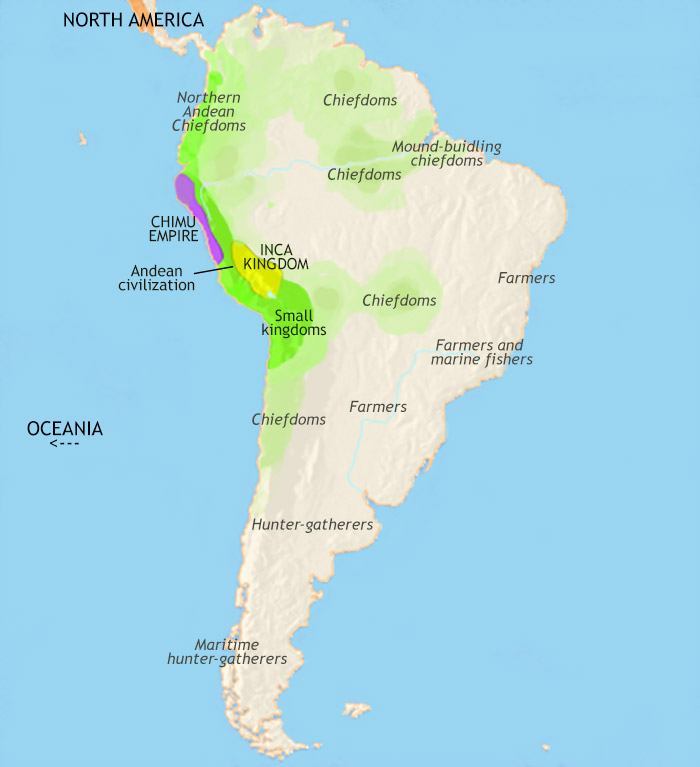
Nothing major happened in South America that we know of until 1492, when Christopher Columbus discovered the Americas. What we do know is pretty limited, partly because the Spanish and Portuguese destroyed much of the natives homes and killed many natives themselves, partly because the natives didn’t write much or even know what their ancestors did. We do know that there were two small empires controlling the western side of South America, though they were very small. The Chimu Empire occupied some of what is now modern day Peru, while the Inca Empire controlled part of modern day Bolivia. The rest of the continent was divided among small groups of natives that would have got by with some farming and quite a few hunter-gatherers. The only major landmarks made by, presumably, the ancient Chimu’s is the Nazca lines, a collection of pictures made by mounding up dirt on such a large scale that they can only be seen from above. I say it was presumably the Chimu’s since the lines are found in Peru, but we don’t really know how much the kingdoms moved around.

After 1492, however, the Spanish came in force and wiped away the natives, taking the western side for their colonies while Portugal took the eastern side. The colonists only missed one major town, Machu Pichu, which has allowed historians a glimpse into the ancient peoples lives. Spain also moved up into Central America and even North America, also taking control from the sparse villages populating the area.

My House

My house is at the head of a cul-de-sac, a ring of houses arranged around a dead end. Since we are also on a hill, my house rises above the neighboring homes. Unfortunately, the ground on this hill is made of clay, which expands a lot when it’s wet and contracts when it’s dry. Because of this some of our doors don’t work in the summer, or require a lot of strength to open, though they’re fine in the fall and winter since we get a lot of rain. For the same reason our backyard develops cracks in it during hot summers, but it seals up and even gets muddy in the winter.

I have a pretty big house, and nice too, despite it cracking in the summer. Immediately to your right, should you walk in through the front door, is our living room. This room has a very large couch and a TV, as well as plentiful toys lying on the floor, mostly from my baby brother. Going straight, however, will bring you to the kitchen-dining room area. Unlike the rest of the house, which is carpeted, this area is, thankfully, tiled. There is no real lines to say where the kitchen is with regards to the dining room, except for a window looking outside, which is where we put the table, and the counter-space that ends on one side with the fridge, and ends on the other just before said window. In addition to the fridge, the kitchen has an oven, dishwasher, sink, and many cupboards and closets.

Just off of the dining room is the second living room, which has two repurposed closets that me and my dad use as desks, me for schoolwork like this, and my dad just about anything. I say “repurposed”, and they were, because we had to work on them quite a bit, but I have no idea what their original purpose was. Also in this room is a stone-decorated fireplace, as well as a smaller couch, armchair, and rocking chair. Going further past this room is the laundry room, with a bathroom to the left and a garage to the right.

If you turn to your left instead of right at the front door you’ll find stairs that lead to my family’s rooms. First off on your right is a bathroom, then mine and my brothers rooms on the left. Going right at the end of the hall you’ll find a room the size of a walk-in-closet, which I have turned into a Lego-devoted room. At the end of this second hall is my parents room, which is rather spacious and contains the third, and last, bathroom.

Before My Fog Project

As part of my science class, I am performing a science project with regards to fog, since I have been studying it for my past week of school. I plan on measuring the volume of fog when changing the difference of the temperatures that create fog. As I have said in my article about fog, it is created when there is a major temperature change in a humid area. In nature this is caused by either sea currents of different temperatures meeting and mixing, or when the sun goes down and leaves warm ground and cool air. In my experiment I will be using uniform amounts of Dry Ice, which has a permanent temperature of 109 degrees Fahrenheit (since it’ll melt instead of warm up), in a bowl to simulate a temperature, and I will put a uniform amount of water into the bowl to create the necessary humidity and different temperature. Due to the difference of the temperature of the water and Dry Ice, fog should erupt from the bowl. I will then place a tall plastic tube over the bowl before the fog erupts, to see any difference in the volume of the created fog when I change the heat of the water. My theory is that the colder the water, the less fog that I’ll create, since the relative temperature between the water and Dry Ice will be less than with hot water, which should make more fog. To measure how much fog I’ll be making, I’m writing on a paper that will then be taped to the opposite side of the clear plastic tube. This will allow me to see whether or not the fog gets thicker as the temperature changes. I expect the fog will get thicker more than it grows taller, since its weight should condense the air below it, but I’ll also make tick marks at one inch intervals on the side of the tube that will be facing me, to know how much the height of the fog changes, especially as I could be wrong and it doesn’t condense, just flowing upwards instead.

With regards to possible errors, I believe that the fact that I am using Dry Ice in the experiment shouldn’t mess with the fogs consistency, since frozen carbon dioxide gas, which dry ice is, is not visible once it melts into its gaseous state, and the chemical will be leaving the water directly as it melts, which may cause some bubbling in the fog, but it shouldn’t do anything that might change the findings. This is meant to reassure you that the fog will be made out of the water, and not from any form of chemical reaction, other than the natural ones. The difference in temperatures shouldn’t effect the quantity of water, and therefore fog, in any meaningful way, since I won’t actually be boiling it. The bowl will displace some fog, but again, not enough to majorly change the findings. Besides, I could always find the volume of the bowl. The only other problem I can foresee is fog escaping when I drop the tube over the bowl, but I don’t really expect that to be a problem, since I’ll have a helper to do it nearly as I pour the water. I will address these problems again after I perform the experiment and write my post about it and my findings.

Fog

Fog is an odd natural phenomenon that is known as a ground cloud, or a cloud that touches the ground. Fog and clouds are made out of small water droplets, floating through the air and obscuring your vision whenever you try to see through it. Fog comes in a few different types, though all of them require extreme humidity, or wetness, in the air. The most common type are Radiation Fog and Advection Fog. The only difference between fog and mist is that fog is thicker, cutting your sight around you to 1 kilometer or less, while mist lets you see farther than a kilometer.

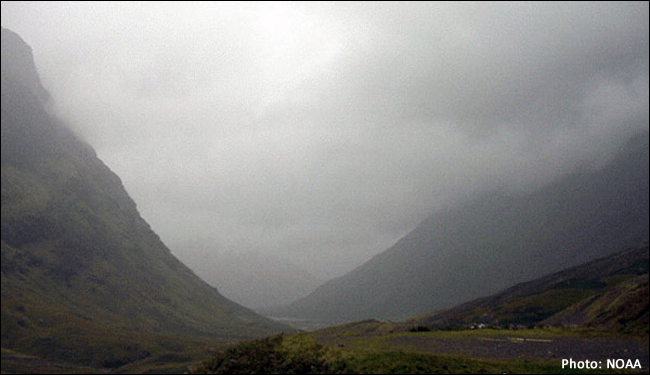
Radiation Fog occurs at night, when the sun disappears beyond the horizon and the ground cools off. For the ground to cool off, the heat has to go somewhere, which is the air, since it’s so conveniently right above said ground. As the warm air from the ground meets the cooler, moist air above the ground, water droplets form around bits of dust and matter in the air, resulting in floating water droplets that don’t drop to the ground due to the slight thermal drafts, and don’t condense together due to the surface tension of the water. Valley Fog, such as in the picture above, is Radiation fog that forms on the tops of the ridges of valleys and rolls down into the depression. Radiation fog often disappears in the morning as the sun applies regular heat to the ground and air.

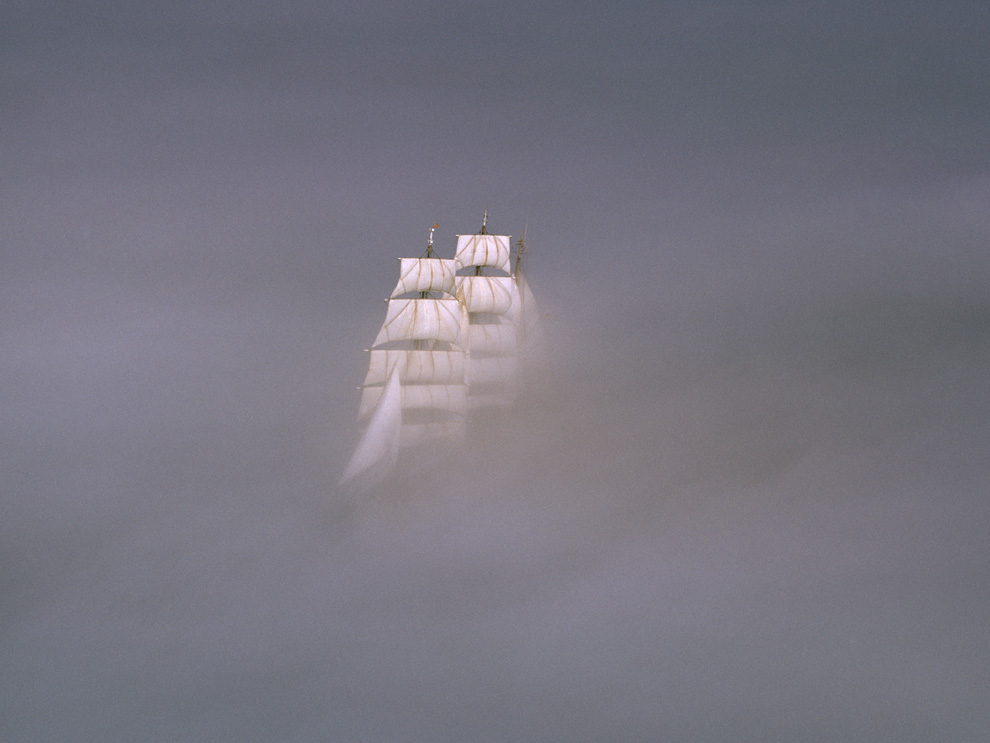
Advection Fog comes when warm air or water comes into contact with cooler air or water, and the temperature changes result in fog forming around bits of dust or salt, salt especially when taking into account warmer and cooler sea currents, which mix into sea fog like in the picture below. Advection fog normally ignores the time of day, as currents are warm and cool regardless of the sun, so it is more oftentimes seen than Radiation Fog. My explanations for these kinds of fogs and their causes came from these National Geographic and National Weather Service websites.

Due to the need for moisture, fog often forms around coasts or rivers in any of its forms, though places with heavy rainfall are more than adequate. One town famous for its fog is London, with fog coming from the river Thames, which runs straight through the city. However, London is not nearly as foggy as is commonly believed, at least, not anymore. Fog requires some particle for the water to form around, which can be dust, dirt, salt, or even burnt coal. Starting as early as the 13th century “Pea-soupers” were a known phenomenon where fog would build up on the burnt coal floating through the air. They were called pea-soupers due to their color, namely, a muddy yellow. Based on that, I, for one, am quite glad not to have ever had pea soup. The major problem with these fogs was that coal is poisonous to inhale, and now there was a ton of it floating in the air, where people happened to breath. it wasn’t too much of a problem until the 1600s, however, when coal started to be used plentifully, and even then nothing was done about the not quite huge numbers of people dying of poisonous water/air until 1952. the reason for the sudden interest was the Great Smog of London, a five day-long pea-souper of immense proportions, and poisons. it’s currently estimated that 4,000 people died during the fog, and the total lives taken by the fog to be around 12,000 lives. I got this info from the Britannica. After the smog, coal was used more sparingly and further from the main city, resulting in only normal fogs from there on out. But famous books from authors like Charles Dickens and Arthur Conan Doyle were written before the fogs died down, and so London has been immortalized as being constantly fog-covered.

The Middle East

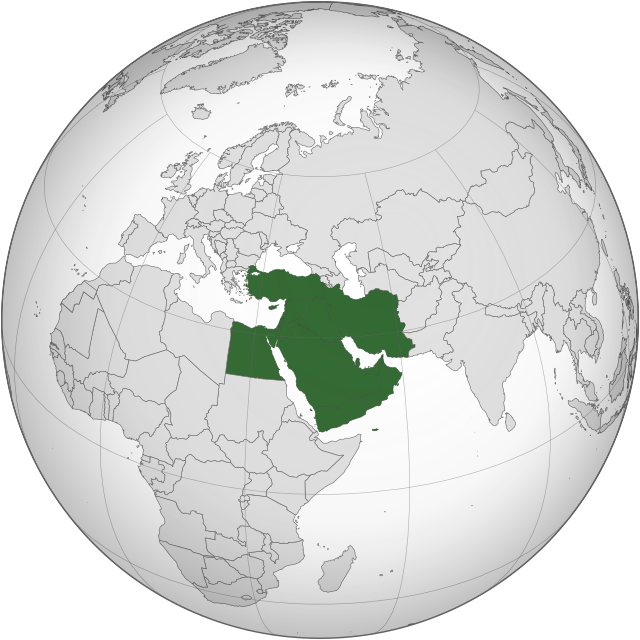
The Middle East is a subcontinent between Africa and Asia, though it also connects to Europe. It is considered the birthplace of civilization, as the earliest evidence of farming has been found in the Fertile Crescent, a patch of land between the Tigris and Euphrates rivers, which now run through the modern day countries of Turkey, Syria, and Iraq.

This area has also been one of the most contested and fought over areas throughout history, with five major empires all claiming it before 500 AD. The first of these Empires was the Babylonian Empire, one of the first known empires as it originated in the Fertile Crescent. Next came Persia, originating in the area around Turkey. Persia took the middle east and held on to it until Alexander the Great came through and took it in his expansive, but ridiculously short-lived empire. After Alexander died one of his generals took the area and named his empire “Parthia” This lasted until the Romans swept through and toppled the Parthians. As Rome began to deteriorate, however, it split in half. The Western section kept the Mediterranean and Europe, but the Eastern half, called the Byzantine Empire, retained the Middle East. The Byzantines then had a rivalry with the remnants of Persia (which had been hiding further east) until Persia was finally toppled by the brand new religion of Islam, which primarily took the form of the Ottoman Empire in the 700s, and took North Africa in it’s empire. Islam also took power from Byzantium, but they would survive a while longer.

Funnily, none of those empires would leave a legacy in the Middle East, since the Muslim Ottomans would convert everything to Islam. The Europeans were nearly entirely Christian at this point, the same way the Middle East was Muslim. The problem with this was that both Christianity and Islam considered the Middle East their own Holy Land, and thought it should be kept from the other. The Europeans sent their knights on crusades to reclaim their Holy Land from the 1100s to the 1600s, though they were nearly entirely unsuccessful, and ended up finishing off their own ally, Byzantium. The Muslims meanwhile converted all of the Christian churches built there into Muslim churches. The only territory that the Crusaders managed to hold was the Island of Rhodes, which eventually fell in 1522, though the Crusaders only backed up to the neighboring island of Malta, where you can still see the Christian influences.

By the 1750s, which is where my knowledge fails me, the Ottomans controled most everything in the Middle East, though the empire is starting rot, just like the ones before it.

Away From Home

I’ve traveled quite a bit, going to Colorado most summers to go on a camping trip with my family on my paternal Grandpa’s side, who all, obviously, live in Colorado. Technically, the farthest I’ve been from my home (in Oregon) is Hawaii, though that doesn’t really count seeing as I wasn’t even a year old at the time, and I can’t remember it at all.

While Colorado is the farthest I’ve ever been that I can remember, I’ve also been to Montana, where we stayed for nearly a year. It was pretty cool there, as well as cold in the winter, far colder and snowier than it gets here in Oregon. Of course, it does get snowy like that in Colorado in the winter, but I haven’t been to Colorado in the wintertime much. Montana was also hot in the summer, which surprised me quite a bit since it had been so cold in the winter.

I’ve also spent a summer going on a huge road trip, visiting places and landmarks all the way from California’s Legoland and Disneyland to the Grand Canyon. Other places include Four Corners (the only place in the U.S. where four states meet at a corner), Mesa Verde (an old native American site), and Death Valley (a desert in northern California).

My Favorite Home School Class

I am taking 3 classes with the Ron Paul Curriculum homeschooling program, Math, English, and History. I used to take a science class with the Ron Paul program, but this year I decided it would be better to do a more self taught course, researching different topics. For example, this week I’m researching fog and mist, and next week I plan on running an experiment concerning fog, while the week after that I’ll research something else.

My Math class is pretty good at teaching it’s subject, though the lessons can get rather repetitive and redundant, as well as monotonous whenever there’s a particularly long video lesson, or a review lesson. So I like to go over it with my dad to make sure I actually absorbed what the teacher was teaching.

English is a fairly short class, with the video lessons commonly just repeating themselves with regards to the subject at hand, as the tangible part of the lessons comes in the reading and writing assignments. The reading is nearly always enjoyable, since the teacher has me reading old and popular books, like 20,000 Leagues Under the Sea, or Treasure Island. The writing, is rather less enjoyable, especially this 8th grade year, since he has me writing multiple essays a week.

The History class is probably my favorite, not for a quality reason, but just because I enjoy learning about the past and how certain things happened, and what life would’ve been like. It’s also interesting to me how different cultures were spread through the world in different manners.