Martin Luther’s Goals

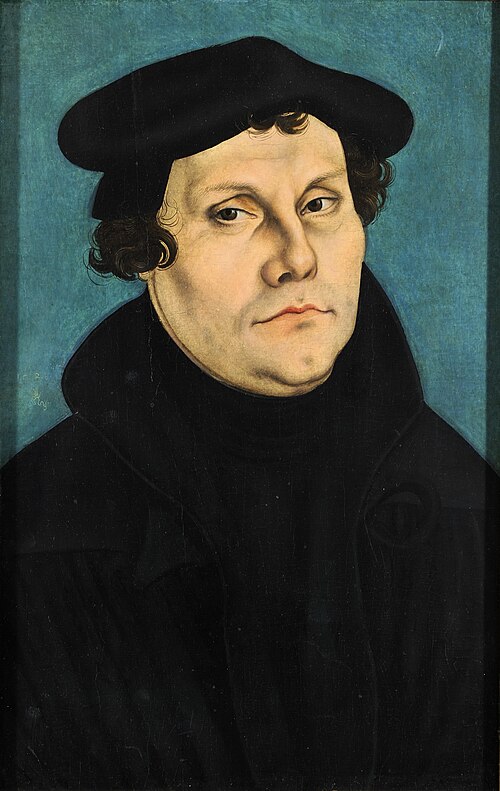
A Portrait of Martin Luther

Martin Luther wrote his 95 Theses on October 31st 1517, and mailed them to the Archbishop Albrecht. He wrote them in response to the indulgences being sold, particularly the ones being sold by Johann Tetzel to build St. Peters Basilica. Originally in Latin, the language of the Church and unintelligible to the common man, the theses appear to have been a genuine call for debate, and that he really believed that indulgences were not only false, but that the pope himself would be aghast at the sale of them. He calls several times not only to the idea that the pope would not sell indulgences, but that no one, not even the pope, has the power to sell indulgences. In the next few years he would find out the pope very much did know about the sales.

A popular story is that he posted his theses to the door of the Wittenburg Church, and that it became famous from there. But Luther never makes mention of posting his paper in such a manner. It seems that the story comes from Peter Melanchthon, a friend of Luther’s. He wrote a biography of Luther in 1546, after Luther’s death, and in it is the first written account of the nailing, from a man who wasn’t even in Wittenburg.

So how did his paper become so famous? Because the common man read it. How? It was in Latin, and handwritten. Someone translated all 95 theses into german, and then gave it to the printing presses. Who? No one knows. If Luther really did want a debate on indulgences, he wouldn’t have done this, there would have been no reason to. But throughout the theses, Luther makes snide comments, such as thesis #52; “The assurance of salvation by letters is vain even though the commissary, nay, even though the pope himself, were to stake his soul upon it.” So despite his ostensible faith in the Catholic Church, he not only undermines the pope and his church, he outright damns the indulgences, which the pope was then forced to defend from this no one of a priest from a middle of nowhere town. The church then made their case worse by never publicly defending the indulgences, but still selling them. I believe Luther did in fact publish his theses to the people, and did so very cleverly, never outright splitting from the church in the theses, but forcing the Church to reform, or force a split.

By 1521, only 4 years later, Luther made his real split with the Church, and he took many people with him, partially, I believe, due to the rabble-rousing techniques Luther follows in his theses. Thesis #92: “Away, then, with all those prophets who say to the people of Christ, “Peace, peace,” and there is no peace!” What could this possibly be used for except to incite people to care about this public refutation of the Catholic Church? The theses were ostensibly supposed to be bullet points, each of which were to be debated, or used in a debate, in person between Luther and another priest. Some of the early theses were theological in nature, but as they go on they get more emotional, more angry. Also, if he did not know that the archbishop and the pope approved of the indulgences, why send them a letter? After all, He wasn’t going to debate the archbishop if they agreed. I believe he would’ve sent his letter to Tetzel if he wanted a debate, and not a revolution.
On the Hierarchy Shown in Genesis 1-3

In Genesis 1 of the Bible, after creating light, dividing the heavens from the earth, and revealing dry land, God creates plant life, and then created the stars. Then does God create animal life in the sea, animal life in the air, and animal life on land before finally making Man. From the start God creates Man to be superior to all life previously created, and even tells him that it is his duty to subdue the earth, and to have dominion over all life.

Genesis 2 takes a deeper look at the creation of Man. It says that God formed Man of the dust of the earth, and breathed life into his nostrils, granting Man a living soul. After creating Man, God forms a garden known as the Garden of Eden, as a place for Man to reside. God is said to put Man in this garden to “dress it and to keep it.” as well as telling him he may eat of every fruit of every tree, except for the tree of the knowledge of good and evil, showing God’s authority to create moral laws as well as the natural ones made during the creation of the world. God then decides to create a helper for Adam, but first brings all the animals to him, that he would name them. After naming every living creature, God grants Eve, the first woman, to Adam as an equal helper for him.

Genesis 3 begins with telling us that the Serpent asked of Eve whether or not she was allowed to eat of any tree in the garden. Upon telling him of the only moral law that God had ordered of her and Adam, not to eat of the tree of the knowledge of good and evil, the Serpent contradicted God, saying that neither she nor Adam would die were they to eat of the tree, as God had told them. The Serpent instead says that they would become like God. Eve eats of the tree, believing the Serpent, her inferior, instead of God, her superior, and takes the fruit of the tree back to Adam, who also eats it. Then they sew clothes of fig leaves in order to cover their bodies. God finds them doing this and asks Adam whether or not he ate of the tree. Adam then attempts, not to lie, but to displace his guilt onto both his superior, God, and his equal, Eve, by saying that the woman who God gave to him gave him the fruit to eat, as though God were responsible for all she did, and that Adam had no choice but to eat the fruit when she gave it to him. God then asks Eve why she took the fruit of the tree, and she too displaces the blame, not to Adam, but solely onto the Serpent, whom God asked nothing of, letting the blame rest.

God then punishes all three involved in the matter. First the Serpent, who God declares lower than any other beast, forces to crawl on his belly, and to forever more have a mutual hatred with all children of Eve. Eve then was punished with painful childbirth, and instead of being an equal helper to Adam, will now be ruled over by him. Adam’s punishment was to have to fight the earth for his food, tilling and farming the land instead of gathering fruits. All the animals who were previously servile to Adam, as their acknowledged master set by God, now turned on man, and would have to each be tamed and disciplined independently if they were to be controlled.

God is shown to be the Lord of all things, as he made all things and all life. He set up Man as his inferior, to be lord of all things through the authority of God, but when he rejects God he must become the master of the land and the animals through his own authority, which is far less than God’s. Eve is now the inferior to Adam for being beguiled by the Serpent, who himself is set as the inferior of all living things for contradicting God and lying to Eve, a representative of Man.

In His Steps

Written by Charles Sheldon, “In His Steps” was written as propaganda for the social gospel, and resulted in a complete Utopia, in that Sheldon’s imagination led him to believe and write that should just a hundred church members in some remote town adopt Sheldon’s own morals, they could effect nothing less than a revolution throughout the nation.

One of the Charles’ worst deficiencies is the lack of any kind of Creed, which he totes as a benefit, saying that, somehow, by the people asking “What would Jesus do?” which is the oft repeated motto of the entire book, would result in people’s lives getting much better, even if they had no clue as to what he would do. And his lack of any creed results in people having no way to figure it out. The result is that people end up doing whatever they feel they ought to, which traditional Christianity warns of. Christianity does have a creed, which is to do what the bible says to, and it contains the teachings of Christ, which Sheldon and his characters seem perfectly content to ignore.

A major example of a character going against Jesus when wondering what he would do is Virginia, a young heiress who donates the modern day equivalent of 18.6 million dollars to a failing Newspaper. The newspaper is failing because the owner and editor of it has decided to do what he feels he ought to do, resulting in a newspaper without a Sunday edition (they still have a Monday edition, so people must be working on Sunday, though that isn’t addressed) no advertisements that include anything suggestive at all, like liquor of tobacco, who were pretty much the only advertisers back in 1896, no political recommendations, no reports on personal or corporate scandals, and no reports on violent crime. And all this based purely on how Norman, the Editor of the newspaper, felt Jesus would do, without so much of a glance at a bible or his pastor, not that the pastor would’ve helped, because he doesn’t care for it either, despite it being the record of Jesus’ life. So Norman, going bankrupt, asks for help, and receives it from Virginia.

Virginia had been eaten up by guilt because of her immense wealth, all of which was inherited by herself, not earned. She felt like she was sinful for being rich while other people were poor, and so ends up spending enormous sums on projects like Norman’s newspaper. When he asked for help, he simply asked for the money to keep going with his plan, which has already definitively bankrupted him. So Virginia gives away something between a third and a half of her wealth to a project that has already failed. Of course, thanks to Sheldon’s dreams, the newspaper then turns a profit, and we are told that “… it is one of the most interesting and remarkable papers ever printed in the United States.” Well, how can this be? It already failed, we know that, and it has no news of interest known to the world at large, so how can this be? What happened? Even Charles fails to conjure a reason this time, and it seems that, as far as we know, all laws of the free market and people’s interest have completely upended themselves.

This is but one instance of “In His Steps” being, quite simply, low level propaganda for the social gospel, which is a socialist take on Christianity, and as we see here, is just as nonsensical as standard socialism.